
Zero Hedge
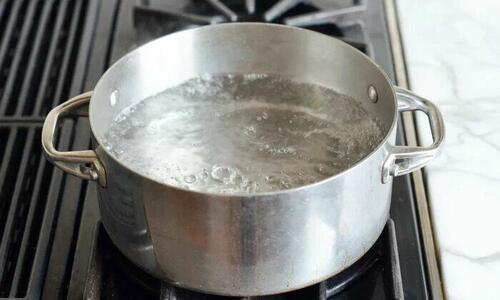
A new research letter published in Environmental Science & Technology Letters indicates that boiling tap water for just five minutes could reduce the amount of microplastics by up to 90 percent. Researchers from Guangzhou Medical University and the Center for Environmental Microplastics Studies in China recommend boiling water in nonplastic electric kettles on gas stoves to remove impurities such as polystyrene, polyethylene, and polypropylene.
According to the researchers, boiling water has been used since ancient times as a purification method in some Asian countries. “This simple boiling-water strategy can ‘decontaminate’ [nano- and microplastics] from household tap water and has the potential for harmlessly alleviating human intake of [nano- and microplastics] through water consumption,” they wrote.
Harder Water Captures More Microplastics
Water of a certain alkalinity and hardness typically produces incrustants—insoluble mineral remnants like calcium carbonate—upon boiling. For the study, the researchers hypothesized that calcium carbonate encounters nanoplastics as it crystallizes in hot water. The calcium carbonate then encapsulates the nanoplastics as it becomes the flaky crust you sometimes see at the bottom of your tea kettle.
The study showed that boiling hard tap water containing 300 milligrams per liter (mg/L-1) of calcium carbonate reduced nano- and microplastics by nearly 90 percent, while water containing 80 mg/L-1 reduced particles by 84 percent. In soft water samples containing less than 60 mg/L-1 of calcium carbonate, boiling still reduced plastics by over 25 percent.
The Problem With Millions of Tons of Plastic
Because of our heavy reliance on plastic, nanoplastics and microplastics are common in groundwater and surface water around the globe. Microplastics are truly everywhere, having been detected as far south as Antarctica and north as the Arctic. These insidious particles have even been detected at the peak of Mt. Everest and down in the Mariana Trench. In fact, plastic comprises the largest portion of marine garbage; according to a 2020 study published in Science of the Total Environment, more than 8 million tons of plastic entered the ocean in 2017. That number represented over 33 times more plastic than the amount that had entered the ocean in 2015, indicating a disturbingly worsening problem.
As plastic disintegrates, microscopic pieces are released into the environment. Microplastics are typically less than 5 millimeters in size but can break down into even smaller pieces called nanoplastics. Nanoplastics are nearly impossible to see at 1 micrometer in size. The micro and nano pieces have been found in water, air, soil, food, and table salt, according to some studies.
The health effects of nano- and microplastics haven’t been fully realized. Still, research has suggested that their accumulation in the human body can cause insulin resistance, liver metabolic disorder, DNA damage, organ dysfunction, immune response issues, neurotoxicity, and reproductive harm.
While the research team only focused on three types of nanoparticles, the discovery is a boon for public health. The team estimated that people who boil their water take in two to five times less nanoplastics than those who do not.
“Drinking boiled water apparently is a viable long-term strategy for reducing global exposure to [nano- and microplastics],” the research team wrote, adding that it is likely more effective than drinking bottled water, especially bottled in plastic. The average liter-sized bottle of water contains 240,000 pieces of nanoplastic, which is 10 to 100 times more particles than previously thought.
[…]
Via https://www.zerohedge.com/medical/boiling-hard-tap-water-removes-90-percent-microplastics-study


Good to know, but water purity is already contaminated by PVC pipes, plastic cups and plasticized cookware, like Teflon. As you have noted, the plastics industry is huge, with much of the plastic packaging produced in the US.
LikeLike
Here in New Zealand, Katherine, we worry more about fluoride, a proven neurotoxin, which the government has been adding to our water – despite a ban on fluoride in most of Europe. I consider myself very lucky to get my water from a rainwater tank.
LikeLiked by 2 people
I remember seeing cisterns when I travelled in South America. I thought it was very practical, but we also have problems with mosquitoes breeding in water. When I was a child, we had a concrete swimming pool we filled with a shallow well hose. It was full of sulfur, but we used to dump a gallon of Chlorox in the water when it began to turn green.
LikeLike
Unfortunately, boiling tap water will not eliminate the other contaminants such as lead, cadmium, mercury and the list is endless. We are ALL about to drop dead. And there is not much that we can do about it. In fact, the fire department just let me back onto the elevator and whisked me back to my apartment after having put out a fire in another part of the building. My windows are currently open trying to get the smoke odor out. It is 3:09a.m. Sunday morning and the temperature is 24 degrees Fahrenheit. If and when I finally get to sleep, I can only hope that I am not awakened because there has been another fire in the building. What the hell is going on??!!! I have been telling y’all that ALL hell is breaking loose, at least where I am. Go figure!!!!
LikeLiked by 1 person
Can water filtration systems get rid of the contaminants?
LikeLiked by 1 person
They claim to remove 99%, but even if that is true, it would appear that contaminants are still in the tap water. We can only hope to reduce what we ingest, but we will never really totally eliminate the contaminates, sadly.
LikeLike
As I understand, only a reverse osmosis filter will remove micorplastics, fluoride and similar contaminants.
LikeLiked by 1 person
Pingback: Study: Boiling Hard Tap Water Removes Up To 90% Of Microplastics | Worldtruth
Have you ever heard of Shungite crystals, Shelby? Apparently they’re a complex carbon crystal found in Russia, which was long used by the Russian navy to purify water on long naval voyages. Apparently they also help with insomnia – https://atmosure.com/blogs/stories/shungite-water-benefits
LikeLiked by 1 person
No, I’d never heard of that, Dr. Bramhall. Thank you for the suggestion.
LikeLike
Pingback: Nanoplastics Linked to Heart Attacks and Stroke | Worldtruth
Pingback: Is Bottled Water Full of Microplastics Still Natural? | Worldtruth