
Episode 30: The Overthrow of Robespierre
Living the French Revolution and Age of Napoleon
Dr Suzanne M Desan
Film Review
Ironically the Republic’s war against both foreign and domestic enemies flourished under the Jacobin Rein of Terror. By mid-1794, the French had decisively thwarted the Austrian invasion and were about to march on Brussels.** The French army had also also thwarted a Spanish invasion via the Pyrenees, and a French naval flotilla had flouted the British blockade with coffee, sugar and other foodstuffs from the Caribbean.
Within France, Republican troops had effectively put down the Vendée Rebellion and Federalist Revolt.
Yet instead of reducing the Terror attack on dissent, the Committee for Public Safety increased its repressive measures. On the the 22nd of Prairiale (June 10, 1794), they required all Terror defendants to be tried in Paris. Whereas previously nearly all were found innocent, now 80% were declared guilty. In fact more than half the Terror executions (more than 1300) occurred during the last six weeks of the Terror.
With the growing split between the Jacobins and the Sans-culottes,* Robespierre became increasingly unpopular and there were rumors he wanted to make himself a dictator. In the National Convention, moderates proposing to shut down the Committee of Public Safety pushed through a vote recalling 18 extreme pro-Terror bureaucrats from the provinces for their violent attacks on dissenters. As a compromise the Convention formed the Committee of General Security as a counterbalance to the Committee to Public City.
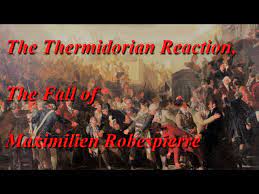
After a bitter batte with two ultra-revolutionaries on the Committee of Public Safety, Robespierre withdrew from public life for three weeks in the summer of 1794. When he returned to the Convention on July 26, 35 Thermadorians*** rose to denounce him. When they called for his arrest, along with four of his supporters, the Paris commune (which ran all the city prisons), refused to take him into custody. After temporarily imprisoning him in the town hall, his Jacobin opponents stormed the building, shattering his jaw with a bullet in the assault. He and 100 supporters would be guillotined that evening without trial.
Following Robespierre’s murder, the convention quickly dismantled the laws establishing the Reign of Terror, and restrict the role of the Committee for Public Safety to the conduct of war and diplomacy. After releasing the remaining 4300 Terror suspects prisoners from the Paris jails, they also arrested, tried and guillotined Jean-Baptist Carrier for his brutal treatment of 13,000 “counterrevolutionaries” in Nantes and deported several Committee of Public Safety members to Guyana.
*Although the Sans-culottes had pushed hard for the Terror legislation, the Jacobins’ moved to shut down all political clubs and women’s groups, while simultaneously restricting the activity and power of sections, made them extremely unpopular.
**Themadorians is short for the Thermadorian Reaction (named after Thermador, a summer month in the revolutionary calendar corresponding roughly to July) Reaction. This was a diverse group that formed a majority in the National Convention after removing Robespierre from power.
Film can be viewed free with a library card on Kanopy.
 The Most Revolutionary Act