
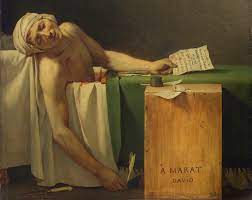
 The Death of Marat by Jacques Louis David (1787)
Episode 27: Revolution in Crisis – Summer 1793
Living the French Revolution and Age of Napoleon
Dr Suzanne M Desan
Film Review
After the Girondins were purged from the National Convention, it set about writing a new constitution guaranteeing universal suffrage and direct elections by the people. They also wrote a new declaration of rights that included a right to education and subsistence (either via work or financial aid).
A record turnout (35-49% of those eligible) attended voting assemblies to approve the new constitution. Two million were in favor and 12,000 against. A few jurisdictions allowed women to participate in voting. Voting was impossible in 10% of the country, either due to civil war or foreign invasion.
Former Girondins and other republicans opposing the new constitution came together in the provinces to form Federalist clubs. Unlike American US federalists, French federalists wanted local government to have more political control. By early 1794, there were 6,000 local Federalists clubs. As local governments, became more and more Federalist, Jacobin officials appointed by the Convention had them arrested and thrown in prison.
The Federalist revolt in Lyon was the most tragic. Previously the center of textile manufacturing and trade, 22,000 weavers were unemployed in a city of 150,000. Initially the silk merchants controlled the local government, but this ended after the the Lyon aristocracy emigrated and demand for fine silks collapsed. The Lyons uprising resulted in the death of 17 non-juring priests (Catholic priests who refused to swear allegiance to the constitution – see The French Revolution Dismantles the Catholic Church) and rebel army officers. After winning control of the Lyon commune, Jacobin leaders price controls and began to prosecute hoarders of food, wood and other basic necessities.
In all thirteen departments* and the three biggest cities (outside Paris) participated in the Federalist Revolt. However they were unable to build armies or exert military power like the counterrevolutionaries in Vendée (see 1793: The French Revolution Faces Counterrevolution).
On July 17, 1793 Charlotte Corday, a Federalist of noble background who supported the Girondins, assassinated the Jacobin leader Jean-Paul Marat (later discovered to be a British spy). Although no one believed she acted on her own, she went to the guillotine as a martyr. The crowd also glorified Marat as a martyr, and paranoia about further assassination plots led to calls for Marie Antoinette’s death.
The same day as Marat’s murder, the Lyon commune guillotined the Jacobin leader Joseph Chatelier. In response French troops laid siege to Lyons a month later.
On July 22, the Jacobins arrested General Adam Custine, general-in-chief of the French army in the Rhine, after he called for a military dictatorship. He was guillotined a month later.
On July 30, Valenciennes in northern France surrendered to Austrian and British forces.
*The first (1791) French constitution divided France into 86 administrative units called departments.
Film can be viewed free with a library card on Kanopy.
 The Most Revolutionary Act