
Episode 19: Overthrowing the Monarchy
Living the French Revolution and Age of Napoleon
Dr Suzanne M Desan
Film Review
In July 1792, as Prussian and Austrian troops prepared to invade France to crush the revolution, thousands of volunteers (Federés), flowed into Paris to save it. The National Assembly authorized an additional 2,000 national guards and passed a law to deport any priest denounced by 20 citizens for refusing to swear to uphold the constitution. Louis XVI’s veto of these new laws led to a massive insurrection, as ten thousands Parisians marched on the Tuilleries palace. After forcing the king to put on a red liberty cap and drink a toast to France, they departed peacefully.
By this point, France had organized one of the first viable direct, participatory democracies. Each of the 48 Paris neighborhoods had its own “section,” where citizens met to debate political proposals, submit petitions to the National Assembly, secure. Each section sent representatives to the Commune (the municipal government of Paris).
According to Desan, most of the sections were dominated by “San Culottes,”* who believed insurrection was the ultimate determinant of democracy and wanted the monarchy abolished. Still dominated by Girondins, who supported a constitutional monarchy, the National Assembly ignored the Paris sections call to remove the king from power. To defend the King, Lafayette, who commanded the National Guard, returned from the front and tried to pressure the legislature to close down the Jacobin clubs and radical press
On July 11, the Paris Assembly declared France in imminent danger of invasion and assumed emergency powers. The same day Federés from all over France arrived in Paris, sending delegates to the Paris Assembly and parading through the streets calling for the king to be overthrown and Lafayette impeached. The latter organized a personal army to march on Paris and escort the king to safety in Normandy. Marie Antoinette vetoed this proposal because she didn’t trust Lafayette.
The sections, which met nightly, violated the constitution by allowing “passive” citizens (men without property) to participate in their meetings. 24,000 Parisians met almost every night in the 48 different sections.
On July 29, 47 of the 48 sections demanded the National Assembly overthrow the king. By now, many deputies had abandoned the National Assembly and those who remained engaged in stalling maneuvers. Meanwhile the commander of the Prussian forces threatened to decimate any city that harmed Louis XVI and right wing newspapers published the names of revolutionaries the Prussians planned to execute.
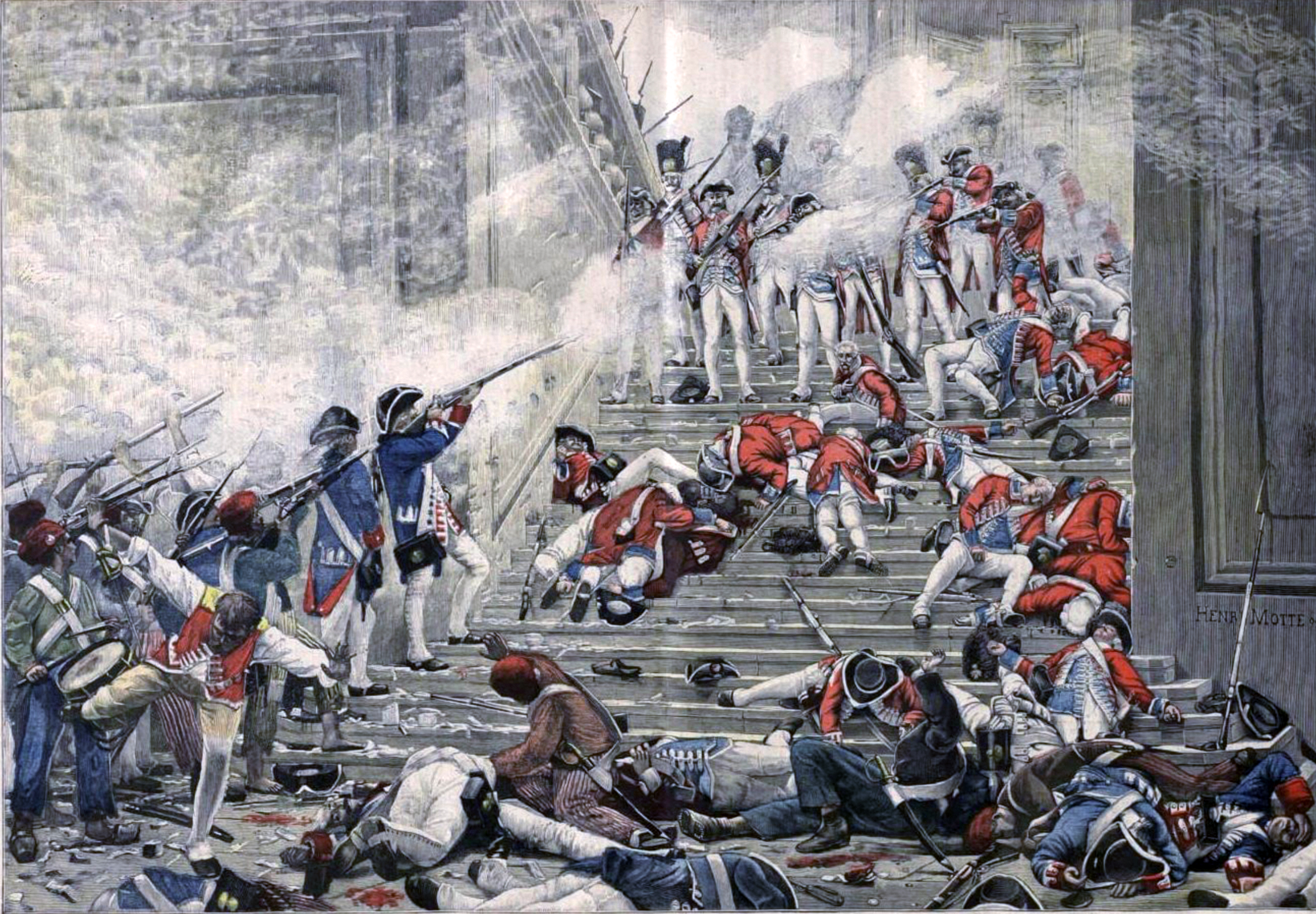
On August 9, Sans Culottes rang church bells throughout Paris calling people to action. At dawn two columns of Federés and armed Sans Culottes (1100 from the Saint Antoine neighborhood near the former Bastille and 1500 from the Left Bank) marched to the Tuilleries, with massive crowds behind them.
The palace was defended by 800 Swiss guards, 200 royalist volunteers and 1200 national guards (although many deserted to join the insurgents). Vastly outnumbered, those who survived the attack surrendered the palace at 3 pm. Four hundred insurgents were killed and 800 palace guards.
At the town hall, a newly selected Paris Commune assumed temporary control of France, imprisoned the royal family and ordered the creation of a new Convention via universal manhood suffrage. As Prussians troops crossed the border into France, 20,000 men volunteered to fight them as the Convention declared a republic..
Lafayette fled into Austria, where he was imprisoned for five years.
.*The San Culottes (Without Britches) adopted this name to distinguish themselves from the nobility, who dressed themselves in short knee britches and fancy silk stockings. They were artisans, skilled workers, shopkeepers and tradesmen. The women who fought beside them called themselves San Jupons (Without Petticoats). They believed they should have the power to pass laws, with the National Assembly deputies merely following their directives. They also wanted the vote extended to all adult males (not just those who owned property.
Film can be viewed free with a library card on Kanopy.
https://www.kanopy.com/en/pukeariki/watch/video/149323/149359
 The Most Revolutionary Act
Pingback: 1793: The France Revolution Enters Its Reign of Terror | The Most Revolutionary Act