
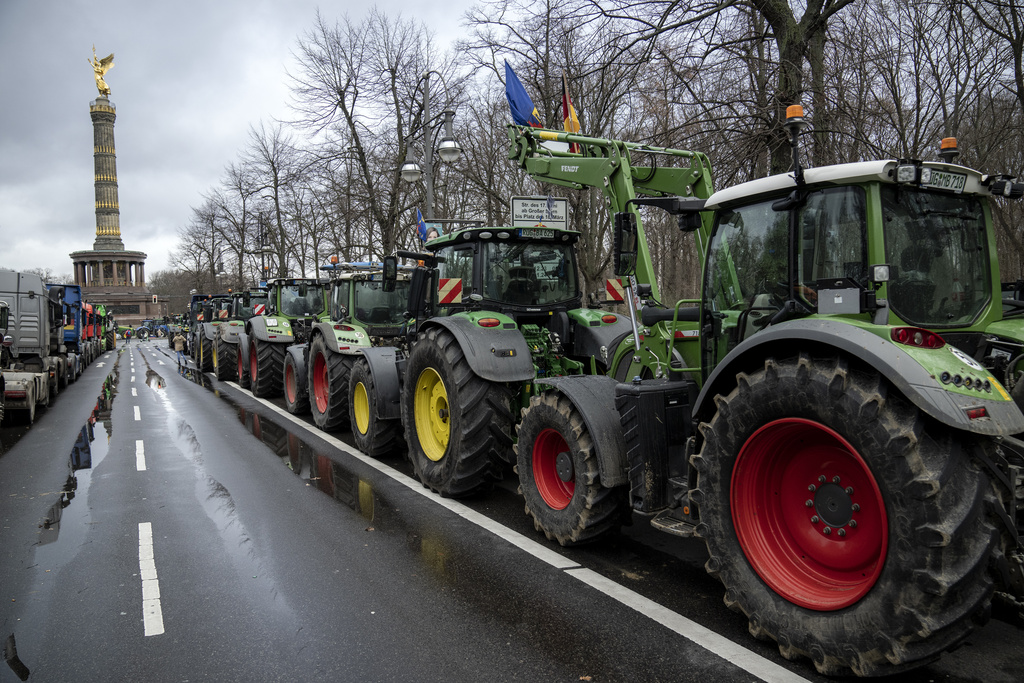
 Farmers parked their tractors in Berlin, Germany, Monday, Jan 15, 2024. (AP Photo/Ebrahim Noroozi)
László Bogár
REMIX NEWS
The farmers’ protests are akin to the peasant wars that have deep roots in European history, writes economist László Bogár for the Magyar Hírlap daily
Although the global media used all its weapons of opinion to make the “peasant war” that shook Germany seem nonexistent, the world was still treated to dramatic images of the mass farmers’ demonstrations through the new era of social media.
“No fuel, no food, no future” — that is the slogan most often used by German farmers, obviously in English because it was the only way to get mass exposure of their current plight.
However, you’d be forgiven for missing the protests raging across Germany — and in many other countries this past week, including Romania and France — due to the mainstream media’s apparent disinterest in the farming revolution, with producers seemingly given particularly strict instructions on what to, and what not to report.
The existence of protests unfolding throughout Europe appeared to be under some form of media embargo. Perhaps it might be worth considering why.
It is true in general, but in post-WWII Europe in particular, which was in a rather dire situation, it has proven true many times over that food supply is perhaps an even more delicate and important strategic sector than heavy industry. Although in macro statistics, which give a false picture, agriculture’s share could be only a few percent, or even “negligible,” it is not only not negligible, but it turns out to be more important than anything imaginable.
The great peasant wars of the 15th and 16th centuries were fought for exactly the same reasons as today. In that century and a half, in addition to literally “pulling the rug out from under the peasantry,” the average peasant’s daily working hours doubled, and the income he received for those hours was cut in half. It is understandable (though not excusable) that the brutal cruelty of the somewhat frustrated peasant masses knew no bounds. Nor, indeed, did the reprisals that followed.
The global power economy and the collaborationist power structures of Europe, increasingly subordinated to it and forced into a pariah role, are now doing the same, shifting onto peasant society the costs of prolonging the agony of the U.S. world empire.
The outcome of the conflict is, as of yet, unpredictable, as the entire European system of domination is on the verge of collapse. Just as the rebel leaders who led the peasant wars many centuries ago had no “adequate narrative” of what an acceptable settlement looked like, today, we are still living through a whirlwind of emotions, with little sign of an amicable solution being reached anytime soon.
[…]
Via https://rmx.news/economy/why-is-the-wests-mainstream-media-ignoring-the-farmers-revolt/
 The Most Revolutionary Act
The “global media’s weapons of opinion” will not feed them or the protestors.
From Julius Caesar, to ancient kings and pharohs of Egypt and Asia, to empires of China, the Ottomans, and the Persians knew that controlling the food and water suppplies were key to dominating and controlling a population. Who actually produces the food, in most of the world? Not the Olympians from on high. No. The peasants perform the labor that converts human endeavor into edible produce. The fishermen, the farmers, the hunter-gatherers of the world supply food to their circles, whether family, community, or nation.
We must realize that if the peasants starve, everybody starves, in the long run. Times have changed, but people still need to eat.
LikeLike
Pingback: Why is mainstream media ignoring farmers’ revolt? | Worldtruth
But Bill Gates assures us, Katherine, that he will keep us fed with his factory-baed food.
LikeLike
Pingback: Why the US Won’t Risk World War III | Worldtruth