
Charles Hugh Smith
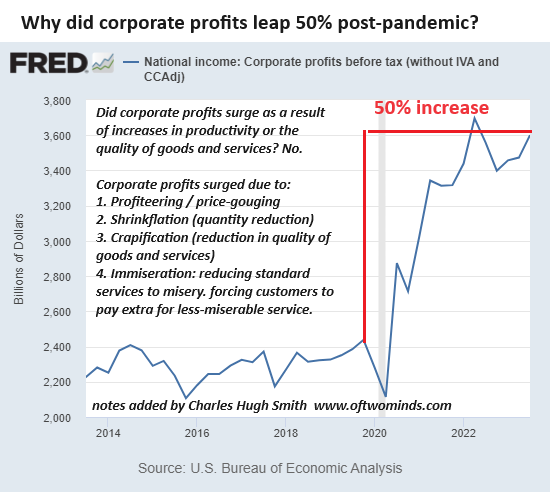
One of the most extraordinary economic marvels of the past decade is the astounding 50% leap in corporate profits, from $2.4 trillion (pre-tax) pre-pandemic lockdown to $3.6 trillion (pre-tax) in the years since the lockdown ended.
Strangely, few seem to ask the source of this astounding 50% leap. Wall Street has certainly cheered this vast increase, but few analysts ponder the source, or ask if the source is a net plus for the economy and nation.
As shockingly heretical as it sounds, the interests of corporate America often diverge from the interests of the citizenry, overall economy and the nation. For example, the wholesale gutting of the US industrial base in the mad rush to lower costs and quality by shipping entire supply chains to China.
As I’ve often pointed out, the meagre savings that trickled down to the consumer were more than offset by the collapse of quality and durability in the globalized goods that now line the shelves of every retailer in the US.
Corporate PR and its well-paid army of toady analysts and pundits would have us believe this is “capitalism” busily at work as pent-up consumer demand naturally pushed prices higher, and corporations were–sadly–forced to pass along these higher costs to consumers.
Recall that “higher costs” don’t show up as higher profits. If the “cost of goods” is $1, and I charge the consumer $2, I reap $1 profit. If my costs double to $2 and I charge the consumer $3, I reap the same $1 profit as I did before the cost spike pushed my production costs up.
The higher corporate profits are the direct result of profiteering and price-gouging. Oh boo-hoo, our costs went up and we were forced to pass them along was simply the cover story. If the cost of a $1 item went up $1 to $2, Corporate America merrily doubled its profit margin from $1 to $2.
This is what happens when you allow your economy to be dominated by quasi-monopolies and cartels. They all raise prices and diminish quality as a unified concentration of financial and political power.
The other source of sharply higher corporate profits is shrinkflation, the relentless reduction in the quantity of product in the packaging. One wonders how thin the can of tuna will eventually be–the thickness of a pancake? Or how thin can they make the box of cereal before the container can no longer stand upright?
The reduction of the quality of goods and services, a.k.a. crapification, is a key source of soaring corporate profits. As the unhappy buyer of three replacement appliances this year alone, all replacements for failed name-brand appliances that lasted 7 years or less–I can attest that crapification / planned obsolescence is a core source of higher profits.
Design the product to fail, or default to the lowest cost components, i.e. failure by default, and consumers are forced to replace appliances every few years that once routinely lasted decades. This conveyor belt of products to the Landfill is highly profitable.
Lastly, there’s the immiseration of services, making standard service so miserable that consumers are forced to either endure wretched, incompetent, unreliable service, or pay extra for a “premium” service which is actually of poorer quality than the old standard of service.
We’re adding adverts to all the films and TV programs you’re already paying for. If you want to watch ad-free content, that will now cost you another $2.99 a month.
As Darth Vader would summarize this immiseration: “Pray I don’t alter the deal any further.” No wonder Corporate America added $1.2 trillion in profits to be distributed to the elites of America: everything is diminished, stripped of quality and rendered miserable. Too bad there’s no real competition left in the US economy.
[…]
Via https://charleshughsmith.substack.com/p/whats-the-source-of-the-astounding
 The Most Revolutionary Act
‘As shockingly heretical as it sounds, the interests of corporate America often diverge from the interests of the citizenry, overall economy and the nation. For example, the wholesale gutting of the US industrial base in the mad rush to lower costs and quality by shipping entire supply chains to China.’
it certainly is heretical but not shocking to me. its part of that ongoing transfer of wealth from the rest of us to the wealthy thats been happening for decades, but even faster now, in a post pandemic crescendo.
‘The reduction of the quality of goods and services, a.k.a. crapification, is a key source of soaring corporate profits.’
boy is that the case. i have noticed a decline in the quality of some grocery items so much so that i have just ceased to buy some previously favorite items. in addition choice is increasingly diminishing. stuff i used to buy, stores dont stock anymore. this presages a crisis in available consumer goods. you ain gone be able to find many of the things you want and need in stores anywhere. third world here we come.
LikeLiked by 1 person
Here in New Zealand, nomad, where wages have never kept up with the standard of living, people typically rely on “op shops” for clothes and never gave up raising their own veggies (cauliflower costs $7 a head at the supermarket) and chickens.
LikeLiked by 1 person
Nomad, It is not a pretty picture you’re painting about America. A certain percentage in Australia can still live mavellously good here in Australia. But maybe not for much longer.
Some of the people who can still well afford to regularly go out to sit down for some nice coffee with friends, already have to miss out on certain days when for instance a cafe has to close for they cannot find enough staff. Nowhere in Australia are there enough people to do the required work. Australia has to import more and more people!
LikeLiked by 1 person
New Zealand is Australia’s poor cousin, Aunty. Good paying jobs are so scarce here that we lose hundreds of thousands of our young people to Australia every year.
LikeLiked by 1 person
Well, good luck to them, Stuart.
It can be very tough for young people in Australia as well. Not everyone earns enough money to pay for very high rent that becones more and more unaffordable. It is a fact that property prices are going through the roof everywhere. It is probably the same in New Zealand?
LikeLike
I just saw an interview with Andrew Forrest and googled him. He points out we’re not progressive enough in the way we handle climate change.
Mining projects just so some people can make a lot of money?
LikeLike
I spent $450 furnishing my apartment. I purchased a brand-new bed, a four-foot fold out card table, one chair to go with that, a standup reading lamp, a chair from a thrift store, two fans and one pot, one pan, four plates, two bowls, four glasses and 2 cups, four spoons, forks and two knives. I even do my laundry by hand even though there are laundry facilities on each floor. They are just too dirty for me to even bother with. I did spend about $60 on champagne, but that was because I gave that up after New Year’s.
I say all of that to showcase that I do understand that corporations are ripping folks off if they choose to keep running in the doors of stores coming out with junk or sitting somewhere ordering mess online that they don’t really need. I do understand the need to replace worn-out, broken-down appliances and I sympathize with those who need to do that since I had a devil of a time getting my landlord to replace my broken-down refrigerator. I absolutely REFUSE to spend money if I don’t have to. My clothes are literally falling off me due to my washing them repeatedly and the fact that I lost weight when I was homeless. However, until my pants end up down around my ankles when I am out in public, I refuse to purchase clothing replacements. I am so ANTI-CAPITALISM, it ain’t even funny.
LikeLiked by 1 person
I admit to sharing a lot of the same feelings, Shelby. I feel like, why on earth should I let them steal my money if I don’t have to.
LikeLiked by 1 person
I suspect other factors are also at play, such as the declining value of the dollar, and that many corporations have laid off or fired so many employees. Labor costs often comprise the largest chunk of business budgets.
I rarely buy anything new anymore, except food. I’ve re-purposed my clothes so many times that they are rags. I get shoes from Goodwill, because my feet are constantly having to run through mud puddles on streets or on my lawn.
If corporate profits are going up, I agree Smith’s article is correct, but addition, I suspect they are prioritizing providing stock dividends to institutional investors .
LikeLiked by 1 person
I would agree, Katherine, though that’s a very old story. Don’t forget the obscene CEO salararies.
LikeLiked by 1 person