
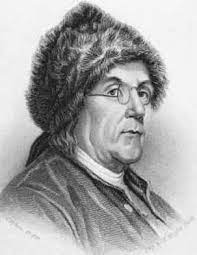
 Ambassador Benjamin Franklin
Episode 5: American Revolution and the Economic Crisis
Living the French Revolution and Age of Napoleon
Dr Suzanne M Desan
Film Review
Desan begins this lecture by highlighting Benjamin Franklin’s role in winning over French public opinion for the military support Louis XVI provided the colonies in US War of Independence. Franklin, who was 70, already had a strong reputation as an enlightenment philosopher and scientist. During his stay in France, he was invited to speak in salons, academies and masonic lodges. As he refused to wear a powdered wig or silken clothes like European intellectuals, his rough coonskin cap and farmer’s coat were emblematic of the system of natural law French Enlightenment philosophers were promoting. Franklin was so popular, enterprising merchants used his face to decorate dishes, snuff boxes, clothes, handkerchiefs.

Ben Franklin snuff box
Deeply in debt from the Seven Years War, Louis XVI was reluctant to send military aid until the Americans proved their military prowess by defeating the British at Saratoga. Although he committed no troops, the French king provided naval support (the American navy was extremely limited) as well as 90% of the colonists’ gunpowder. The total cost of this support was 1-1.3 billion livres (roughly 2 billion euros in modern currency).
The king had to borrow this money and owing to his government’s mounting debt, had to pay his bankers twice as much interest (roughly 6%) as other countries. By 1787, an economic downturn meant that half of all tax revenue went to pay this interest. Hoping to make borrowing easier, his finance minister encouraged conspicuous consumption by the royal family, as well as increased (deficit) spending on public infrastructure.
France’s declining economy related in part to poor harvests and in part to the devastation their textile industry experienced after the king signed a free trade agreement with Britain. Following the 1775 publication of Adam Smith’s Wealth of Nations, both countries felt pressures to repeal their protective tariffs (Smith excessive government regulation as “mercantilism”). Britain, whose textile industry was more industrialized, flooded the French market with cheap cloth – leading to the layoff of more than 50% of the textile workers in northern France.
In 1787 finance minister Charles-Alexandre de Calonne called an assembly of nobles to discuss implementation of a single land tax on all property owners (including nobles and clergy) and a stamp tax on all commerce. After Marie Antoinette and other family members vetoed this proposal, Calonne was fired and hounded out of France. Instead the assembly of nobles recommended that the king call an Estates General (the French kings had stopped calling them at the beginning of the 17th century.
*The Estates-General, created in 1302, was an advisory body that met only occasionally. A meeting of elected representatives of the three estates (clergy, nobility, commoners), it met when summoned by the king, who called it only when he needed extraordinary income or special support (most recently in 1484, 1560, 1576, and 1588; the last three because of the Wars of Religion). Governments were reluctant to convoke an Estates-General because of the fear that it might become a regularly meeting body with well-defined powers. Prior to 1789, it had last met in 1614.
Film can be viewed free with a library card on Kanopy.
https://www.kanopy.com/en/pukeariki/watch/video/149323/149333
 The Most Revolutionary Act