
 Episode 23 Etruscan Legacy in the Roman World
The Mysterious Etruscans
Dr Steven L Tuck (2016)
Film Review
During his regime, the emperor Augustus (27 BC – 14 AD) rebuilt much of Rome as a classical Greek city, replacing brick facades of its public buildings with marble. At the same time, most of the innovations the modern world credit to Romans are really Etruscan. The Romans bequeathed most of them to modern Western culture.
- road and bridge building
- bronze sculpture
- the chariot
- togas
- the lituus (the crooked rod carried by augers which became the bishop’s crosier in the Catholic Church)
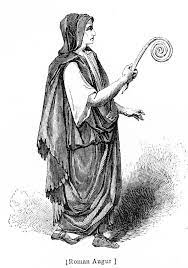 lituus
crozier
- bullae, amulets male children war to protect them from harm
- the acceptance of women and children in public life.
- the helmet, breastplate, grieves (shinguards), sword and javelin, as well as the metallurgical technology used to produce them
- the battle trumpet (used to communicate with military legions)
- the rostrum (battering ram warships used to ram other vessels)
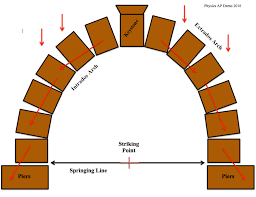
- the arch
- the atrium (front public room of private homes)
- the construction of cities on hills fortified with walls.
- the triumphal procession following military victories
- divination and augury
- the magistrates chair (photo)
- horse racing
- science education (Etruscan Platonic solids* predated the Greek scientists Plato and Pythagoras)
- temples and theaters (Roman theater originated from the dramas enacted in Etruscan temples as part of religious rituals).
- human sacrifice of enemies captured in battle.
- gladiators
- altars
- post and lintel door construction
Romans owe their excellent military unit organization, their love of marble in architecture and their pantheon of gods to the Greeks.
According to Tuck, uniquely Roman innovations are limited to concrete, public bath complexes and basilicas.
*In geometry, a Platonic solid is a convex regular polyedron in three-dimensional Euclidean space. A polyhedon is regular if all the faces are congruent (identical in size and shape) and the same number of faces meet at each vertex. There are only five such polyhedra:
| Tetrahedron | Cube | Octahedron | Dodecahedron | Icosahedron |
| Four faces | Six faces | Eight faces | Twelve faces | Twenty faces |
 (Animation, 3D model) (Animation, 3D model) |
 (Animation, 3D model) (Animation, 3D model) |
 (Animation, 3D model) (Animation, 3D model) |
 (Animation, 3D model) (Animation, 3D model) |
 (Animation, 3D model) (Animation, 3D model) |
**istrones, the Latin word for actor is derived from the Etruscan word hister.
https://www.kanopy.com/en/pukeariki/watch/video/239710/239653


