
Episode 19 Etruscan Women
The Mysterious Etruscans
Dr Steven L Tuck (2016)
Film Review
According to Greek and Roman historians, aristocratic Etruscan women (who shaved their bodies and exercised to keep them fit) were “luxurious,” frivolous and depraved, because they drank alcohol and appeared in public in immodest attire revealing their beautiful bodies. Etruscan children also participated in public life, and both boys and girls learned to read. These attitudes are depicted in Etruscan tomb paintings.
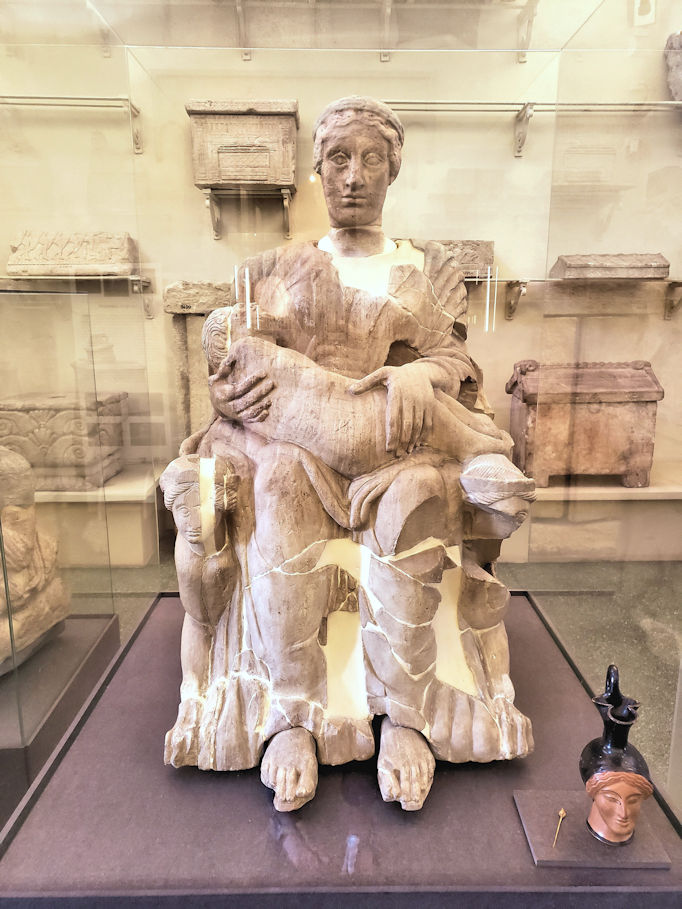
In contract, depiction of nursing mothers or children in Greek or Roman Art was extremely rare. In Greek and Roman society, childbirth was viewed as comparable to a baker baking a loaf of bread – and getting all the credit for it. Etruscan families were like those of Israel and Egypt, in which men accepted all children born to the household of the birth mother. This was totally unlike Greece and Rome, where the male head of household could reject a newborn and order it “exposed.”*
In marriage Etruscan women kept their own names, rather than their father’s or husband’s name, and were allowed to inherit and bequeath property. Etruscan women of all classes had clearly sexually defined roles, mainly child rearing and spinning, dyeing and weaving wool. Fabric production was commonly performed by groups of women who sang and told stories as their worked. Some historians believe this was how Etrurian myths were passed to new generations.
Elite Etruscan woman oversaw slaves in food preparation for banquets. Elite Etrurian men were expected to undertake religious (including divination) duties, civic and military duties.
As high priestesses and oracles, Etruscan women were also agents of political change, a function denied Greek and Roman women (except for the Greek oracle at Delphi and the Roman vestal virgins). Tuck gives as examples the Etruscan priestess at Mater Matuta (the temple to Uni Servius) who had to approve new Roman kings* and the Sybillic Cumae who predicted Rome’s defeat of Hannibal.
Greek and Roman historians also condemned religious fertility rites (depicted in Etruscan tomb paintings) in which couples engaged in group sex to increase crop fertility or whipped women with rawhide to help them conceive and to increase their likelihood of surviving child birth. Etruscans were legitimately concerned about high maternal mortality rights, which remained high (around 1%) until the late 20th century.***
***Although infant exposure (rejection from the household) often equated with infanticide (the outright killing of a newborn), it allowed the possibility of the infant’s survival and rescue by a third party/
**Once the Roman senate elected a new king, he had to spend the night at Mater Matuta for the Etruscan priestess to pronounce him fit for office.
***In 1936 US maternal mortality was 1% – approximately 36% of US troop mortality in World War I.
Film can be viewed free with a library card on Kanopy.
https://www.kanopy.com/en/pukeariki/watch/video/239710/239647
 The Most Revolutionary Act