
Episode 16 Bronze, Terra Cotta and Portraiture
The Mysterious Etruscans
Dr Steven L Tuck (2016)
Film Review
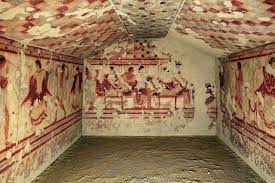
The best-known Etruscan art available to archeologists are tomb paintings, bronze free-standing statues, relief plaques, gold jewelry and bronze and terra cotta vessels.
Etruria had the richest metal resources (copper, iron, zinc, arsenic, mercury and tin) in northern Italy. The federation was also endowed with vast forests (for fuel) and clay beds
The Etruscans were clear innovators in Mediterranean portraiture and the first European artists to realistically portray hands and noses (with distinctive nasolabial folds). Although they clearly valued Greek art and invited Greek artists to work in their communities, they also developed their own bronze and terra cotta industries. Bronze Etruscan statues were in high demand in elite Greek homes. After Rome conquered Erutria, they looted 2,000 bronzed statues from Overtia.
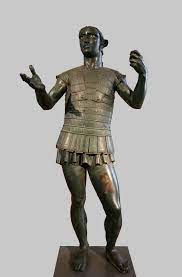 The main techniques the Etruscans used to mass produce bronze statues were casting and lost wax casting.* Bronze armor and breast plates were hammered out of bronze sheets. Razing (pounding a bronze sheet around a rounded rod) was used for helmets. Annealing** (alternately heating and slowly cooling) was used to keep bronze from hardening as it was hammered. Rivets or solder was used to connect feet and handles to bronze dishes.
The Etruscans had highly advanced decorative and finishing techniques. They mainly used flat chasing,*** hammer punching and stamping (where, unlike engraving, no metal is removed) to create complex designs. They also used inlays and overlays with precious metals into preformed indentations and niello, which employed an alloy of copper, silver and lead to make fine black lines – and gold leaf gelding, which fused gold to the bronze with a mercury/gold solution.
Most Etruscan statuettes were terracotta votives, left at various sanctuaries to thank the appropriate gods for services rendered. In fact it was common for Eturscan sanctuaries to house their own ceramic and metal workshops to produce religious items to sell to pilgrims.
Etruscan gold and silver jewelry is the most advanced in the ancient Mediterranean. Their granulized filagree (fine gold) technology used in intricate jewelry designs still can’t be reproduced today. Etruscan potters are responsible for inventing Bucchero, in which tera cotta is decorated (with fake rivet heads and fluting used to strengthen metal vessels) to look like metal.
*With lost wax casting, the statue or item of jewelry is chiseled out of wax which is covered with clay which hardens to form a mold. After the wax is melted to remove it from the mold, it’s replaced by molten bronze.
**A technique still used in producing small bronze objects today.
***Flat chasing involves hammering bronze with small, blunt tools to produce low-relief ornamentation.
Film can be viewed free with a library card on Kanopy.

