
Episode 15 Mediterranean Artisans and Merchants
The Mysterious Etruscans
Dr Steven L Tuck (2016)
Film Review
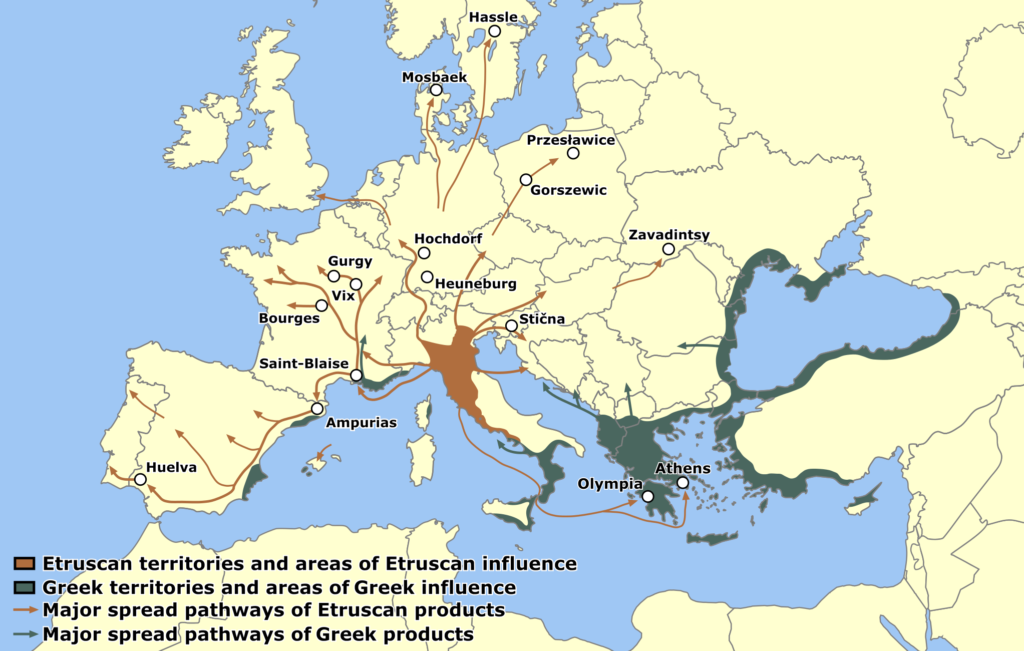
Extensive trade networks from Spain to the eastern Mediterranean had a major impact on Etruscan culture. The Greeks and Phoenicians were their major trading partners.
The Greeks began colonizing southern Italy in the 8th century BC. Ischia was their first settlement and Cumae their second. The Etruscans founded the city of Capua to compete (for trade and agricultural land) with Cumae. The Greeks went on to start colonies in Pompei, Herculaneous, Paestium and Marseilles. They also settled parts of Corsica.
After trading with Sardinia for centuries, the Phoenicians occupied and settled the island in the 6th century BC to mine in it interior. This is also where they produced the red and black figurine vases that have been found in greater numbers in Etruria than any other Mediterranean city.
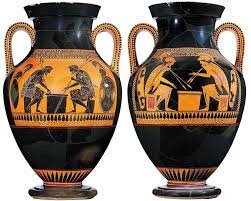 Trade between Etruscan Italy and Corinth, Crete and Cyprus was a conduit for the “orientalizing style” (730-580 BC) of pottery that appeared in Etruscan cities around the 6th century BC.* Corinthian immigrants settled in Etruscan cities to make pottery especially for the Etruscan market.
Archeologists have also found engraved ivory dating from the Etruscan period that was either imported from Phoenicia (aka the Levant**) or accompanied Phoenician immigrants to the Italian peninsula.
The Etruscans also imported glass ornaments from both Phoenicia and Egypt. Phoenicia (Lebanon) was the main source of sodium carbonate to make Egyptian natron glass.***
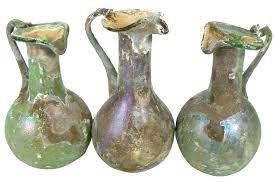 Natron glass vases
It’s less clear what the Etruscans exported. Tuck believes their exports were mainly limited to unfinished raw materials, such a timber, copper, iron, slaves, agricultural products and livestock. However there are no written records to verify this.
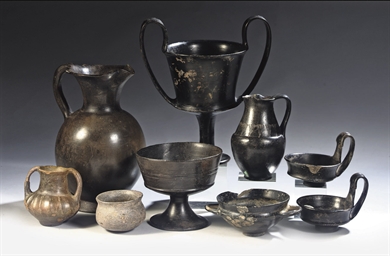
Although archeologists have found a few Etruscan bronzes at the Acropolis in Greece. It seems likely most Etruscan bronzes were melted down for other uses. The Etruscans also exported wine amphora and were famous for their terra cotta religious sculptures and glossy black bucchero vessels found in religious shrines in the Greek colonies. Such relics are also found in Malta, Sicily and at an ancient Phoenician settlement in Cadiz (Spain).
*In 550 BC Eastern Greece came under Persian control, resulting in adoption of Persian art and culture. The Phoenicians also traded extensively in goods from Assyria, Egypt and the Levant. These included ceramics, bronze, silver and glass vases, shells and ostrich eggs (indigenous to Mesopotamia), which were eaten as a delicacy before being engraved and made into drinking cups. The latter are found in Egypt and Sumeria as far back as 3,000 BC.
**The Levant is a historical designation for the region along the eastern Mediterranean, roughly corresponding to modern-day Israel, Jordan, Lebanon, …
***Natron or sodium carbonate (Na2CO3) was used by the ancient Bronze Age societies in the eastern Mediterranean for a wide range of purposes, most importantly as an ingredient in making glass,
Film can be viewed free with a library card on Kanopy.
https://www.kanopy.com/en/pukeariki/watch/video/239710/239639


Pingback: The Greek Colonies You Never Learned About in School | The Most Revolutionary Act