
Episode 14 Etruscan Warriors and Warfare
The Mysterious Etruscans
Dr Steven L Tuck (2016)
Film Review
According to Tuck, the Etruscans were almost continually at war, conducting annual raids on their sister cities for livestock, slaves and booty. Casualties tended to be extremely low, in part due to effective armor, and it was typical to keep fighting until your opponent ran away.
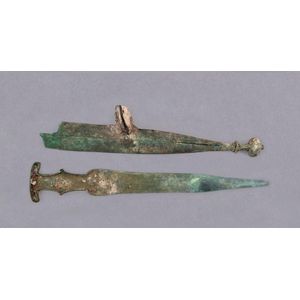
Prior to the 5th century, most armor and weapons were made of bronze. The two main Etruscan weapons were a flanged ax and a single edged sword. Both were wielded in a slashing motion like a machete. The Etruscan cavalry sometimes carried javelins.
Bronze Etruscan flanged ax head
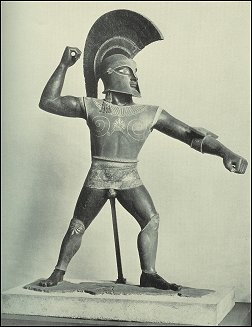
Estruscan warriors also carried shields, which were either bronze or wood covered in bronze and wore bronze helmets and breast plates. Around 475 BC the breast plates were replaced by the bronze cuirass (molded to fit the abdominal musculature).
The cuirass was replaced by linen armor (either soaked in glue to stiffen it or covered with bronze plates).

The Etruscans never adopted the Greek (Spartan) hoplite battle formations. Instead, after charging their opponents on horses, they dismounted and engaged in arm-to-arm combat.
Most of the armies were clan-based and feudal, recruited and armed by local aristocrats. Because warriors weren’t paid, their main aim wasn’t to win battles but to acquire as much loot as possible. In contrast, Greek citizen soldiers were motivated to win battles to protect their democracies. The aristocrats who recruited Etruscan warriors lost control of them once battle began.
When three or four Etruscan cities occasionally united to declare war on a foreign state, each city contributed approximately four to five thousand troops.
Etruscan Warriors At Sea
Etruscan sailing ships sailed the length of the Mediterranean and made an unsuccessful attempt to start a colony on the Atlantic coast of Spain (at modern day Cadiz). They also routinely attacked and looted trading Spanish, French and Corsican trading vessels, as well of those of other Etruscan cities and even those of Athens in the 4th century BC. Between 485-475 BC they occupied Liperi near Sicily. In 364 BC, Alexander the Great was so concerned about Etruscan piracy, he asked Rome to use her navy to attack them.
Significant Etruscan naval battles with the Greeks:
- 535 BC Battle of Alalia – the Etuscans united with the Carthaginians to prevail against the Greek navy and briefly occupied the Greek island of Corsica.
- 474 BC Battle of Cumae – (the Etruscans lost their cities in southern Italy to Greece)
- 453 BC – Etruscans suffered major defeat from Greek navy on their coast.
- 384 BC – Syracuse navy sacked the main Etruscan sanctuary at Volutumnae with 100 ships.
- 335 BC – Etruscans defeated by Athenian navy on west coast of Italy.
As with their military forces, each Etruscan city had their own navy with no centralized control or organization. Another problem for the Etrucans was that they continued to rely on the pentaconter (rowed by 50 oarsmen) when their enemies had adopted the Greek tireme rowed by 150 oarsmen (see The Ultimate Warship of Ancient Greece). The latter was faster and easier to maneuver, as well as having more deck space to facilitate forcible boarding.
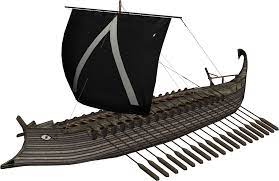 The Etruscan pentaconter
*The Greek hoplite was a heavily armored infantryman who fought in a phalanx formation. The typical formation was eight ranks deep.
Film can be viewed free with a library card on Kanopy.
https://www.kanopy.com/en/pukeariki/watch/video/239710/239637

