
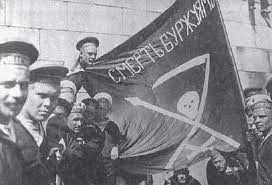
 The 1922 Kronstradt Rebellion
Episode 10: The Red Bridge to World Revolution
The Rise of Communism from Marx to Lenin
Dr Vejas Gabriel Liulevius (2019)
Film Review
After World War I, there were two other socialist states formed, the Hungarian Soviet Republic and the Bavarian Soviet Republic. The first lasted between 21 March and 1 August 1919, when it was put down by occupying Czech, Romanian and French troops. The Bavarian Soviet Republic lasted three weeks.
When Czech, Romanian and French troops occupied Hungary, a German ally, in 1918, all mainstream parties refused to govern under foreign occupation. Instead a fusion between socialists and communists formed a worker-run government, led by Bela Kun. The new government nationalized the nobility’s former estates, banks and apartment buildings, shut down newspapers and arrested dissidents. The support Russia promised never materialized, and their their soviet government collapsed when Romania and Czech armies marched on the capitol.
The Hungarian uprising inspired Bavaria to also declare a soviet republic run by anarchists, writers, and poets promising to overthrow capitalism by printing money. The Bavarian Soviet Republic was overthrown by the Freikorp, the same mercenaries who crushed the Spartacus uprising in Berlin.
When foreign Western armies invaded Russia at the end of 1918 Trotsky, who ran the Red Army, recruited officers who had served the czar. By the time Western troops withdrew in 1920, the Bolshevik government had mobilized five million troops.
The war, which forced the government to requisition crops from farmers, centralized power even further. The Soviet government nationalized former estates, instead of awarding peasant farmers their own farms as they had promised. They nationalized banks and apartment buildings, shut down newspapers, arrested thousands of dissidents and instituted a band on alcohol.
Cling to the belief the Russian example would trigger world revolution, in 1919 Lenin founded the Third International, also known as the Comintern. Unlike the First and Second International, the Comintern was run by the Bolshevik government, though German remained its official language until 1923. Delegates from 37 countries attended the second conference in 1920. This included John Reed (author of Seven Days that Shook the World) from the US and representatives from the Chinese, Vietnamese and Japanese communist parties.
Following the withdrawal of Western troops in 1920, Russia invaded Poland (which had just regained its independence), in the mistaken belief this would inspire Polish workers to rise up and overthrow capitalism.
Following the withdrawal of foreign troops, Lenin declared a new economic policy, eliminating the food requisitions and allowing some small scale free enterprise. He also entered into a trade agreement with Britain.
In December 1922, the Bolshevik government (acknowledging the diversity of ethnic nationalities they represented), renamed the Russian empire the Union of Soviet Socialist Republics.
Lenin became even more disillusioned about the prospects for world revolution in 1921, when Soviet sailors, the naval infantry and civilians staged an insurrection (the Kronstadt Rebellion) demanding a restoration of civil liberties and the election of a new constituent assembly. Trotsky ordered all the leaders shot and imprisoned the rest in camps.
Film can be viewed free with a library card on Kanopy.
 The Most Revolutionary Act
According to Victor Suvorov in his book, ‘The Chief Culprit,’ Stalin actually tried to conquer all of Europe after his treaty with Hitler. The author states that Operation Barbarossa on June 22, 1941 smashed Stalin’s dream, but, also destroyed Germany in the process. He brings up some very good points and has some archival evidence not seen before. I realize this isn’t germane to your article but it puts Stalin in a new light and casts doubt on the idea he was a Nationalist Communist instead of an internationalist.
LikeLike
I think it will still be another few decades, papasha408, before we’re allowed to know the truth about Stalin.
LikeLike