
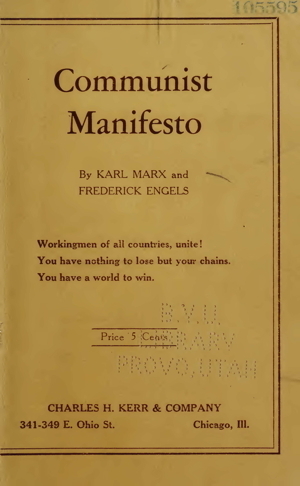
Episode 4 The Communist Manifesto and Das Kapital
The Rise of Communism from Marx to Lenin
Dr Vejas Gabriel Liulevius (2019)
Film Review
The Communist Manifesto
Marx and Engels were both in living exile in Belgium when they published The Communist Manifesto in February 1948. Originally aimed at a small group (20) of radical London tailors and shoemakers, several hundred copies were printed before civil war broke out in France in 1848. This pamphlet attempts to explain the goals of communism (enabling workers to own and control the means of production) as well as explaining class struggle (the exploitation of one class by another) as the driving force behind all history.
The 1848 Revolutions
It was merely coincidence that revolutions occurred throughout Europe that year, all instigated by liberals and nationalists, seeking to replace the European monarchies with with democracies and constitutions. All ultimately failed.
The first began when the French government banned banquets being held by reformers as an indirect form of protest. The Second Republic was declared after King Louis Philippe was forced to flee to Britain.
Popular unrest in Vienna also forced Prince Metternich, the chancellor to flee, and the government promised to create a written constitution. Budapest was next, followed by Prague (capitol of Bohemia) and the Italian city-states of Milan, Rome, Naples and Sicily.
Rioting in Berlin led Germany’s kings to commit to written constitutions and create the Frankfurt assembly to plan for the unification of all Germany.
The provisional socialist government in Paris called for the government to create national workshops to guarantee full employment for al workers. After the conservative National Assembly voted to shut them down. After protests resumed, the French army to killed 4,000 workers and arrested thousands more, exiling them to South Pacific colonies.
The French National Assembly ultimately appoint Napoleon’s nephew Louis Napoleon president. When his term ended in 1851, he declared himself emperor.
Italy’s revolutions were crushed by the Austrian army. When Hungarian Hungarian revolutionaries successfully rebuffed Austrian troops, Russia sent 100,000 troops to help the Habsburgs retake Hungary.
When these revolutions broke out, Marx relocated to Cologne, where he edited a radical newspaper. When the German revolution was crushed, he was ordered to leave the country and moved to London. He only applied for one job in London and was turned down due to abysmal handwriting. He occasionally wrote articles, but most articles appearing under his name were written by Engels.
Marx in London
Engels also supported Marx and his family for 30 years, even though this necessitated his return to work in the Engels family factory (which he hated).* Marx’s wife was frequently ill and had several nervous breakdowns. Of Marx’s seven children by his wife, only three survived to adulthood.
Despite his condemnation of the exploitation of women by the middle class, Marx also fathered an illegitimate child by the maid his mother-in-law hired to help his wife. To protect Marx’s reputation, Engels claimed the child (which was placed in foster care) as his own.
Supported by Engels, Marx spent a total of 34 years in the reading room of the British Museum, writing and rewriting Das Kapital. Engels finally persuaded him to publish the first volume in 1867. Engels would publish volumes two and three from Marx’s notes after his death.
Das Kapital
In Das Kapital, Marx asserted that industrial capitalism was a stage in human evolution that was close to collapse. He believed the collapse of capitalism was inevitable because it was destroying the middle class and increasing the working class (proletariat), while systematically impoverishing it.
Das Kapital describes no exact mechanism for establishing a communist society other than abolishing private property, imposing an income tax and setting up a central bank.
Marx and Engels blamed the lumpen proletariat (who approved numerous plebiscites initiated by Louis Napoleon) for his election as president. They also condemned Slavic peoples as unsophisticated and reactionary and called for them to be wiped out.**
The First International
In 1864, Marx and Engels founded the International Working Men’s Association, which ultimately claimed 800,000 members from most European countries and the US. Holding international conferences in Geneva, Brussels and Lausanne, it was characterized by intense factionalism.
The Russian anarchist Bakunin was Marx’s main opponent in what became known as the First International. He warned against over centralization in general, as well a the excessive personal control Marx exercised over the organization. He and Engels succeed in getting Bakunin expelled in 1872.
*According to late US economist Lyndon Larouche, much of this financial support may have originated from David Urquhart, protege of founder of British intelligence Jeremy Bentham, rather than Engels. See https://larouchepub.com/eiw/public/1996-97/2316/09-eir23n16-19960412.pdf
**Views that were identical to Urguhart’s (and Hitler’s).
Film can be viewed free with a library card on Kanopy.
https://www.kanopy.com/en/pukeariki/watch/video/11239598/11239605
 The Most Revolutionary Act
Marx lived in turbulent times and sought to profit by them, apparently. This vignette shows he didn’t practice what he preached.
LikeLiked by 1 person
The picture I’m getting of Marx is that he was an irascible drunkard who was sold to the world by his friend (and likely British agent) Engels as a genius who used scientific method to predict the future.
LikeLiked by 2 people
That’s my impression, too, based on your blog and on other things I have read, including ” The Communist Manifesto” itself. I was shocked by his blatant call for a “dictatorship of the peoletariat”, the ownership by the state of land and the “means of production”. The Bolshevik Revolution in 1917 was instigated by Marx’ followers like Lenin and Trotsky, and was financed by US and Canadian money, possibly issued through central banks. I could go on . . .
LikeLiked by 1 person
Pingback: Marxism After Marx | The Most Revolutionary Act
Monarchs are today’s royals – you can’t get rid of them. Inbred psychopaths, indeed.
LikeLiked by 1 person
Lara/Trace, They are definitely inbred. Queen Victoria had numerous children, and married them off to heads of state throughout Europe. Kaiser Wilhelm of Germany was a cousin of Edward VII of Britain, but I can’t keep up with royal diddlings. Nicholas II of Russia, a Romanov, married one of Victoria’s daughters. Victoria herself died around 1901.
LikeLiked by 1 person
Both the late Queen Elizabeth and her husband Phillip were descended from Victoria.
LikeLiked by 1 person
See? Proves my point . . .
LikeLiked by 1 person