
Episode 25: The World After 1215
1215: Years That Changed History
Dr Dorsey Armstrong (2019)
Film Review
As Armstrong points out in her very first lecture, the years 1211-1225 experienced the mildest climate in a century and led to bountiful harvests and a population increase.
Following 1225, the world experienced a global environmental climate catastrophe that totally impoverished many of the civilizations discussed in this course. In Europe, for example, there were several planting seasons where it rained continuously (once for as long as six weeks) and seeds rotted in the ground.
Most civilizations declined after 1215:
In the Americas:
- The Mayan empire continued to shrink until Spanish invaders conquered it in the 16th century.
- In contrast, the Incan empire continued to expand until the Spanish conquered it in 1532 an put a puppet emperor on the throne. Incan civilization officially ended in 1572, when the Spanish executed the last Incan emperor Tupac Amaru.
- The Pueblo “accommodated” European culture until 1680, when they led the first successful revolt against Spanish invaders and drove them out of Pueblo territory.
In Africa
- In Ethiopia, the only African country never colonized by Europeans, the ruling Zabwe dynasty was overthrown by the Abyssinians* in 1270. They remained in power until Haile Selassie was assassinated in 1974.
- The Zimbabwe empire thrived for two centuries until 1500.
- After creating Ghana as a separate state, Mali continued to thrive until the 16th century, when it was sacked by its neighbors.
In Europe, increasing resource scarcity lead to an increase of persecutory behavior by church and secular elites focused on confiscating more resources for themselves. Archeological studies reveal human beings became smaller and sicker as the nobility forced them off their communal lands and they crowded into city centers. The temporary inquisition launched against the Cathars in the 12th century became permanent in 1220.
In 1347, an outbreak of plague in Europe, Asia and the Middle East (killing roughly half the European population) decimated communities and created massive political instability. European population levels wouldn’t rebound to 14th century levels until the 1600s.
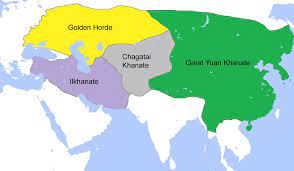
By 1274, the Mongolian Empire had fractured into four separate khanates: the Yuan dynasty in China, the khanate of the Golden Horde in Eastern Europe, the Chagatai khanate in Central Asia and the Ilkhanate in the Middle East. Each became more and more politically autonomous until the Mongol empire ceased to exist in 1368.
*The plague started in China and was transmitted along the Silk Road by Mongol traders.
 The Most Revolutionary Act
Climate change? All over the world. War, trade, and exploration brought clashes of cultures, as well as mutual learning and benefit. Some people think smallpox devastated the Incas. Bubonic plague, from flea-infested rats, traveled with cargo across Asia. Typhus by lice in unclean conditions to susceptible populations.
LikeLike
Either smallpox or measles, Katherine. As I understand the two illnesses were virtually indistinguishable prior to the 20th century.
LikeLiked by 1 person
Or syphilis . . . The “lumpers” and the “splitters” have fallen into both extremes. I don’t think the 20th century brought us greater understanding of what makes a person fall ill. We have fancier tools and some skill, but lots of knowledge has been lost, too.
LikeLike
Climate changes every day. Climate change is just another scam to control us.
LikeLike
I’m especially skeptical of the climate change narrative, papasha408, when JP Morgan CEO Jamie Dimon talks about seizing private property to prevent catastrophic climate change: https://www.rechargenews.com/energy-transition/wall-street-titan-jamie-dimon-says-seize-private-land-for-wind-and-solar-builds/2-1-1431685
LikeLike
When you have 1700 climate scientists saying it’s a scam, I kind of sit up and take notice!
LikeLike
Pingback: Late Middle Age Disasters: Climate and Plague | Worldtruth