
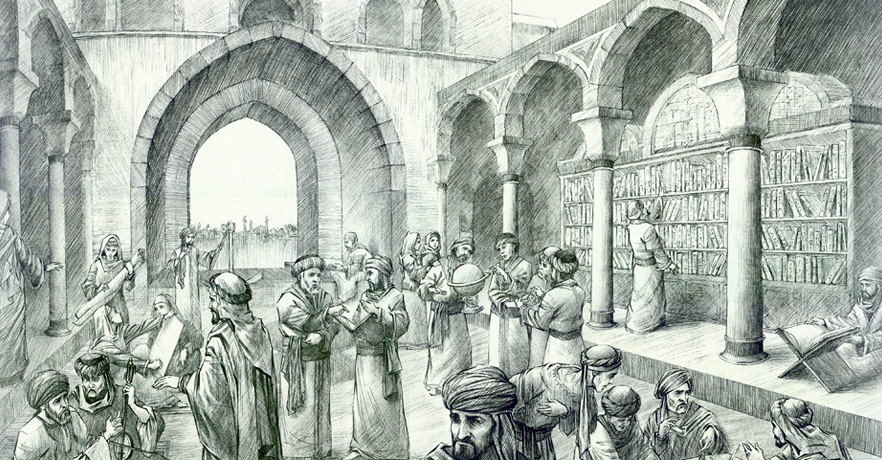
Baghdad’s House of Wisdom
Episode 23 The Islamic World in 1215
1215: Years That Changed History
Dr Dorsey Armstrong (2019)
Film Review
Armstrong begins this lecture by discussing the Islamic Golden Age, in which Islamic scholars made major discoveries and innovations in science, math, medicine, astronomy, art, poetry and architecture. At a time when most of European society was a backwater, interaction with the Islamic world significantly advanced European knowledge of math and medicine.
Europeans owe their numbering system (with Arabic numerals replacing Roman numerals), the concept of zero (which derives from Hindu culture), algebra, trigonometry and calculus to their interactions with Muslim scholars.
Islamic scholars also revived the philosophical teachings of Aristotle, which had been lost to European society. In medicine, they also revived the teachings of Galen and other Greek physicians, as well as performing the first surgical treatment of breast cancer and the first thyroidectomies.
The first European medical school, founded in Italy in the 9th century, was based on the precepts of the Islamic physician Avicenna.
Shortly after Muslim warriors defeated most of the Middle East, North Africa and Spain, it began splitting into rival factions: the Fatimids (mainly associated with Shi’ite Islam), the Umayeds and the Abbasid (both mainly associated with Sunni Islam). The Umayeds were were largely responsible for the conquest of Spain, The Abbasid, who conquered Iraq, moved the capitol of the Islamic caliphate from Mecca to Baghdad in the 8th century. In the 9th century, they founded the first Islamic House of Wisdom. The latter employed numerous Jews and Christians, as well as Arabs, in its translation centers because they could read Hebrew and Greek. There were also major centers of learning in Cordova (on the Iberian peninsula).
In 1171 the Kurdish Sunni Salahuddin, who would retake Jerusalem from the Christians in 1187, overthrew the Fatimid Caliphate in Egypt, establishing the Ayyubid Dynasty (subsequently recognized and allied with the Abbasid Caliphate).
During the Mongol sack of Baghdad in 1258, the Mongols burned all the books in the House of Wisdom, slaughtered the scholars and destroyed the city’s advanced irrigation and public water supply. Viewing the destruction of Baghdad as a punishment from God, leading Islamic scholars adopted increasingly rigid religious beliefs, replacing schools devoted to scientific inquire to those focusing on religious study (Madrasa).
In 1212, the Islamic armies in Iberia (who were mainly Berber converts from North Africa) were defeated by a coalition of rival kings: Sancho VII of Navarre, Peter II of Aragon and Alfonso II of Portugal and driven out of northern Iberia to southern Spain.
Film can be watched free with a library card on Kanopy.
https://www.kanopy.com/en/pukeariki/watch/video/12392969/12393015
 The Most Revolutionary Act
Kurdish Sunni Salahuddin correction
LikeLike
Thanks for the correction, ytaca.
LikeLike
I’m glad to get your historical perspective. I do know Alexander the Great was the son of Phillip of Macedon and was Aristotle’s student. Later, on his campaign to the East, he circled through the “fertile crescent” and got as far as what we know as northern China and eastern India and Pakistan. He apparently died in Babylon, on the return journey. But he apparently sent Aristotle many specimens from his travels, which Aristotle kept in his stash of artifacts. Alexandria, Egypt, is named for him.
LikeLike
Very interesting, Katherine. I seem to be somewhat addicted to history at the moment.
LikeLike
Pingback: The Muslim Father of Comparative Religion Who Measured the Earth’s Circumference | Worldtruth