
Episode 35 Modernizing India
A History of India
Michael Fisher (2016)
Film Review
The 15-Year Reign of Indira Gandhi
Up until 1996, India was mainly governed by a central Nehru-Gandhi dynasty. Born Indira Nehru, Nehru’s daughter separated from her husband Feroe Gandhi (no relation to Mahatma Gandhi) to serve as her father’s first lady during the final years of his presidency. She would become prime minister herself death in 1966 Immediately following Nehru’s death in 1964, Lal Bahadur served India’s second prime minister until his own death in 1966.
Indira Gandhi was a strong supporter of the Wall Street-driven Green Revolution, which brought industrial farming (with soil destroying monocrops, artificial fertilizers, herbicides, pesticides and ultimately GMO crops to much of India.*
In 1971, she initiated a number of controversial reforms, including the abolition of personal property rights and the privy purses (a majority share of tax revenues) of the princely states, as well as the nationalization of banks, insurance companies and coal mines. This was the same year she ordered the Indian army to intervene in East Pakistan.
In 1974, she ordered the first underground test of an Indian nuclear devices.
The Rise of Indian Resistance Movements
In 1967 the states of West Bengal and Karala produced the first freely elected communist government and began a major, successful land distribution program. At the same time the anti-Brahmin Tamil Nationalist Movement (DMK) started their own secession movement in south India. Under Indira’s regime, the Maoist Naxalites in western India began a people’s revolution, a guerilla action in one-third of India’s rural districts.
Undone by Controversial Vasectomy Program
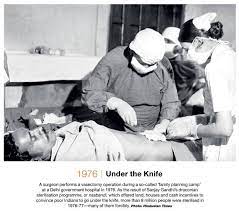
Owing to a number of campaign irregularities nullified her 1975 election. Ignoring the supreme court, she declared an internal national emergency that lasted nearly two years. In addition to suspending habeas corpus, she imprisoned 100,000 activists without, as well as (to slow India’s skyrocketing birth rate) and extremely controversial campaign to vasectomize all men with two or more children. All government departments had to persuade two employees a month to undergo vasectomy or face penalties. She also set up unsterile vasectomy camps that rounded up poor homeless people and prisoners.
In 1977, she released her opponents from prison and called for new elections. The Congress party promptly split into two factions with Gandhi representing Congress-I. A loose Janata** won, installing Moraji Desai as prime minister in 1977 and Charan Singh In 1979.
In 1980, Gandhi’s Congress (I) won by a two-thirds majority. In 1984, a Sikh separatist movement in Punjab became so violent that Gandhi ordered the Gold Temple in Khalistan destroyed with numerous worshipers inside. This led to her assassination by Sikh body guards four months later.
Rajiv Gandhi and the Rise of the BJP
Taking her place, her son deputy prime minister Rajiv Gandhi called for new elections, which he won thanks to his outreach to Muslim voters. This tactic led to significant rise in popular support for the Hindu nationalist BJP (Bharatiya Junata Party).
In 1987, he alienated most of India’ Tamil population by ordering 87,000 Indian “peacekeeping” troops to crush the Tamil Tigers in Sri Lanka. He lost the 1989 election to Janata Dal, a minority part run by Vishwanath Pratup, in large part due to mysterious million dollar payments he made to a secret Swiss bank account.
In 1991, Rajiv Gandhi was once again headed for victory when he was assassinated by a Tamil suicide bomber. Congress-I ultimately won the election under the weak leadership of Narasunha Rao. Owing to poor harvests and a weak economy, Rao was forced to seek an IMF loan and agree to IMF structural adjustments,* which virtually collapsed the country’s economy.
Winning the 1996 election, the BJP’s Atal Bihari Vajpayee served as prime minister for six weeks. In 1988 he was reelected as head of an anti-Congress coalition, served as prime minister for 13 months and set off six nuclear tests. In 1999 he was elected for five years and privatized all Pakistan’s state-owned corporations.
In 2004 Rajiv’s ex-wife Sonia Gandhi (as head of the Indian National Congress) returned the Congress Party (heading up a coalition of 15 parties) returned the Congress party to parliament but declined to serve as prime minister. This post went to Manmohan Singh, who was re-elected in 2009.
In 2014, the BJP’s Narendra Modi was elected prime minister, a post he still holds.
*See Eco Activist Vendana Shiva and her Battle Against Multinational Corporations and GMOs
**The Janata party was an amalgam of parties opposed to Gandhi’s internal state of emergency.
**The structural adjustment policies imposed by the Wall Street-friendly IMF force indebted third world countries to sell off state industries to international corporations, eliminate tariffs deigned to protect their domestic industries and cut public service spending.
Film can be viewed free with a library card on Kanopy.
 The Most Revolutionary Act
Govercorp strikes again. It’s interesting but saddening to realize how the bankers throughout history have seduced entire governments and their citizens to compete among themselves for questionable rewards.
The food, pharmaceutical, and military industries work in tandem to slowly undermine longstanding traditions, values, and beliefs.
Who wins, under this scenario?
LikeLike
Pingback: Class Struggles and Economic Inequality: Modi’s BJP Faces Major Setback in Indian Elections | Worldtruth