
 Episode 33 Independent Bangladesh
A History of India
Michael Fisher (2016)
Film Review
Bangladesh is the eighth most populated country in the world. Geographically the size of Iowa, its population is half that of the US. Agriculturally rich thanks to alluvial soils deposited by the river Ganges, it’s plagued with immense poverty, corrupt and inefficient government and rising sea levels.
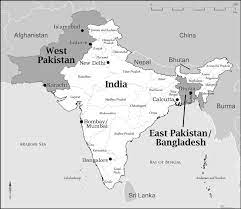
Prior to British occupation, the region had a long history of silk and cotton weaving,* and most early European settlements rose up along Bengal’s early trade networks. Calcutta, which became the center of India’s expanding British economy, was the second largest metropolis in the British Empire (second only to London). For decades, the city was home to the main nationalist networks fighting for Indian independence.
As a direct result of independence, there was a steady transfer of wealth from East to West Pakistan. The former contributed only a tiny minority of officers and officials to Pakistan’s army and civil service.
The Awami League
In 1953, East Pakistan activists formed the Awami league, whose leaders were imprisoned and whose protests were violently suppressed by Pakistani police. Sheikh Majibar Rahman, who was also active in the Bengali language movement,** was one of the most prominent campaigners for increased East Pakistani autonomy.
In 1971, tensions between East and West Pakistan came to a head following Pakistan’s first fully democratic election. Owing to its far larger population, the Awami League won a majority of seats in Pakistan’s new National Assembly. Pakistan’s military dictator General Yahya Khan responded by dismissing the National Assembly and dispatching the army to “restore order” in East Pakistan.
With the help of the Indian army; the Razakars, an East Pakistan paramilitary force; and the Mukti Bahini, guerilla force India organized from East Pakistani refugees, Bengali nationalists prevailed and established Bangladesh as a sovereign country.
A Stormy Electoral History
Rahman, who advocated a program of “secular socialism and land redistribution, was ineffective in implementing these reforms, in large part due to the 1973-74 famine. His move to consolidate power by making Bangladesh a one party state led to a 1975 military coup and the assassination of Rahman and most of his family.
His daughter Begun Sheikh Hasena, who was away from home, inherited the leadership of the Awami League. She was elected prime minister three times, prior to the military coup by General Ziaur Rahman. After organizing the Bangladesh National Party, he was formally elected president in 1978. Following his 1981 assassination by rival military officers, his widow would be elected twice. A military coup launched by General Hussain Muham Mal Ershad removed her from office in 1983. Ershad subsequently formed the Jatiya Party and won the (likely fraudulent) election in 1986 and 1987. Forced to resign in 1990, Ershad was tried and convicted for corruption.
After he supported the election of Rahman’s widow Khaleda Zia as prime minister in 1991, heavy street protests forced her to appoint a caretaker government to run the 1996 election. This resulted in resulted in Begun Sheikh Hasena’s reelection. Khaleda Zia would replace her in the 2001 election.
Heavy street protests resulted in another military coup in 2007 and the appointment of World Bank economist Fakhruddin Ahmed as martial law administrator. Following major electoral reforms, Begun Sheikh Hasena was reelected in 2008 and 2014 (mainly due to a boycott by the opposition parities).
*The British destroyed East Bengal’s early textile London through large exports of raw India cotton, followed by large imports of cheap industrially woven cotton.
**From the outset, West Pakistani leaders tried to force East Pakistan to adopt Urdu (a Persianized Hindustani language), instead of Bangali, as their official language. Although Bengali and Urdu both evolved from Sanskrit, they are mutually incomprehensible.
Film can be viewed free with a library card on Kanopy.
https://www.kanopy.com/en/pukeariki/watch/video/366254/366237
 The Most Revolutionary Act
I’m claiming independence from AmeriKKKa!!!
LikeLike
Good for you, Shelby. A number of us excluded from NZ society for being unvaxxed sought protection from the Wakaminenga Maori Government, which has declared itself sovereign and independent from the NZ government. It’s open to all residents of the world: https://govt.maori.nz/
LikeLiked by 1 person
Pingback: Analyzing the Regime Change Sequence That Toppled Bangladesh’s Long-Serving Prime Minister | Worldtruth
Pingback: Protests/Color Revolution in Bangladesh Brings to Power Tax Evading Banker Who Plunged Poor People Into Debt Through Micro-finance Loan Scheme | Worldtruth