
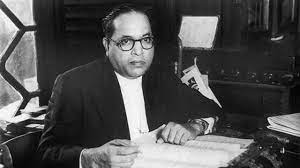
 Dr Bhimrao Ramji Ambedkar
Episode 30 Nationalists Ambedkar, Bose and Jinnah
A History of India
Michael Fisher (2016)
Film Review
In this lecture, Fisher profiles three of India’s nationalist leaders who are often whitewashed out of history because they opposed Gandhi politically and philosophically.
Dr Bhimrao Ramji Ambedkar
Ambedkar played a major role in Indian independence by serving as the chair of its constitution writing committee its first law minister.
Born in 1891 in Mhow in western India, Ambedkar was a Mahar, a slightly higher level of Untouchable assigned to clearing ditches and enforcing decrees.* Mahars sometimes received grants of land for their services and sometimes worked as tenant farmers. Ambedkar’s male relatives had improved their status by enlisting in the Indian National Army as supply clerks (Mahars weren’t allowed to serve as infantry or cavalry). This enabled his father to send Ambedkar to school, even though he was required to sit in a separate room and use a separate water supply. Ambedkar would be the first in his family to graduate from secondary school.
Following his graduation from Bombay university, he received a scholarship from the principality of Baroda to study at Columbia University. After earning his doctorate in 1927, he completed a law degree at Grey’s Inn and a second doctorate from London School of Economics.
He returned to India to work as an administrator for the princely state of Baroda. After facing discrimination, he quit to became a political activist, using his law degree to further the rights of Untouchables in court actions. After working briefly with Gandhi to win Untouchables the right to access Hindu temples, the two parted ways over the best strategy for winning their full equality. Ghandi wanted them to first gain social acceptance by keeping their homes cleaner and imitating the behavior of higher caste Indians.
He opposed Ambedkar’s campaign to create separate Untouchable electorates (where only Untouchables could vote or stand for office), similar to those the British creating for Muslims. In fact, he embarked on a fast until death until Ambedkar agreed to abandon his campaign. In 1932 the two signed the Poona Pact, agreeing to campaign for 18% of India’s voting districts to be limited to Untouchable candidates with the proviso that the entire district would be eligible to vote.
Months before his death, Anbedkar renounced Hinduism and its caste system to covert to Buddhism, as did millions of his Untouchable followers.
Subha Chandra Bose
Born in 1897 into the Kayaths (administrative) Jat in in Bengali, Bose successfully passed the Indian Civil Service Exam in 1919, but refused to join the ICS. Joining the Indian National Congress, he vigorously opposed many of Gandhi’s anti-industrialization policies. He believed it essential for India to embrace modern science and manufacturing to end its economic dependence on the UK and increase living standards for India’s poor.
He also opposed Gandhi’s passive resistance to British rule, organizing violent paramilitary activities against the British that landed him in jail 11 times.
After he became Indian National Congress president in 1938, Gandhi used his influence to force Bose to resign. One World War II started, the latter traveled to Germany to record radio broadcasts for Hitler calling for violent revolution in India. After the formation of the Quit India movement in 1942 led to massive domestic unrest, Hitler helped him organize British Indian Army troops captured in North Africa into the Free Indian Army (aka the Indian National Army). The German and Japanese subsequently transported him by submarine to Singapore, where British officers abandoned 70,000 British Indian Army troops when the Japanese invaded the island. Bose organized 40,000 of them to invade India on behalf of the Indian National Army. After they were joined by by Indian POWs the Japanese captured in Burma, Bose declared himself the prime minister of the provisional Indian government. Hi Indian National Army invaded a few regions of eastern India, surrendering to the British National Army in 1945.
Muhammad Ali Jinnah
Descended from a long line of Hindu mercantile families who had converted to Islam, Muhammad Ali Jinnah was born in Gujjarat in 1876. Married at 16, he left his wife and family in 1893, to train as a barrister in London. On his return to India, he became an extremely prosperous (and the only Muslim) member of the Bombay bar. At 29, he became one of the few Muslims to join the Indian National Congress.
In 1913, seven years after its founding he also joined the Muslim League. After three years, he was elected permanent president. He continued his membership in the Indian National Congress and they held joint sessions in 1915-16, to draw up the Lucknow Pact, a HIndu-Muslim power sharing agreement.
After the INC (under Gandhi’s influence), adopted a number of Hindu religious symbols, Jinnah reigned from the INC in 1920. In 1929, he returned to Britain to practice law in 1929.
Thanks to British political reforms allowing one-sixth of India to vote in provincial elections, the Muslims of Bombay elected Jinnah (in abstentia) as their representative to the Central Legislative Assembly. After the INC renounced the Lucknow Pact, declaring Muslims were underserving of power sharing, his supporters urged him to return to India to become the sole voice of the Muslim League.
In 1939, the Muslim League supported the Viceroy of India’s declaration of war against Germany. Because he failed to consult with the Hindu majority, the INC categorically denounced it. This led to the jailing of many Hindu antiwar activists during World War II.
*The lowest level of Untouchables processed human waste and engaged in leather tannin (a process that involved soaking animal hides in urine).
Film can be viewed free with a library card on Kanopy.
https://www.kanopy.com/en/pukeariki/watch/video/366254/366229

