
Episode 18 The Indian Sultans
A History of India
Michael Fisher (2016)
Film Review
The Indian sultanates established in the 14th century all had majority Hindi populations despite their Muslim rulers. Although a few Hindu temples were destroyed or converted to mosques under their rule, some Muslim sultans supported them financially.
In 711 Muhammad ibn al-Qasim, an Arab military commander in service of the Umayyad caliphate, established a major Islamic Caliphate in Sindh. In addition to expanding his territory as far east as Bengal, he also conducted raids throughout the Indus valley, as well as attacking other Muslim sultanates. His military conquests brought Arabian culture to India, despite a low rate of Muslim immigration.
The Ghund clan continued the raids following Muhammad’s death, employing Central Asian mamluks (slave soldiers) as warriors. Under Turkish occupation, Afghan rulers raised slaves to become warriors, with some of them becoming generals. In most cases, territory they seized became the property of their owner although some mamluks were permitted to bequeath their conquests to their descendants.
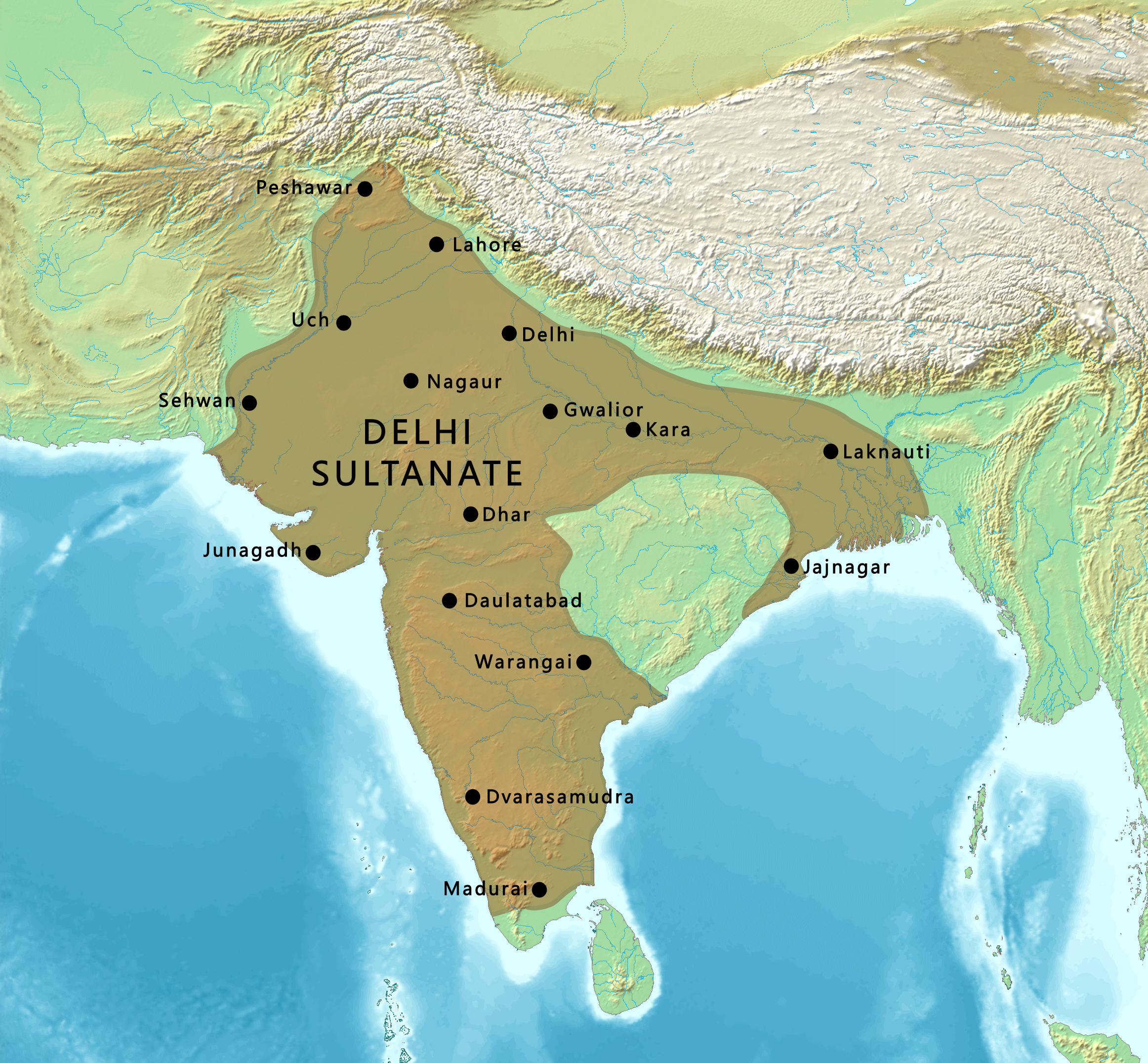
Muhammad Ghund ordered his slave commander Gudaputine to occupy Delhi, on the western boundary of the Ganges Valley. The region, blessed by rich Ganges silt, was irrigated both by the river and runoff from the Himalayan foothills. After winning his freedom from Muhammad’s weak successors, Gudaputine declared himself sultan, creating the first of five Delhi sultanates.
Iltutmish, the third Sultan of Delhi sent tribute to the Abbasid Caliphate in Baghdad. However the takeover of Afghanistan by Genghis Khan* in 1221 led to greater independence for India’s Muslim sultanates, as well as an influx Central Asian and Turkmen immigrants. As the latter increased Persian influence in India (especially in architecture), by 1285 the Delhi sultanate had become fully independent of the Abbasid Caliphate.
There were always major succession battles among the mamluks controlling the Indian sultanates. Hereditary succession on began In 1290, after the Khalji clan of Afghan Turks seized power. Although Khalji himself conquered territory all the way to Magada at India’s southern tip, his successors failed to keep hold of his conquests.
The Khalji clan was overthrown by the slave commander who founded the Tughluq dynasty in 1320. the latter controlled the Delhi sultanate for over a century and issued India’ first copper coins.
The exploits of Firaz Shah, Tughlug’s successor, were recorded by Ziaunn Birhani in the the first Persian-style history of north India. Following Firaz’s death, incompetent administration led numerous provinces to break away from the Delhi sultanate:
- Madura – 1334
- Kashmir – 1339
- Deccan – 1345
- Jaunpar – 1394
- Gujarat broke – 1407.
There were also numerous Hindu rajput rulers who overthrew the Muslim sultans who ruled them. The largest would eventually give rise to the Vijanagara Dynasty, on the South Deccan Plateau.
Over the next 125 years, north India underwent three significant regime changes:
- 1398 – Tamerlane (Timur), a Muslim from Central Asia, sacks Delhi and installs a new regime, the Sayyids.
- 1458 – the Lodi Afghan clan reconquers most of north India.
- 1526 Babur (the Afghan descendant of both Tamerlane and Genghis Khan invades India and to establish the Mughal empire
*See The Great Mongol Conqueror Ghengis Khan Arrives on the Steppes
Film can be viewed free with a library card on Kanopy.
https://www.kanopy.com/en/pukeariki/watch/video/366254/366207

