
 Episode 10 Origins and Rise of Buddhism
A History of India
Michael Fisher (2016)
Film Review
According to Fisher, initial support for Buddhism arose from an increasingly powerful merchant class who were excluded from political power by the Kshatrya varna.*
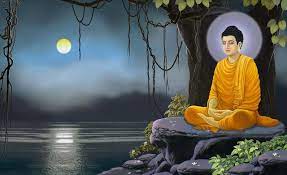
Born the heir to a small Kshatryan kingdom, Siddharta Gautama (who became known as the Buddha) was stil a teenager when he left his wife and son to join a band of ascetics. After six years he renounced asceticism, gaining enlightenment through meditating under a famous fig tree in the city of Gaya (in modern Bahar).
As he and his disciples began preaching they taught four noble truths:
- Suffering is inevitable
- Suffering stems from sensual desire and attachment to this world
- Suffering stops when desire stops.
- The Middle Way (ie rejecting extremes of asceticism and pleasure) is the path to enlightenment.
He taught 7 steps towards achieving the Middle Way:
- Right intention
- Right speech
- Right action
- Right livelihood
- Right effort
- Right mindfulness
- Right concentration
Buddha and his disciples also referred to the Middle Way as Damma, the equivalent of the Sanskrit Dharma.**
Buddha and his disciples established sanga (monasteries), where monks lived four months of the year during monsoon season. They spent the other eight months as wandering teachers. Buddha initial banned women from monastic life but relented following intervention by his foster mother and aunt. Buddhist numbers produced the first record writings by women.
After 537 rebirths, Buddha finally achieved Nirvana when he died at age 80 in 480 BC.
As with Jainism, a religion where a person’s worth was independent of their birth was extremely attractive to increasingly wealthy Vaishya merchants. Thanks to their generous donations, many Buddhist monasteries became important centers of learning.
in the 3rd century BC, Buddhist missionaries went to Sri Lanka, where the vast majority of the population remains Buddhist. From Sri Lanka the religion spread to Southeast Asia (Myanmar, Laos, Thailand, Cambodia and Indonesia), where it remains the predominant religion. Hindusim spread along the same route.
In the first century AD, Mahayan Buddhism emerged and spread to Afghanistan, China, Vietnam and Japan.
In the 7th century AD, Vajrayan (thunderbolt or sudden enlightenment) Buddhism emerged and spread to Nepal and Tibet.
Ironically by the 7th century AD, the religion had died out in India. Fisher blamed this partly on fabulously wealthy Buddhist monasteries that lost touch with the common people and partly on the adoption of Buddhist principles by Hinduism and Jainism.
In the mid-20th century Dalit (Untouchable) activist B R Ambedkar coverted to Buddhism shortly before his death in 1956 and persuaded many of his Dalit followers to convert. At present, there 8 million Buddhists (mainly Dalits) in India. Although they have used the courts to reclaim sacred Buddhist sites (from the Hindu religion), they account for less than 1% of the population.
*See The Vedic Origin of India’s Castes
**Buddha’s followers wrote in the Pali language spoken by north Indian people (not Sanskrit).
Film can be viewed free with a library card on Kanopy.
https://www.kanopy.com/en/pukeariki/watch/video/366254/366191

