
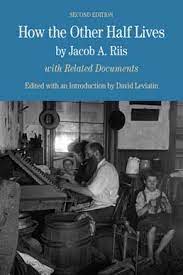
How the Other Half Lives
by Jacob A Riis, Edited with an introduction by David Leviatin
Bedford/St Martin’s 1996
Book Review
Jacob A Riis was a Danish carpenter who immigrated to New York City in 1870. As a police reporter, he became fascinated by flashlight photography technology (employing explosive magnesium allowing photographers to take indoor pictures for the first time. Riis used it to photograph the inside of dilapidated tenements that housed the city’s immigrant population between 1880 and 1890. As one of the world’s first photojournalists, he published his photos together with descriptive text in his 1890 How the Other Half Lives.
The book details how the population of New York started its rapid increase after the war of 1812 triggered massive European emigration. Over 35 years, the cty’s population increased from under 100,000 to 500,000. Beginning in 1830, property developers began subdividing former family homes into flats to accommodate them.
The 1840s and 1850s saw an influx of Irish immigrants during the Potato Famine, with demobilization of Civil War veterans creating another population influx in the late 1860s. The 1880s saw yet another wave of immigration from southern and eastern Europe. By 1890, three quarters of New York’s population lived in tenements. The rents families paid were so high, that some landlords made a 75% annual profit on their investment.*
How the Other Half Lives gives us a tour of the various ethnic neighborhoods that comprised the slums of New York in the 1880s.
- Italian – according to Riis, Italian adults had a monopoly on the city’s fruit stands and their sons on the boot black trade. Many Italian immigrants were brought to the US by padrones expecting to collect rent from them, as well as a percentage of their wages. Because Italian families had to work so hard to pay off the padrone, they had little time to learn English.
- Irish – First generation Irish immigrants worked has hod (coal) carriers, with their sons moving into bricklaying.
- Chinese – the Chinese had a monopoly on the laundry business, with laundries sometimes serving as cover for clandestine opium dens and fan tan games. The Chinese quarter was always the cleanest, with the residents immaculately clean and neat.
- Negro – unable to find jobs in Southern cities, Blacks began filtering into New York City after the Civil War. According to Riis, they were victims of serious prejudice and greed. Denied admission to trade unions, they were forced to give up trades they practiced under slavery (carpentry, bricklaying and barbaring) for unskilled work. They were also charged obscene rents because white families refused to live in the same tenements with them. They tended to disguise their poverty with nice clothes, pianos and parlor furniture. Regular church attendees, they also frequented the penny lottery, numbers games and fortune tellers.
- Jewish quarter – here tenements were much more crowded, with most housing sewing workshops employing up to 12 people per room. Half the clothes in New York’s major department stores were made in these sweatshops.
- Bohemian (Czech) quarter – about half the residents made cigars (including half the women, as they were also excluded from US trade unions). Typically working seven days a week they also had no time to learn English (to help qualify for better jobs).
Despite the tenement reform movement, which started in 1879 (Riis was a member), the Tammany Hall machine running New York was loathe to enforce the city’s laws against overcrowding because Tammany Hall politicians depended on (bought) tenement votes at election time. More than half the city’s voters lived in tenements.
The book includes excellent chapters on homeless children in the tenement quarters, as well as their gangs and the private philanthropists and charities that set up schemes to get them off the street.
*In one example a landlord with a $800 building charged 10 families $5 per month each, for a net annual profit of $600.

