
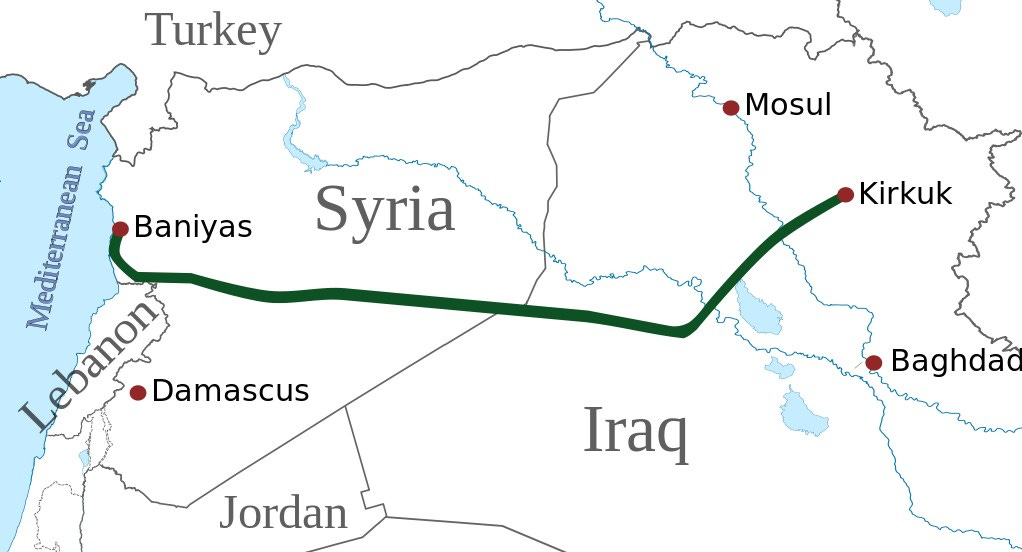
The Kirkuk-Baniyas pipeline revival.
Vanessa Beeley
According to various media reports– negotiations are ongoing to revive the strategic Iraqi Kirkuk to Syrian Baniyas oil pipeline. Iraqi Trade Minister Atheer Al Ghurairy has intimated increased efforts by Iraq to develop energy cooperation with Syria in the coming months and years.
During a meeting with the Syrian Oil and Mineral Resources Minister Firas Hassan Kaddour views were exchanged on the launch of investment in oil and energy fields in both countries. Despite the current US military occupation of Syrian oil resources, Kaddour presented a strategy to facilitate investment by Iraqi companies in the Syrian oil industry. On the table was the restoration of the Kirkuk-Baniyas oil pipeline which would re-connect Iraqi oil fields with Syrian maritime ports and crude oil refineries.
This would resolve some of Syrian energy deprivation issues and provide Iraq with a more expedient oil transport route to refineries in Syria that could process the 12% of total Iraqi oil reserves that originate in Kirkuk.
[…]
For Syria, added benefits would include a stimulation of trade in Syrian ports by increasing maritime traffic despite the threat of punitive US Caesar sanctions that target sovereign nations trade or collaboration with Syria. The Syrian economy would receive a boost from such trade and industry revival.
[…]
After the pre-planned and unlawful invasion of Iraq launched by the US in March 2003, Bechtel Corp. was one of the primary benefactors of the US savagery with and estimated $ 3 billion in Iraq reconstruction contracts. It is worth noting that military industrial complex leader Lockheed Martin was handed “more than $ 11 billion increase in sales and contracts worth $ 5.6 million with the US Air Force in Iraq.” Bechtel made it onto the Business Pundit’s list of the ‘25 most vicious Iraq war profiteers’.
[…]
Syria and Iraq made several attempts to reactivate the strategic oil pipeline between 2007 and 2010. However, technical and political hurdles kept the pipeline shut down.
Pumping was resumed in 2010 but did not last long due to the start of the regime change war against Syria and the occupation of much of the route by ISIS terrorist groups. The US also destroyed sections of the pipeline allegedly in its war on terror/ISIS which has been proven to be a fraudulent claim.
For some time Russia has been trying to secure an influential role in Iraq via the oil industry route amongst others. Russian oil companies have invested in many of Iraq’s oil fields since 2010.
In 2019 Moscow was planning to help Baghdad to transport Kirkuk’s oil to the Mediterranean sea. In 2007 Russian Gazprom was scheduled to repair the pipeline but Iraqi lack of finances were an obstacle. In 2010, as mentioned, Iraq and Syria attempted to get the pipeline up and running again.
[…]
Back in 2019 Russia was trying to convince Iraqi and Syrian governments that it “can successfully implement the Kirkuk-Baniyas project”.
[…]
This pipeline track will also have potential to strengthen the Iranian-Russian alliance. Before ISIS took control of Mosul in 2014 there had been intensive discussions on an Iranian desire to build a pipeline connecting Iranian oilfields to the Kirkuk-Baniyas pipeline.
From a geopolitical perspective the US regional resource piracy would inevitably come to an end. “There is a hope that this pipeline will link the fate of Iran, Russia, Iraq, Syria and even Lebanon economically and militarily” while squeezing the US and its Kurdish Contra proxies (Iraq and Syria) out of the equation.
The threat of a US-managed ISIS revival is also to be countered, with terrorist sleeper cells still embedded and active in Iraq and Syria but a united axis of terror-adversaries including Iran and Russia would be able to combat such a risk to the pipeline renewal.
[…]
As Robert F Kennedy JR wrote in 2016 for Politico Magazine – “Why the Arabs don’t want us in Syria”:
They don’t hate our freedoms. They hate that we have betrayed our ideals in their own countries – for oil
Let’s face it; what we call the “war on terror” is really just another oil war. We’ve squandered $6 trillion on three wars abroad and on constructing a national security warfare state at home since oilman Dick Cheney declared the “Long War” in 2001. The only winners have been the military contractors and oil companies that have pocketed historic profits, the intelligence agencies that have grown exponentially in power and influence to the detriment of our freedoms and the jihadists who invariably used our interventions as their most effective recruiting tool. We have compromised our values, butchered our own youth, killed hundreds of thousands of innocent people, subverted our idealism and squandered our national treasures in fruitless and costly adventures abroad. In the process, we have helped our worst enemies and turned America, once the world’s beacon of freedom, into a national security surveillance state and an international moral pariah.
Over the past seven decades, the Dulles brothers, the Cheney gang, the neocons and their ilk have hijacked that fundamental principle of American idealism and deployed our military and intelligence apparatus to serve the mercantile interests of large corporations and particularly, the petroleum companies and military contractors that have literally made a killing from these conflicts.
It’s time for Americans to turn America away from this new imperialism and back to the path of idealism and democracy. We should let the Arabs govern Arabia and turn our energies to the great endeavor of nation building at home. We need to begin this process, not by invading Syria, but by ending the ruinous addiction to oil that has warped U.S. foreign policy for half a century.
[…]
Via https://beeley.substack.com/p/iraq-and-syria-to-re-open-crucial/


RFK, Jr. impresses me more and more. He certainly has taken on some huge, intermingled cartels.
LikeLike
I agree, Katherine. I especially like his foreign policy.
LikeLike