
Episode 11 Brittany and Galicia: Fringe of the Fringe
The Celtic World
Dr Jennifer Paxton (2018)
Film Review
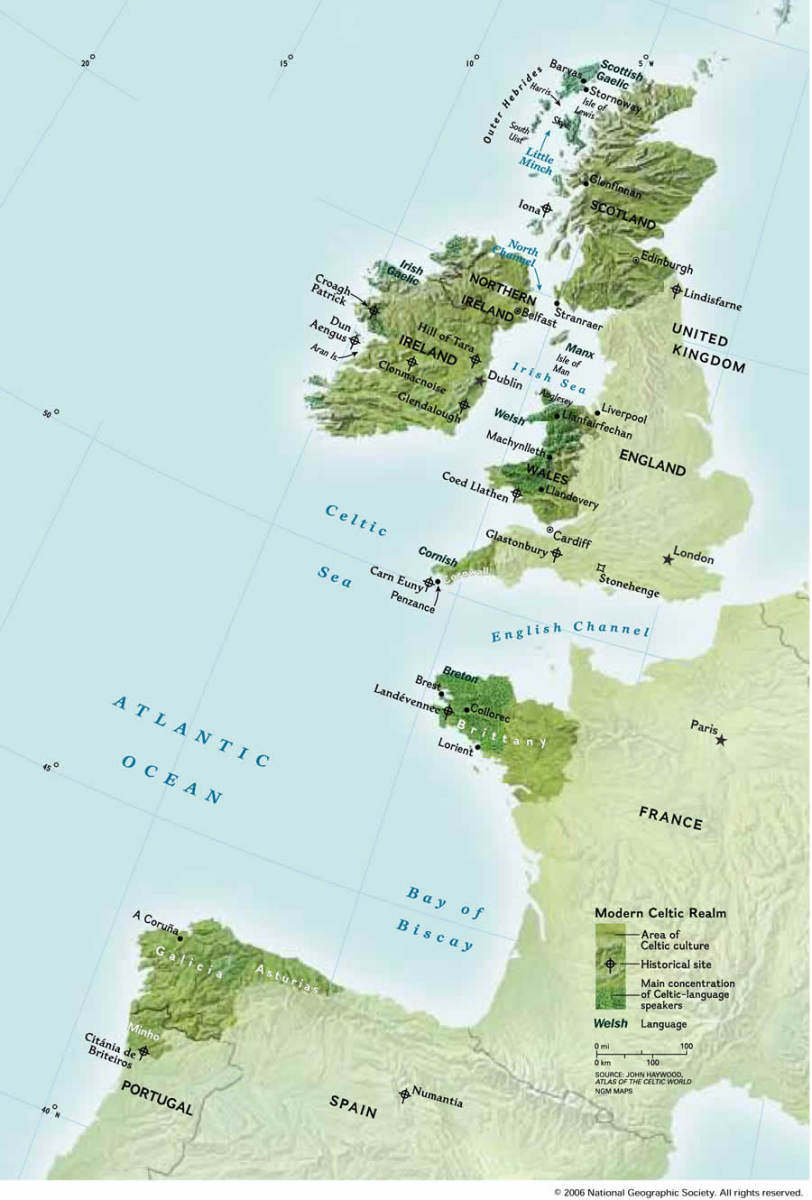
Brittany (formerly known as Amorica*) has the largest concentration of megaliths in Europe although archeologists believe they pre-date Celtic culture (3000 BC). Cultures producing megaliths were always relatively prosperous. In the case of Amorica, this wealth most likely derived from sea trade.
Amorican megaliths
History of Brittany
Under Julius Caesar, some tribes favored Roman colonization, due to robust trade and infrastructure improvements that resulted. However most of the Amorican peninsula allied with Vercingetorix in his rebellion against Rome.
Up until the fifth century AD, most residents of the Amorican peninsula spoke Gallic and some were bilingual in Gallic and Latin. In the fifth and sixth century, instability in the British Isles (stemming from Rome’s collapse) led wealthy Celts from Cornwall and Devon to emigrate to Amorica. By 850 AD, these immigrants had established political and economic dominance over native tribes and their Brittonic language displaced native Gallic and Latin. Later in the 9th century, Norman occupation of northeast France stemmed the western advance of the region now known as Brittany. However border wars continued until the Norman invasion of Britain in 1066. When William the Conqueror brought Britain under Norman control, hundreds of Bretons fought alongside William at Hastings. Subsequently some remained as settlers.
During this lecture, Paxton also discusses Geoffrey of Monmouth, of mixed Breton and Welsh, who first wrote about the legendary Celtic king Arthur in his History of the Kings of Britain.
During a period when British kings controlled most of France’s eastern seaboard, the Bretons also adopted Arthur as their hero. Brittany would maintain their independence from France until the 15th century, when control of the region passed to a duchess who married the King of France.
In 1980, there were one million Breton speakers in Brittany. At present, that number has declined to 500,000.
History of Gallcia
Galicia, an autonomous Celtic community in northwest Spain, gets its name from the Galaeci tribe inhabiting the region in the first millennium BC. After being conquered (with the rest of Spain) by Julius Caesar, it was a Roman province until the 5th century AD, when it was conquered first by the Sueves and later by the Visigoths.
There are presently no Celtic speakers in Galicia, which historically spoke Q-Celtic like Ireland (supporting the theory that Irish Celts originated from Spain). However Galician music is very similar to that of Ireland.
The current dialect spoken in Galicia is closer to Portuguese than Spanish.
*During the second century BC, the three most prosperous Amorican tribes were the Veneti, the Riedones and the Namnetes, The modern cities of Vennes, Nantes and Rennes are named for them.
Film can be viewed free with a library card on Kanopy.
https://pukeariki.kanopy.com/en/pukeariki/video/5701024/5701046


Pingback: The Celtic History of Brittany and Galicia — The Most Revolutionary Act | Vermont Folk Troth