
Source: LA Times
By Brian Shilhavy
Editor, Health Impact News
In what is still probably one of the most under-reported breaking news stories in the U.S. today, the situation with the flooding in California, which produces 50% of the nation’s agriculture, is going from bad to worse, while other parts of the nation are still in drought conditions which threaten the nation’s winter wheat crops, it was reported today.
And then there was this report published by the LA Times yesterday:
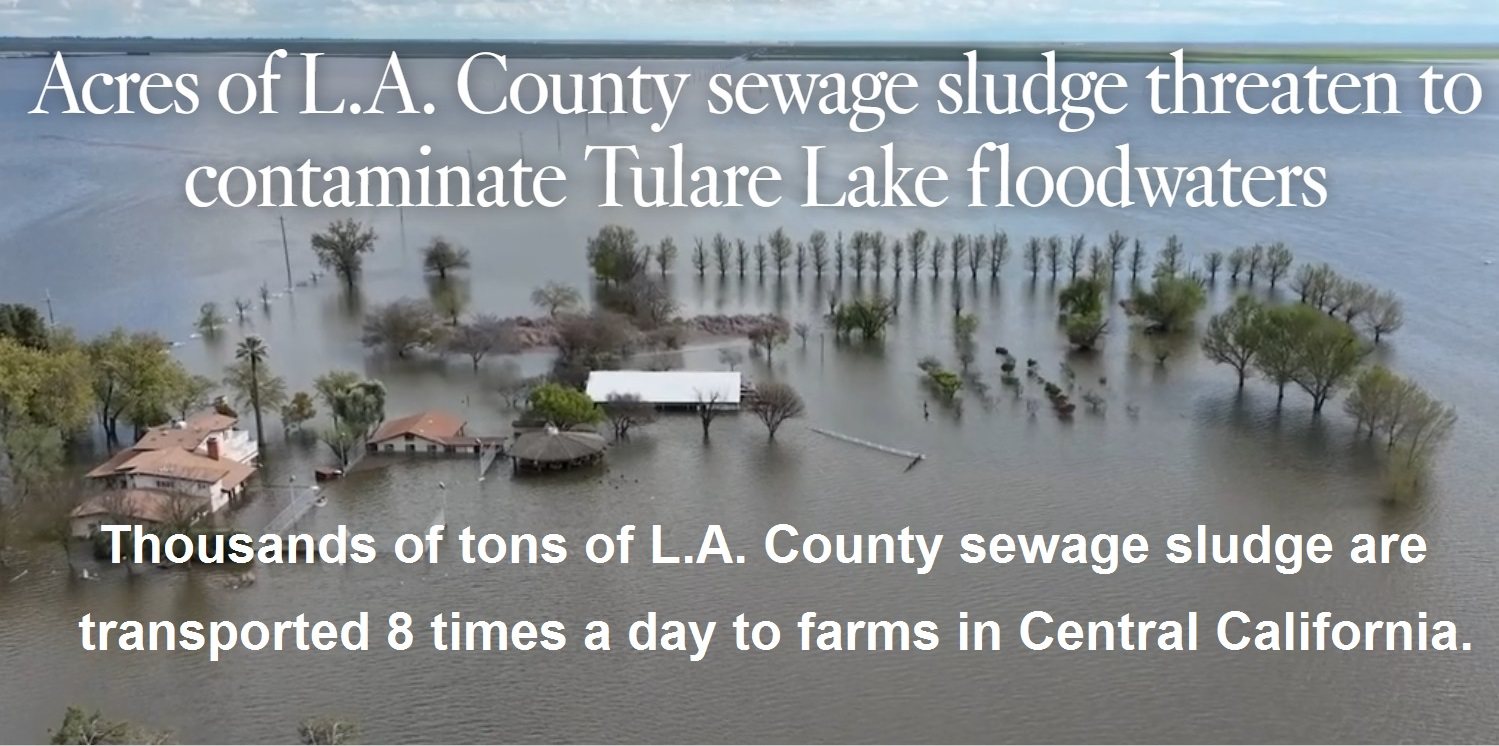
Here at the western edge of the Tulare Lake Basin dwells a smelly industrial site the size of 150 football fields. Roughly eight times a day, its operations are replenished with a truckload of human waste from the residents of Los Angeles County.
Since 2016, the Tulare Lake Compost facility has been converting Southland sewage sludge into high-grade organic fertilizer, and sparing L.A. County the bother of burying its waste in local landfills.
But as epic Sierra Nevada snowpack threatens to overwhelm this phantom lake bed with spring runoff — inundating a region that has already suffered flooding from a series of powerful storms — some fear the facility could be transformed into an environmental disaster.
“When the southwest corner of Tulare Lake floods, thousands of tons of L.A. County sewage sludge, containing toxic heavy metals, will become part of the mix in the newly formed lake,” said Tom Frantz, a retired schoolteacher and environmental activist who once lived in the area but moved to San Luis Obispo three years ago.
“You can’t grow food for humans where this waste has been spread,” Frantz said. (Source.)
“Human waste” is a polite term to use for what this “sludge” is that now threatens $billions of food in California farmlands.
[…]
And all of this “human waste” is in ADDITION TO the “waste” produced in Central California from huge dairy and poultry operations, which now also are in danger of spreading into California’s water supplies.
80,000-100,000 acres of Farmland Threatened to go Underwater as Record Snow Depths Melt in California Mountains
The California Department of Water Resources conducted a snow survey yesterday, stating that this year’s snowpack melt could top every record they’ve ever seen since the snow sensor network was established in the 1980s.
[…]
California is the top milk producer in the United States, with most of the State’s large dairy farms residing in the Central Valley where all the flooding is taking place.
Over 100,000 cows have already been taken out of milk production because they had to be moved to higher ground into temporary facilities, and those facilities do not have milking machines to milk the cows.
The emphasis has just been on saving the cows, but those cows are not currently producing any milk. (Source.)
Some dairy farmers doubt whether they can stay in business.
Besides dairy farms, Central California is home to some of the largest beef processing plants in the nation.
One of the flooded counties, Kings County, is home to Central Valley Meats, which as of 2021 was processing 1,500 head of cattle a day, but has been expanding their operation to 4,500 head a day, and employs over 600,000 workers. (Source.)
I have not been able to find any news reports yet about how the floods have affected their operations, as they are a major supplier of beef to the fast food industry.
Inquiries by Health Impact News to Central Valley Meats have not been responded to, but they may be reluctant to respond to the media, as in the past whistleblowers have given them a bad reputation for how their animals are treated when being slaughtered.
Food Shortages and Inflation Set to Skyrocket
Since California produces so much of the nation’s food, the loss of agricultural products in California is going to cause shortages and higher prices.
[…]
California also grows a lot of grains, not to sell in the retail market, but to feed their huge dairy and cattle industries in feed lots, and many of these grain fields are also under water now.
If they have to go outside the state to secure wheat and other grains, they may have a difficult time doing so based on a report published today about high prices of American winter wheat, due to droughts in the Midwest.
[…]
To make matters even worse, the announcement by OPEC over the weekend to reduce oil production is going to lead to higher fuel prices, and farmers are already one of the largest consumers of diesel gasoline to run all their farm equipment, and now many of them would need to transport grains from far away just to keep their dairy and cattle farms operating, increasing their need for fuel.
This is a national disaster on the nation’s food supply that is an ongoing breaking news story that few yet fully understand.
I have been warning the public now for over 20 years that this nation’s food supply is too dependent on technology and is very fragile, and that the day would eventually come where Americans go their local grocery stores and find the shelves bare.
We may be approaching that day in the not-too-distant future.
We saw this for a limited time during the early days of lockdowns due to COVID in 2020, which caused online ecommerce retailers of food to see increases in online ordering for food.
Since then, however, many ecommerce companies are downsizing or going out of business due to the downturn in the Technology sector which is laying off hundreds of thousands of workers here in 2023.
And that includes food delivery services.
It was announced today that online bulk grocery retailer Boxed has filed for Chapter 11 bankruptcy, for example.
[…]


Live long enough, and every predicted disaster will come true.
I remember in the 1970s, people worried that California was sliding into the ocean, because of fault lines.
California was the “go-to” haven of gold prospectors, and of the impoverished, later, during the US Depression of the 1930s. It birthed Hollywood and the film industry that supplied the world with entertainment before the advent of television.
Now we have Silicon Valley named for the element–silicon, or common sand– that provides the basis for the computer chips that the world now relies on. But Silicon Valley’s bank just crashed. I’m writing now on a cell phone, made possible through all the interconnections of the world wide web of computers and of life itself.
Now California is sinking into its own human slime? Unfortunately for human life on the planet, California’s problem is our problem, but there are no easy or fast solutions.
The tectonic plates are shifting, but no one can predict how, when, or where it will happen. The magnetic north pole is moving toward Siberia, but no one can predict if it will continue in that direction.
Basic elements, sodium and chloride, combine to form salt, which ionizes in water, “the universal solvent”, in a perpetual earthly cycle of crystallization and dissolution, sort of like a human being or human structures.
There is no end. There is only process, with the new growing out of the old and decayed.
People do what they must to cope with change.
LikeLike
Pingback: Food Shortages & High Inflation Threaten Nation’s Food Supply — The Most Revolutionary Act | Vermont Folk Troth
I think the changes will be life threatening for low income Americans who are already missing meals due to high food prices. Here in New Zealand, there is already a 10+ year difference in life expectancy between European and Maori, who tend to be disproportionately low income.
LikeLike