
Hippodamus of Miletus, father of urban planning
Lecture 10: Cities By Design – The Rise of Urban Planning
Understanding Greek and Roman Technology: From the Catapult to the Pantheon
Dr Stephen Ressler (2013)
Film Review
In the Bronze Age Mycenaean civilization, cities sprang up organically around the king’s palace. The only “city planning” that occurred related to defense, usually a city wall following the boundary. Unplanned dirt streets were narrow and winding.
In the Greek poleis (city-states) of the 7th century BC, markets and public buildings replaced the king’s palace on the acropolis (hilltop). Residences sprang up haphazardly around the acropolis, and narrow, winding streets connected them. Here the only planning related to the distinctive architectural style reserved for public buildings.
In the golden age of Athens, following their victory over Persia (490 BC), city planning took a monumental leap forward. Considered the father of city planning, utopia philosopher Hippodamus of Miletus redesigned Miletus after the Persians sacked it. He based the new city on a gridiron pattern of rectangular city blocks divided into public, private and sacred zones.

As Athens became a major naval power in 465 BC, the Athenian assembly hired Hippodamus to design a port for them in nearby Pareus. He employed the same gridiron pattern he used in Miletus, ensuring all streets were straight and of uniform widths (main boulevards were 45 feet wide, side streets 25 feet, and alleys 15 feet). Each private residential block was divided into 8 x 70 foot building lots for two-story dwellings with an interior courtyard.
New cities across the Mediterranean followed this design, especially during the 4th century BC as formerly independent city states became part of the Hellenistic Empire.
The Romans first learned about city planning from the Etruscans (due to strong Greek influence over many Etruscan cities), and adopted the same approach to city design as they conquered new colonies. When the Western Roman Empire collapsed, this systematic approach to urban development would disappear until the Middle Ages.
Instead of centering their cities around hills (which were easier to defend), the Romans built them around existing rivers or roads and relied on stronger boundary walls for defense. They liked to divide cities into four main zones, which they subdivided into blocks, which they subdivided into 200 x 300 foot residential plots. One city zone would be devoted to baths, amphitheaters and other pubic facilities and one zone to the forum.
The Romans also developed land surveying technology to establish an accurate city grid. They used the rising sun and an instrument called a groma and a decampeda to measure distance. It was the role of army engineers to subdivide conquered land, employing a system still used in many regions of modern Italy.
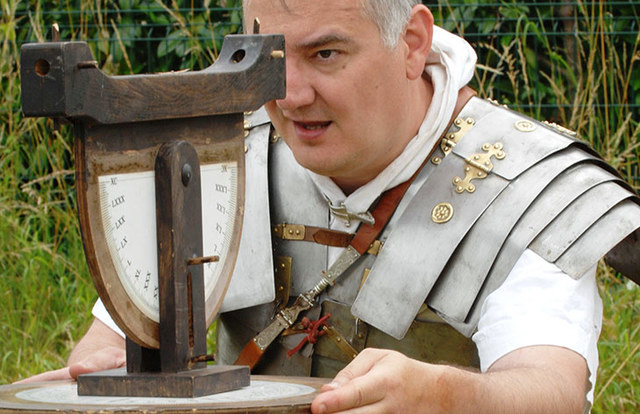
Decampeda
Roman military camps were even more highly planned than towns and cities and featured hospitals, granaries and bathhouses. As camps became permanent, tents were replaced with buildings.
Massive Roman military camp unearthed in Germany
Film can be viewed free with a library card on Kanopy.


Reblogged this on Calculus of Decay .
LikeLike