
By
TomDispatch
The Burden of Massive EV Batteries Will Be Borne by People and Ecosystems
Much of the excitement over the Inflation Reduction Act, which became law this summer, focused on the boost it should give to the sales of electric vehicles. Sadly, though, manufacturing and driving tens of millions of individual electric passenger cars won’t get us far enough down the road to ending greenhouse-gas emissions and stanching the overheating of this planet. Worse yet, the coming global race to electrify the personal vehicle is likely to exacerbate ecological degradation, geopolitical tensions, and military conflict.
The batteries that power electric vehicles are likely to be the source of much international competition and the heart of the problem lies in two of the metallic elements used to make their electrodes: cobalt and lithium. Most deposits of those metals lie outside the borders of the United States and will leave manufacturers here (and elsewhere) relying heavily on foreign supplies to electrify road travel on the scale now being envisioned.
Adventurers and Opportunists
In the battery business, the Democratic Republic of Congo is referred to as “the Saudi Arabia of cobalt.” For two decades, its cobalt — 80% of the world’s known reserves — has been highly prized for its role in mobile-phone manufacturing. Such cobalt mining has already taken a terrible human and ecological toll.
Now, the pressure to increase Congo’s cobalt output is intensifying on a staggering scale. Whereas a phone contains just thousandths of a gram of cobalt, an electric vehicle battery has pounds of the metal, and a quarter-billion such batteries will have to be manufactured to fully electrify the American passenger car fleet as it now exists.
Not surprisingly, the investment world is now converging on Congo’s capital, Kinshasa. In a remarkable series of articles late last year, the New York Times reported on how the cobalt rush in that country has been caught up “in a familiar cycle of exploitation, greed, and gamesmanship that often puts narrow national aspirations above all else.” The most intense rivalry is between China, which has, in recent years, been buying up cobalt-mining operations in Congo at a rapid clip, and the United States, now playing catch-up. Those two nations, wrote the Times, “have entered a new ‘Great Game’ of sorts,” a reference to the nineteenth-century confrontation between the Russian and British Empires over Afghanistan.
Fifteen of 19 cobalt mines in Congo are now under Chinese control. In and around those mines, the health and the safety of workers have been severely compromised, while local residents have been displaced from their homes. People sneaking into the area to collect leftover lumps of cobalt to sell are being shot at. The killing of one man by the Congolese military (at the urging of Chinese mine owners) spurred an uprising in his village, during which a protester was also shot and killed.
The Times further reported, “Troops with AK-47s were posted outside the mine this year, along with security guards hired from a company founded by Erik Prince.” Prince is notorious for having been the founder and boss of the mercenary contractor Blackwater, which committed atrocities during America’s “forever wars” of the 2000s. Among other mayhem, Blackwater mercenaries fired upon unarmed civilians in both Iraq and Afghanistan and were convicted of the killings and woundings that resulted. From 2014 to 2021, he was the chair of a China-based company, Frontier Services Group, that provided Blackwater-style services to mining companies in Congo.
Prince has joined what the Times calls “a wave of adventurers and opportunists who have filled a vacuum created by the departure of major American mining companies, and by the reluctance of other traditional Western firms to do business in a country with a reputation for labor abuses and bribery.”
Neo-Conquistadors
Forbes reported recently that 384 additional mines may be needed worldwide by 2035 to keep battery factories supplied with cobalt, lithium, and nickel. Even were there to be a rapid acceleration of the recycling of metals from old batteries, 336 new mines would still be needed. A battery-industry CEO told the magazine:
“If you just look at Tesla’s ambition to produce 20 million electric vehicles a year in 2030, that alone will require close to two times the present global annual supply [of those minerals] and that’s before you include VW, Ford, GM, and the Chinese.”
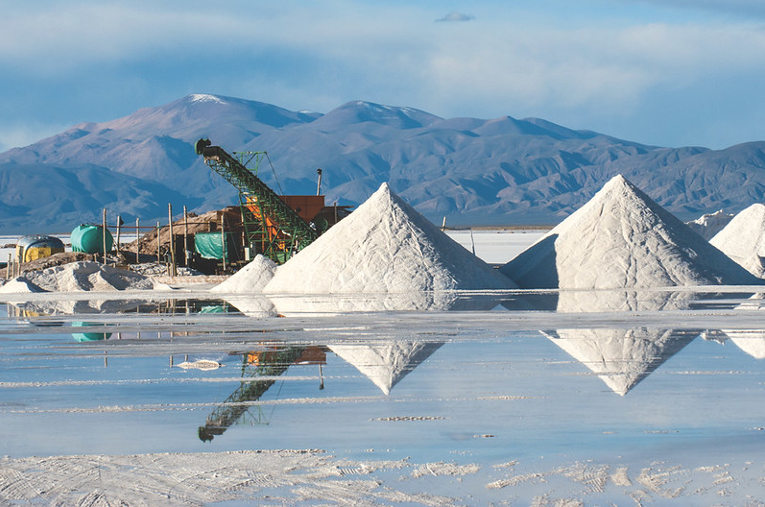
Currently, the bulk of the world’s lithium production occurs in Australia, Chile, and China, while there are vast unexploited reserves in the southern part of Bolivia where it joins Chile and Argentina in what’s come to be known as the “lithium triangle.” China owns lithium mines outright throughout that triangle and in Australia, and two-thirds of the world’s lithium processing is done in Chinese-owned facilities.
Lithium extraction and processing is not exactly a green business. In Chile’s Atacama Desert, for instance, where lithium mining requires vast evaporation ponds, a half million gallons of water are needed for every metric ton of lithium extracted. The process accounts for 65% of the total amount of water used in that region and causes extensive soil and water contamination, as well as air pollution.
While evidently uninterested in Mother Nature, Tesla’s electric car tycoon Elon Musk is intensely interested in vertically integrating lithium mining with electric battery and vehicle production on the Chinese model. Accordingly, he’s been trying for years to get his hands on Bolivia’s pristine lithium reserves. Until ousted in a 2020 coup, that country’s president Evo Morales stood in Musk’s way, pledging to “industrialize with dignity and sovereignty.”
When a Twitter user accused Musk of being complicit in the coup, the Tesla tycoon responded, “We will coup whoever we want! Deal with it.” (He later deleted the tweet.) As Vijay Prashad and Alejandro Bejarano observed at the time, “Musk’s admission, however intemperate, is at least honest… Earlier this year, Musk and his company revealed that they wanted to build a Tesla factory in Brazil, which would be supplied by lithium from Bolivia; when we wrote about that we called our report ‘Elon Musk Is Acting Like a Neo-Conquistador for South America’s Lithium.’”
[…]
Via
 The Most Revolutionary Act
Have many problems with this article. Especially as it is a well known fact that the NYT has a habit of misrepresenting US evil activities and downplaying them.
The US were in various parts of the country using, for the most part, children, to mine cobalt with the then Congolese govt approval. The people in these areas are usually unemployed and have no money. Many of the children fell sick & often died. THAT Congo govt. didn’t give a damn.
The Chinese companies moved in. They offered the Congo govt alternative deals by which they would have exclusive control of the mines in return for the building of infrastructure, a clinic, school and housing for the hundreds of workers. They also provided the workers with various items of PPE, masks, gloves etc.and better working conditions to limit the harm to workers as well as better pay. Unfortunately, thugs with AK 47’s harassed the workers and killed some of them. The likelihood is that the US was employing these thugs and supplying the weapons to damage Chinese operations.
The Chinese govt. usually steps in if any corporation working under it’s mandate is found to be in breach of the codes dictated by it.
There were some incidents where workers were killed by both unknown thugs and gov’t troops, and this may well be the case in a few of the mines operated by the Chinese.
Whilst I totally disapprove of the exploitation of any and all workers, the Chinese and Russian companies under their respective governments, do at least, have some standards which countries in the west certainly do not have.
In this respect, it really is a case of the “lesser of two evils”.
Trust the NYT to spin things against China whilst failing to mention why the US corporations cannot get contracts within the country.
TomDispatch, who rarely gets much wrong & certainly does not misrepresent facts is correct in his denunciation of the wilful West’s pursuit of rare earths and minerals (REM’s) and their acquisition by any means regardless of harm all in the name of profit whilst promoting their version of a “World Order”.
But, given that the DPR is somewhere in the high 170’s in GDP is a country in dire poverty and life is cheap when you don’t live passed your late 30’s and starve if you can’t find work, it’s not difficult to understand why it’s people are grateful for Chinese interest in their most important prerequisite in the modern world. You couldn’t stop them for seeking work and a living if you tried. We in the west cannot and do not appreciate their plight because we have already plundered every resource available to afford us the living standards we take for granted and have not known DRC’s poverty.
The sooner African Countries join the Shanghai Cooperative Organisation, the better their chances of being treated as human beings, rather than just a “resource” for exploitation.
Tom Engelhardt is a valuable source of information- the NYT is most definitely not.
LikeLike
Valuable insights, Mohandeer. Thanks for sharing. I agree totally with your views on the SCO.
LikeLike