
Education: COVID-19 Vaccine Risk Statement (VRS)
Pfizer-BioNTech COVID-19 Vaccine:
Short-Term Efficacy & Safety Data
 1. WHAT IS THE PFIZER-BIONTECH COVID-19 VACCINE?
The Pfizer-BioNTech COVID-19 vaccine is made from synthetic genetic material that is immersed in fatty substances, including cholesterol and polyethylene glycol (PEG). More specifically, modified RNA molecules that encode for a mutated spike (S) protein antigen of the SARS-CoV-2 virus, the virus that can cause COVID-19, are immersed in lipid nanoparticles. The drug is administered in two intramuscular doses, 21 days apart.1
 2. HOW WAS THE VACCINE STUDIED PRIOR TO OBTAINING EUA?
The Pfizer-BioNTech COVID-19 vaccine has obtained emergency use authorization (EUA) from the U.S. Food and Drug Administration (FDA) and is currently investigational.1 The vaccine was studied through nonclinical data from rats and nonhuman primates, and clinical data from humans. The EUA was based on a human clinical trial comparing approximately 22,000 subjects who received the vaccine with 22,000 subjects who did not receive the vaccine (Table 1).2 The trial included a median observation period of two months; 50.6% of subjects were followed up for about two months after the second dose.2 The FDA states that due to the length of the clinical trial’s observation period, “it is not possible to assess sustained efficacy over a period longer than 2 months.”3
 3. HOW EFFECTIVE IS THE VACCINE IN ADULTS AND THE ELDERLY?
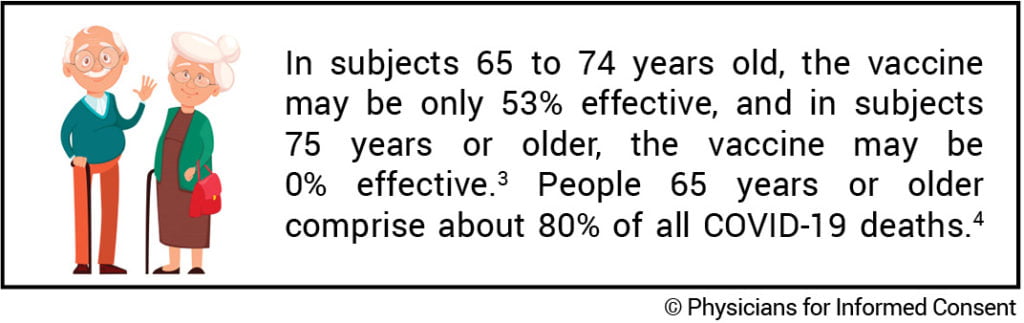
Vaccine effectiveness was calculated by observing the number of cases in the vaccinated group versus the number of cases in the unvaccinated group, where a COVID-19 case was defined as the presence of at least one COVID-19 symptom and a positive SARS-CoV-2 test at least seven days after the second dose. In subjects 18 to 64 years old, the vaccine was 89–98% effective over a two-month observation period.3 However, since there were only 15 COVID-19 cases observed in subjects 65 to 74 years old and only five cases in subjects 75 years or older, the clinical trial did not have enough statistical power to accurately measure the vaccine’s effectiveness in those age groups. The vaccine may be only 53% effective in subjects 65 to 74 years old and 0% effective in subjects 75 years or older.3 See Table 1. Subjects 65 years or older comprise about 80% of all COVID-19 deaths, and subjects 75 years or older comprise about 60% of all COVID-19 deaths.4
 4. IS THE VACCINE EFFECTIVE IN CHILDREN?
Safety and efficacy data was either not tested or insufficient in children younger than 16 years old. In addition, since there was only one case of COVID-19 in subjects 16-17 years old, the study did not have enough statistical power to measure effectiveness in that age group.3 See Table 1.
 5. DOES THE VACCINE PREVENT HOSPITALIZATIONS AND DEATHS?
Since only two hospitalized cases of COVID-19 were observed, the clinical trial did not have enough statistical power to measure the vaccine’s ability to prevent hospitalizations from COVID-19.3 See Table 1. The FDA states, “A larger number of individuals at high risk of COVID-19 and higher attack rates would be needed to confirm efficacy of the vaccine against mortality.”3
[…]
Source: Education: COVID-19 Vaccine


How can get an axempt from this soon to be mandatory vaccines?
LikeLike
At the moment, Sharon, all the vaccines are considered experimental treatments, and federal law prohibits any employer, school or local authority from requiring you to take it. See https://childrenshealthdefense.org/defender/under-federal-law-can-your-employer-make-you-get-covid-vaccine/
LikeLike
What is the opinion of PIC on the use of Ivermectin as a prophylactic against Covid-19? Is there a list of California Physicians who are willing to prescribe Ivermectin for this purpose?
LikeLike
It seems from the PIC website, Thomas, that their research is limited to vaccines. Here’s a directory of physicians who prescribe Ivermectin. It looks like there are 9 in California: https://www.exstnc.com/
LikeLike
Do you still have the rest if the information that was on the PIC print out? or a decent screen print mine is very blury. Thank you very much
LikeLike
Here’s a link to the PIC website, Canadian: https://physiciansforinformedconsent.org/
LikeLike
thank you, the website doesnt have it anymore and there’s no conact info on their website. sigh… tc fot all you do to keep people informed
cheers
LikeLike