
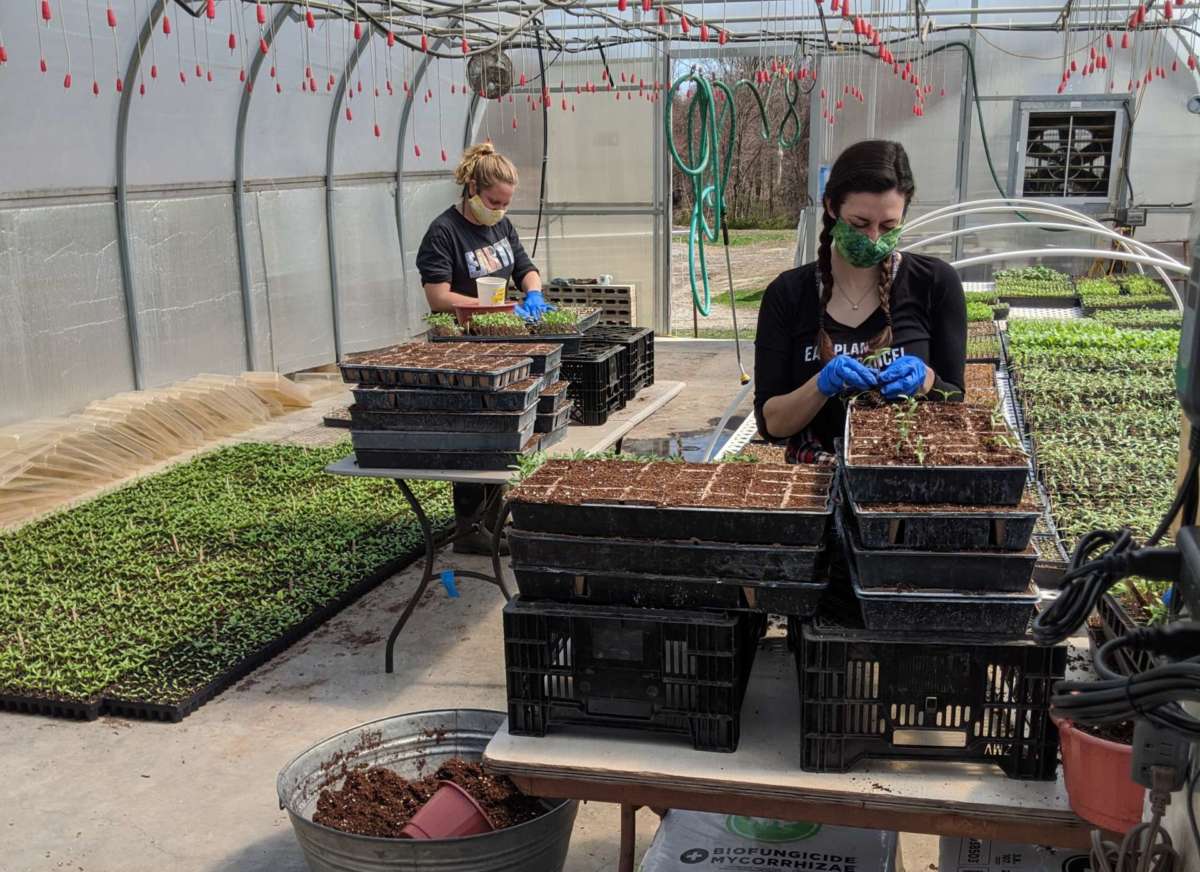
In the greenhouse at Massaro Community Farm, masked and gloved workers keep a safe distance from one another. In the foreground is Jessica Cipriano, with Kayla Uhl farther back. Alyssa DesRosier
By Elizabeth Henderson, Truthout
The COVID-19 pandemic has exposed deep craters in the U.S. food supply chain. Dairies that supply milk and food products to restaurants have had the heartbreaking task of dumping millions of gallons of milk. Many giant meat processing plants had to close down because their workers were getting infected by the virus. The shutting down of these plants resulted in millions of farm animals being “culled” by drowning, shooting and suffocating. The meat processing plants were ordered to reopen when the administration declared that it is essential to maintain the meat supply in late April, even as the death toll and number of infections continue to swell. Since April 22, there have been more than 32,000 COVID-19 cases and 109 deaths among food-system workers, according to the Food & Environment Reporting Network.
During the crisis, however, family-scale farms that are deeply embedded in their communities have been able to pivot nimbly to provide high-quality, locally grown and processed foods while keeping everyone — farm family, workers and customers — safe. Community-supported agriculture (CSA) farms are where customers become loyal supporters by signing up for weekly shares for the whole season to share the risks and benefits with the farmers, and during this time, they have retained old members and attracted new ones. By March 20, within days of the lockdown due to COVID-19, Massaro Community Farm, a nonprofit, certified-organic CSA farm in Woodbridge, Connecticut, was taking orders via email, and a week later, running a new online store — not only to sell winter greens from their own greenhouse, but also to offer products from neighboring farms that had lost markets when restaurants and schools closed.
“Farming through a pandemic has been an exhausting, but exciting, endeavor,” said Alyssa DesRosier, assistant farm manager at Massaro Community Farm. “The hardest part has been the lack of social connection. Our community is one of the biggest parts of our CSA; it’s part of our mission statement: Keep farming, feed people, build community.”
Steve Munno has been the farm manager since the start of Massaro Community Farm 12 years ago when he answered the call for a farmer who could organize a CSA farm combined with hunger relief and educational programs. Having trained at the University of California, Santa Cruz, and worked with the Food Project, Munno was excited to shape a farm that would combine organic farming with food justice. “The injustices of our world, my own privileges and the need to actively work for change were evident early on, so these are the initial seeds,” Munno said. “From there, over the years I got to study and work with people and at organizations where social justice was a pertinent part of the conversation or integral to the mission.”
The farm now has an executive director and a staff of eight, including an education director, a CSA with 250 shares, sales at local farmers’ markets and area restaurants. In addition to commercial sales, Massaro has made a commitment to donate 10 percent of all production to local hunger relief agencies. The farm has given away over 65,000 pounds of food since 2010 and has raised funds to pay for the donations and educational programs by organizing annual community-building events like an on-farm dinner and a bikeathon. Munno lives in the farmhouse with his young family, which includes his wife and two children, so farm safety also means family safety during the pandemic […]
 The Most Revolutionary Act
Reblogged this on Rangitikei Environmental Health Watch.
LikeLike
Pingback: Community-Based Farms Rise to the Occasion as Big Food Supply Chains Stall | canisgallicus
Pingback: Community-Based Farms Rise to the Occasion as Big Food Supply Chains Stall | Auntie Dogma's Garden Spot