
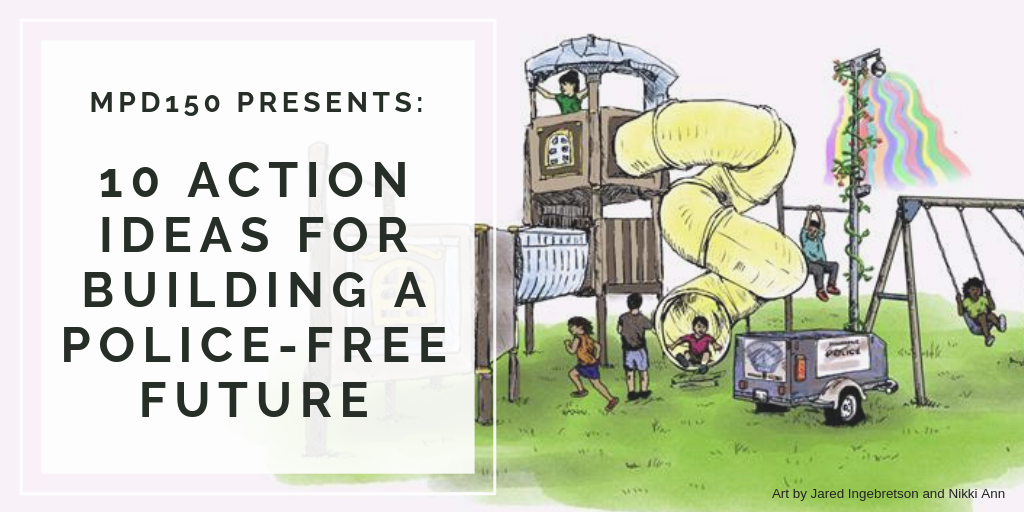
Imagine that you were asked to help create stability in a newly-founded city. How would you try to solve the problems that your friends and neighbors encountered? How would you respond to crisis and violence? Would your *first* choice be an unaccountable army with a history of oppression and violence patrolling your neighborhood around the clock?
— from Enough is Enough: A 150-Year Performance Review of the Minneapolis Police Department
What makes a community healthy and safe? This document doesn’t have all the answers, but it acknowledges that for many of us, police are not part of the solution. Patterns of racism, sexism, homophobia, transphobia, and bullying are too common. When someone is having a mental health crisis, or when neighbors are concerned about a fellow neighbor, or when we feel unsafe– are the police our only option? Of course, different communities have different needs. Vibrant, dynamic, and police-free communities aren’t going to be created by outside groups– they’re going to bloom from the soil that already exists in those spaces. What we can share here, though, is what that process has looked like elsewhere. Here are a few tools, ideas, and strategies:
1. An easy one: STOP calling the police when it’s clearly unnecessary.
We can’t tell you to never call the police (though some do make that choice). We can challenge you, however, to reflect on that choice, to make sure that calling them isn’t an automatic response to each and every moment of personal discomfort or uncertainty. Never forget: an inconvenience for one person, once police are involved, can become a death sentence for another person.
2. Get trained in first aid, crisis de-escalation, restorative justice, etc.
The more skills we have to share with our neighbors and family, the less we have to rely on unaccountable armed paramilitary forces! Find or organize local trainings, and share that knowledge.
3. Build community all the time, not just in times of trouble.
It isn’t just about building capacity as individuals; it’s about cultivating resilient communities. One of the first steps we can take toward communities that no longer need police is meeting one another. We can know our neighbor’s names. We can hold potlucks, volunteer to help our neighbors with simple things like shoveling snow or carrying groceries, and build real relationships. That way, when crises happen, we have other resources to call upon besides the police.
As Critical Resistance’s Abolitionist Toolkit puts it: It can be as simple as asking a friend a basic question: “If I needed to, could I call you?” or telling someone “If you ever needed someone, you could call me.” We know that this is nothing like a perfect solution. But we have to begin to try out what solutions might work, especially because know that calling the police doesn’t.
4. If you DO need police, go to them instead of calling them to you.
From the zine, “12 Things to Do Instead of Calling the Cops:” If something of yours is stolen and you need to file a report for insurance or other purposes, consider going to the police station instead of bringing cops into your community. You may inadvertently be putting someone in your neighborhood at risk.
5. With mental health crises, remember to center the person in crisis.
From the article “5 Ways to Help Someone in a Mental Health Emergency Without Calling the Police” (Tastrom):
Remember that the person having the mental health crisis is a person and their wishes should be followed as much as is safe. The best intervention strategies will be things that the person buys into and does voluntarily. Those of us with mental health issues have likely been traumatized by doctors and other practitioners not listening to us or doing things against our will. All of this is contextual and there are no absolutes, but think about trauma when you are considering what actions to take.
6. Make a list of local services/hotlines you can call instead of the police.
From domestic abuse crisis centers, to shelters for people experiencing homelessness, to mental health support groups, to a range of other kinds of advocates and service-providers, find the people who can deal with the kinds of crises that police so often are not equipped to handle. Find out which ones involve the police as a matter of protocol, and which ones don’t. Hang the list on your refrigerator. Keep those contacts in your phone. Make copies and give them to friends and neighbors.
7. Support organizations that really do keep our communities healthy.
On that note: where these services exist, support them, whether by volunteering, donating, or lobbying for funding from city/county/etc. government. Some great alternatives to the police already exist; they’re just often extremely underfunded […]
Via https://www.mpd150.com/10-action-ideas-for-building-a-police-free-future/
 The Most Revolutionary Act
You are so wise!
LikeLike
It’s not mine Trace. It’s put out by a group called MPD50.
LikeLike
Reblogged this on Alexanders' Blog.
LikeLike
FALSE FLAG ALERT: Obama Foundation tweeted about George Floyd on May 17th, a week before his supposed murder
https://www.naturalnews.com/2020-06-08-false-flag-obama-foundation-tweeted-george-floyd.html
But carry on how plan-DEM-ic cities like my home demunist run Minneapolis r so bad🤪
LikeLiked by 1 person
false flag, huh? well, i guess sometimes false flags have unintended consequences.
LikeLike
Reblogged this on and commented:
A thought-provoking approach to building a more self-sustainable community. Very interesting.
LikeLike
Really interesting and valuable. Reading this from Germany, but some approaches are nevertheless interesting thought experiments to build a stronger community.
LikeLiked by 1 person
Indeed, Pauline. I find the approach useful in establishing a new mental “frame” people use to think about policing.
LikeLike