
“First and foremost, we must recapture the belief in politics. We need to regain public control over our cities so that we, together, can decide to say no when private interests want to exploit and build in ways that will ruin the possibilities of planning for a good city structure. We must revitalize our local communities that have been totally shredded by mass-motoring, separating of functions, privatization and segregation. But without a belief in the political capacity to heal these wounds we can not even start to dream of a different city.”

One is not born a motorist, one becomes one.
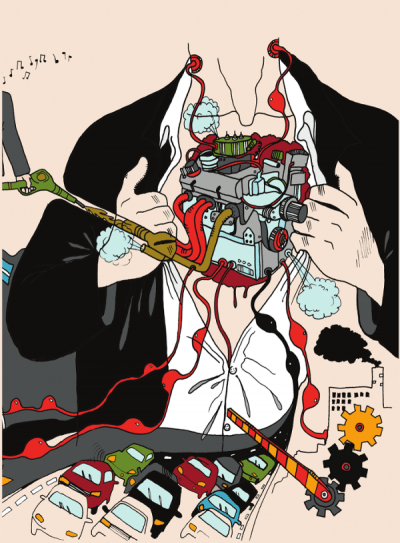
Mobility and class are deeply entangled. Not only because one’s potential for mobility often has to do with one’s economic position, but also because a society built on today’s mobility paradigm – automobility – directly contributes to growing economic and social differences.
A society which puts the car on a pedestal quite obviously favours motorists. Another obvious fact is that white high-income and middle-aged men are an over-represented group among motorists. And the opposite is true among public transport users. But, a society that prioritizes motoring, and looks at ever-growing mobility as an almost magical recipe for development, increases the differences between its citizens and different parts in other ways as well.
The current traffic hierarchy, with the car on top and with public transport, bikers and pedestrians at the bottom, manifests itself…
View original post 3,556 more words
 The Most Revolutionary Act
Insightful and thought-provoking article. I don’t drive and don’t own a vehicle. As a result, over the years of my professional life, I’ve been considered of lower status. Apart from not contributing to air pollution and atmospheric carbon build-up, I remain grounded when I walk the streets and use public transport.
LikeLike
I don’t own a vehicle, either, Rosaliene. We have pretty poor public transportation in rural New Zealand, so I walk nearly everywhere and bike long distances. I’m amazed how much more you notice about your surroundings when you walk, as well as getting to know a lot of street people who also walk everywhere.
LikeLike
I didn’t read the whole article, but I agree in concept. Fact is, the US has been socially engineered to become dependent on private automobiles. The public transportation systems like passenger rail, trolleys, street cars, and even buses, have been allowed to founder in favor of cars, even though cars are increasingly impractical for most people because of cost, maintenance, insurance, and the erratic price of gasoline.
But people like me are forced to own a car, because I live in a semi-rural district with lousy and erratic public transportation. Urban sprawl, with accompanying paved road systems, fosters housing developments along the routes determined by the governments–city, county, state, and federal–and local real estate developers play a major role in where the new roads go. Then they rush to buy up the surrounding land.
I’ve seen this happen in Savannah, which is why we have a Walmart with its street sweeper within hearing distance, and International Paper’s real estate development on its former Skidaway Island tree farm, along with a taxpayer-funded Truman Parkway and two taxpayer-funded bridges across the intracoastal waterway. The county is happy for the tax revenues brought by these urban Yankee escapees who can shop at Walmart on their way from downtown to their gated gilded prison. The path divides the city down the middle, causing major congestion to everyone headed east or west throughout the city.
But this is only one example of how the consumerist economy has been built on the legacies of Standard Oil and its ilk. The private automobile has been very good for the oil and war industries.
LikeLike
You make an excellent point, Katherine, about how the automobile and fossil fuel industry profits have made most of our communities unlivable. That is definitely one of the transformations that needs to take place if we are to solve the climate crisis. Something people must make happen – if the oligarchs get their way with this so-called fourth industrial revolution, the lifestyle of ordinary people is going to get even worse.
LikeLike