
by Stansfield Smith, January 4, 2019, Chicagoalbasolidarity
Evo Morales will soon have been the president of Bolivia for 12 years, heralding the ascent of the indigenous social movements to governmental power. This ended the apartheid system against the indigenous that existed for 500 years in Bolivia. Evo won in 2005 with 53.7% of the vote, followed by re-elections in 2009 with 64.2% and 2014 with 61.3%.
The country has made great strides in economic development, national sovereignty, women’s and Original Peoples’ rights, respect for Mother Earth, raising the people’s standard of living, level of education, and health care.
His presidency, which has brought an era of relative social peace and economic growth, has been the longest in Bolivia’s history. Since 1825 Bolivia has had 83 presidents with 37, almost half, by means of coup d’etats. Previous presidents typically lacked social legitimacy, representing a political system that excluded participation of the indigenous peoples, plagued by social and economic inequality, subjugated to foreign interests, and complicit with the looting of natural resources. By 2002, after years of neoliberal regimes serving foreign, mostly US corporations, the proportion of the rural population living in extreme poverty had risen to 75%.
The election of Evo, a campesino movement leader and head of the Movement Toward Socialism (MAS), began what his government describes as the “Process of Change” that shifted power away from Bolivia’s traditional elite, the mostly white owners of industry and agriculture, and towards the majority, the mostly indigenous workers and campesinos.
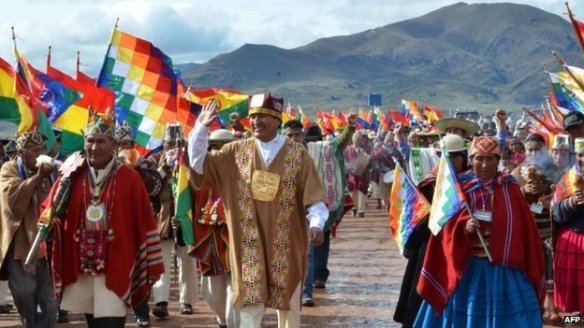
Reflecting on the historic significance of the changes underway in Bolivia, Morales declared: “We are the indigenous blood of Mother Earth. Until now Bolivia has been ruled by a few families that have all the political and economic power. They despise, humiliate, marginalize and hate the majority of the indigenous population.” “After 525 years of colonization, we indigenous peoples are part of the construction of a new Plurinational State and we have full particpation in international political organizations and forums.”
Why Has Economic Development Been so Successful During the Process of Change
The MAS government undertook an anti-neoliberal program, which has enabled the economy to grow an average 5% per year since 2006, compared to 2.8% during the years 1951-2005. As a result, the Gross Domestic Product has grown four-fold from $9 billion in 2005 to $36 billion today. Bolivia has become the fastest growing economy in Latin America.
Economic strategy focused on regaining national sovereignty over the country’s natural resources and using this wealth not to enrich foreign multinationals but to raise the standard of living of the neglected people of Bolivia. In 2006 Evo Morales asserted public ownership over the country’s gas and oil resources, making foreign companies turn over extractive industry resources to the state . The state now fully controls sales, transport and distribution as well as key decisions regarding the extraction and refining of raw materials. The nationalization decree also forced foreign oil companies to renegotiate contracts with the new administration. Today, foreign corporations still extract most of Bolivia’s natural gas, but do so as contractors hired by the state, on the state’s terms.
Prior to the nationalizations (not only of gas and oil, but telecommunications, water, electricity, and a number of mines), foreign corporations pocketed about 85% of the profits generated by natural gas production. Morales increased the country’s profit share from gas from about 15% before his presidency to between 80-90%.[i] In 2005, before nationalization, government gas revenues totalled $0.6 billion; in 2015 it was over four times as much, $2.6 billion – in fact down from $4.5 billion in 2014.
In 2015 all gas and oil revenues yielded $4 billion, making up nearly half of Bolivia’s export earnings.
Over ten years, Evo’s Bolivia has gained $31.5 billion from the nationalizations, compared to a mere $2.5 billion earned during the previous ten years of neoliberal policies. This vastly increased revenue, largely used to benefit the people, starkly exemplifies the extent the people have been robbed to serve foreign corporate interests.
By the end of 2013 the state-owned portion of the economy reached 35%, double that of previous neoliberal governments. The state has become the main generator of wealth, and public investment amounted to over $5 billion in 2016, compared to a mere $629 million in 2006. Much of this new revenue funds the country’s impressive development, infrastructure, community projects, such as schools, gyms, clinics, roads, and subsidies for agricultural production. It is spent on the people’s health and education, on price controls for staple foods, on wage increases, and social security benefits.
This humane redistribution of national wealth away from corporate interests to serving the poor majority has allowed one in five Bolivians, two million people, to escape a life of poverty. Even the World Bank has recognized the country as world champion in income growth for the poorest 40% of its population [. . .]
Source: Accomplishments of Eleven Years of the “Process of Change” in Evo Morales’ Bolivia
 The Most Revolutionary Act
Finally, good news, for a change! Three cheers for Evo Morales and the people of Bolivia!! It is about time a country’s leader looked out for his people instead of just his own interests. What’s occurring in Bolivia, the citizens of the U.S. will never experience. That’s for sure!
LikeLiked by 1 person
Too right, Shelby. In my view the Bolivian people deserve most of the credit. In 2005, they overthrew their corrupt US-backed government for skyrocketing water charges after handing over their public water supply to a private US corporation (Bechtel).
LikeLiked by 1 person