
The Global #RiseForClimate actions are just one example of many that the climate justice movement is building the power needed to transform the economy and put in place policies to confront climate change. The ingredients exist for the climate justice movement to rapidly succeed. A challenge is not knowing how much time we have. Scientists have been conservative in their estimates, and feedback loops could rapidly increase the impacts of climate change.
The costs of not acting are high. The benefits of investing in a clean energy economy would be widespread. We need to keep building the movement.
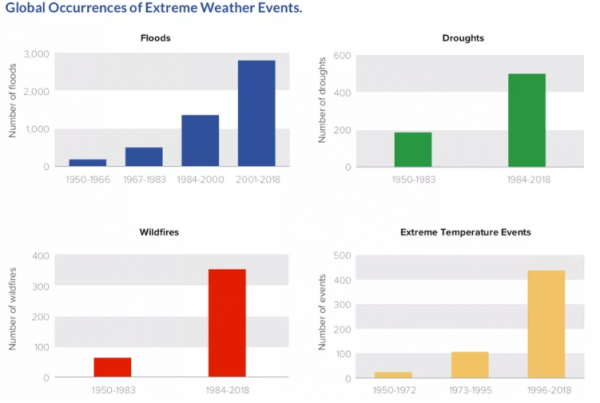
Source: New Climate Economy
The Climate Crisis Is Already Devastating
The urgency of the climate crisis is obvious and cannot be reasonably denied. ABC News reported about the horrific California wildfires, saying there is an “undeniable link to climate change.” They wrote,
“Experts have said that rising temperatures linked to climate change are making the fires larger, more dangerous and more expensive to fight.”
This year’s fires broke records set by last year’s fires, leading Governor Jerry Brown to describe them as the “new normal” caused by years of drought and rising temperatures.
Researchers at Columbia University and the University of Idaho reported in 2017 that human-caused warming was drying out forests, causing peak fire seasons across the West to expand every year by an average of nine days since 2000. The U.S. Department of Agriculture said the 2017 fire season cost more than $2 billion, making it the most expensive fire season on record.
Extreme heat is becoming more common because of climate change. Since 2001, 17 of the 18 warmest years on record have occurred. Records were broken all over the world this year. Record heat is also contributing to more ferocious storms. Storms with heavy rain and high winds are increasing, as the Union of Concerned Scientists warns.
Michael Mann, an atmospheric science professor at Penn State University, clarifies the science:
“What we can conclude with a great deal of confidence now is that climate change is making these events more extreme. And its not rocket science, you warm the atmosphere it’s going to hold more moisture, you get larger flooding events, you get more rainfall. You warm the planet, you’re going to get more frequent and intense heat waves. You warm the soils, you dry them out, you get worse drought. You bring all that together and those are all the ingredients for unprecedented wildfires.”
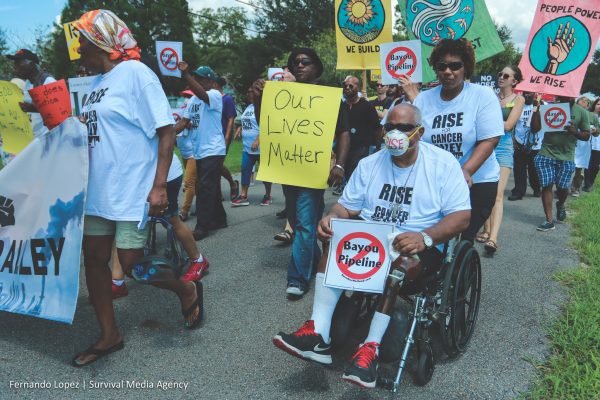
Our Lives Matter from #RiseOnClimate Flickr.
Economic Cost of Climate Impacts Is Rising
Global warming will hit the US economy hard, particularly in the South. The Richmond branch of the Federal Reserve Bank cites a study that finds refusing to combat climate change could utterly devastate the South’s entire economy. The Fed notes, “higher summer temperatures could reduce overall U.S. economic growth by as much as one-third over the next century, with Southern states accounting for a disproportionate share of that potential reduction.”
There is a correlation between higher temperatures and lower factory production, lower worker productivity and lower economic growth. An August 2018 report found:
“The occurrence of six or more days with temperatures above 90 degrees Fahrenheit reduces the weekly production of U.S. automobile manufacturing plants by an average of 8 percent.”
Ironically, the oil and gas industry, which is accused of undermining climate science, is now asking government to protect it from the impacts of climate change. When Hurricane Harvey hit Texas, swamping Houston, it caused an immediate 28 cents per gallon increase in the price of oil. After Harvey a Texas commission report sought $61 billion from Congress to protect Texas from future storms. Joel N. Myers, of AccuWeather, predicted in 2017 that the total losses from Harvey “would reach $190 billion or one percent of the nation’s gross domestic product.” The cost of a 60 mile seawall along the Texas coast is initially projected to be $12 billion. . .
 The Most Revolutionary Act
Burning coal and hyrocarbons pollutes the air, water and food with megatons of radium, polonium, thorium and protractinium annually. It is one of the prime reasons 200 million or more americans drink radioactive water.
These natural radionuclides also come from oil and chemical refineries, concentrating them and dumping them into the air and rivers. Fracking does a great deal of dirty work this way too.
Humans are living in a world of self-created radiionuclide filth and sewer!
LikeLike
Thanks for pointing this out, Nick.
LikeLike
Don’t take this seriously. Is that all you can do, think of yourself and a few others? (Few billion?) Think of those you would deprive of greater wealth and power for once! Set up a FundMe foundation for them. (If you play that foundation right, you could do well for yourself, (and ne), a long-time admirer. Did I ever tell you how attractive you are in your picture?)
Okay, petrodollars, petrowars, etc., the causes of many of today’s problems, could be stopped whenever those controlling it wanted to.
LikeLike
LOL, marbenecltr.
LikeLike
We knew that back in the 70s! Somehow they’ve kept going. Now we’re deep in the s**t!
LikeLike
Yes, indeed, Alan. No one knows for sure if we can prevent catastrophic climate change.
LikeLike
We were given a beautiful planet, now look at what happened. But we are still the most intelligent of all creatures, or am I stupid. That calls for a yes or no answer, I am trying I to decide myself.
LikeLike
Marblenecltr, I would sure hate to be put up against a killer whale in an intelligence contest – especially if it included social intelligence.
LikeLike