
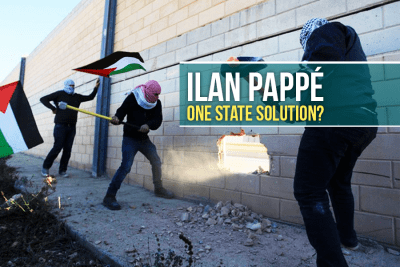
How can Palestine escape from the misery imposed on it by the Israeli state? Here eminent historian Ilan Pappé makes the case for a one-state solution to the crisis; arguing that a new generation of Palestinians and their supporters are taking up the call as the only way out of the cycle of Israeli oppression.
In April this year, a new initiative was launched in Israel-Palestine entitled the ‘Campaign for a One Democratic State’. It was a Palestinian initiative supported by progressive Israeli Jews. The aim of the initiative is to try and organise under one umbrella all the groups and individuals who support the idea inside and outside historical Palestine.
Background
The idea of a one democratic state as the only solution for the conflict in historical Palestine is not a new one. After the 1948 catastrophe, it took the Palestinian national movement a few years to re-emerge as a modern day anti-colonialist liberation movement. In the 1960s, the Palestine Liberation Organisation (PLO) chartered a clear vision for the future. In its 1968 covenant, the PLO called for the establishment of a secular democratic state all over historical Palestine. That vision called for the right of return for Palestinians to their pre-1948 homelands that were now under occupation. In the early 1970s—under pressure from changing realities on the ground—the PLO began to rethink the way forward and adapted its strategy. It began, alongside the armed struggle, a successful diplomatic campaign which led it to endorse the creation of Palestinian state in the West Bank and the Gaza Strip, next to Israel, as a first stage for full liberation. The commitment to a two-states solution was further cemented in the Declaration of Independence that was adopted in November 1988 by the PLO.
In many ways, the 1988 declaration was forced on the PLO as a pre-condition of entering as a partner in a new Pax-Americana framework that so far has ended disastrously for the Palestinian people. This PLO move was a direct consequence of the Israeli invasion of Lebanon in 1982 which forced the organisation’s headquarters to move to Tunis and weakened the Palestinian national movement, deepening its already existing fragmentation. This process culminated in the Oslo accord of 1993.
The fall of the Soviet Union, and Yasser Arafat’s support for Saddam Hussein’s invasion of Kuwait, undermined considerably the PLO’s international standing and limited its strategic options. This is why—despite warnings from some of his best friends and colleagues—Arafat accepted the Oslo framework, which was conceived and constructed in Israel. Its Israeli architects were looking for a formula that would enable them to have control of the land from the river to the sea without incorporating the population living there as citizens. They sold it to the world and to the Palestinians as a two-state solution (although the final documents of the Oslo accord do not mention the establishment of an independent Palestinian state next to Israel). If you have the territory and not the people, you can remain a ‘Jewish democratic state’. Indeed, Oslo was just one more ploy in the attempt by liberal Zionism to square the circle, this time with Palestinian legitimisation.
The Two-State Solution
Zionism is, in essence, a settler colonial movement, which was interested in having as much of the land of Palestine with as few Palestinians on it as possible. As the late scholar of settler colonialism, Patrick Wolfe, has put it; the encounter between the settlers and the indigenous population triggered ‘the logic of the elimination of the native’. In some places, such as North America, annihilation was literally a genocide of the native; in Palestine it was a different kind of elimination, obtained through segregation, ethnic cleansing and enclavement.
Zionist and later Israeli policies towards the Palestinians wherever they are, are guided by this logic. The vision is the same, the means change according to the historical circumstances. In 1948, the Zionist movement attempted a massive expulsion of the native Palestinians and succeeded in uprooting half of Palestine’s population and in taking over 78% of historical Palestine. The Palestinians who remained in Israel were put under a harsh military rule that robbed them of their basic human and civil rights. This military rule was transferred to the West Bank and the Gaza Strip when Israel occupied them (the remaining 22% of historical Palestine). With the new territory, additional Palestinian population was incorporated and posed a new demographic challenge to the settler state. There was a strategic consensus among the leaders of Israel that the West Bank and the Gaza Strip should be under their control. Tactically, there were debates of how best to achieve it, but the world was fooled to see these tactical debates as a clash between a ‘peace’ (the left) and the ‘war’ (the right) camps. The right wing in Israel wished to annex the territories and either cause the local population to leave or restrain it through an official Apartheid system. The left wished to create two Bantustans, in the West Bank and the Gaza Strip, which would allow Israel to control them indirectly and was hoping to convince both the Palestinians and the world that this could be the basis for a peace process. This is the backdrop to the Oslo accord.
The accord, therefore, was based on a thoroughly Israeli interpretation of the two states solution; the establishment of two Palestinian Bantustans in return for an end of conflict. It is possible that the PLO hoped to achieve more through the Oslo process, but on the ground the process provided Israel immunity to continue with the colonisation of the West Bank and the Gaza Strip. When the Palestinian resistance to the Oslo accord grew with the eruption of the second Intifada in 2000, the Israeli leadership decided to forsake the settlements in the Gaza Strip and control it by enclaving it from the outside. The vacuum in Gaza was filled by Hamas who took over the Strip in 2006, exposing the real intent behind Israel’s unilateral withdrawal in the process. The Gaza Strip could either be run like a typical Palestinian authority area or it would be punished by a siege and naval blockade until the people there are forced to change their democratic choice. When Hamas reacted with its own armed struggle to the strangulation policy, the Israeli retaliation was brutal leading to what I termed elsewhere as an ‘incremental genocide’ of the people through military assaults and siege—a situation that led the UN to predict that the Strip will be unsustainable in a few years.
Since Israel only occupied 78% of Palestine in 1948 and half of the population remained in its homeland, the means for implementing the vision of the settler state changed with time, but the aim was the same; to have as much of Palestine as possible with as few Palestinian as possible. Until 1967, it imposed military rule on the Palestinian citizens in Israel and transferred this regime to the Palestinians in the occupied West Bank and the Gaza Strip after the June 1967 war. The various Israeli plans, some branded as peace proposals, were meant to resolve the contradiction between the wish to take over the land (22% remaining of historical Palestine) while not incorporating the millions of Palestinians living there so as not to undermine the demographic balance of the enlarged Jewish State. Any Palestinian resistance was brutally crushed. Neither the Oslo accord of 1993, nor the unilateral withdrawal of Jewish settlers from the Gaza strip in 2005, changed this reality. In fact, what was broadcast as steps towards peace, made life even more difficult for the Palestinians.
Nonetheless, and despite these tragic developments, the outfits that represent the Palestinian national movement—be it the PLO, the Palestinian Authority or the Palestinian parties in Israel—still adhere to the two-states solutions as the only way forward. As long as this is the official Palestinian position it will be very difficult to offer alternative views including ones based on the PLO’s original plan and vision.
A New Departure?
And yet, there is one factor that enabled Palestinian alternative thinking to evolve despite the fragmentation and the hesitation of the leadership to move beyond the two-states’ solution. And this is the fact that Palestinian society is one of the youngest in the world and these young people are still waiting to make their impact (they are hardly represented in the bodies leading the Palestinian national movement today). This younger generation is very active in the cyber space. They have one big advantage over the previous generation of Palestinian activists; they can easily communicate with each other and overcome the physical fragmentation Zionism has imposed on the Palestinian people. This may explain their support for the one-state vision and their scepticism towards the two-states solution.
On the ground, in Israel, these young Palestinians have been busy with what one can call cultural resistance, as Antonio Gramsci defined it; both as a grand rehearsal for a political resistance and a substitute for such a resistance when the circumstances do not allow it. This cultural resistance is focused on the 1948 Nakba as a formative event that is still going on today. They visit destroyed villages of 1948, reconstruct them as they had been in the past, and build models of how they will look when the Palestinian right of return will be implemented. They joined the young people of the Gaza Strip who were demonstrating on the fence that has strangulated them since 1994, demanding the lifting of the siege and the right to return to their villages on the other side of the fence. At the same time—as it coincided with the calendric commemoration of the Nakba—ceremonies and demonstrations took place in the Palestinian areas in Israel, linking the assault of Gaza with the 1948 massacres.
Some of these young Palestinians have now joined the campaign for a one-state solution. The updated version of a one-state solution is based on a very different perception of the conflict from the one underlying the two-states solution. The two-states solution assumes that the conflict in Palestine is between two national movements with equal claim to the land. It also refers to 1967 as the departure point for any discussion about the future. Hence, Palestine is reduced to the areas Israel occupied in the June 1967 war and the Palestinians are only those living in those areas. Two important Palestinian groups are excluded from this perception: those living in Israel and the Palestinian refugees. Moreover, this solution excluded 78% of historical Palestine from the peace equation. . .
Source: One-State Solution and The Way Forward For Palestine
 The Most Revolutionary Act
Great article
LikeLike
My pleasure, avatar. Thanks for stopping by.
LikeLike
Pingback: Worldtruth
Pingback: Leaked New York Times Style Guide Reveals Biased Palestine-Israeli Conflict Reporting | Worldtruth
Pingback: Türkiye, EU, Arab League, 16 countries endorse ‘New York Declaration’ supporting 2-state solution | Worldtruth
Pingback: Trump’s Gaza Blueprint Won’t End Palestine’s Historical Resistance | Worldtruth