U.S. illegal presence in Syria

Quote

Syria

The devastating seven-year Syrian civil war is moving swiftly to a logical conclusion, and it’s hard not to agree with this statement. This is evidenced by the rapid advance of the Syrian Arab Army (SAA) and the allied forces in the south-western part of the country when within a month and a half the government forces managed to liberate 4,000 square kilometers of the territories as well as more than 70 towns and settlements. Due to the humanitarian aid from Russia, Syria gradually returns to peace. For the past two months, more than 7,000 Syrian refugees have already returned to their homes.

It’s worth noting that the liberation of the south-western province has been a strategic matter for President Assad as it was the birthplace of the sedition that began on March 6, 2011. The city had been run by both the Syrian opposition and HTS militants.

The military successes of the Syrian troops play into Assad’s, whose defeat in 2015 seems to be a matter of time. At that time the SAA suffered heavy losses in all sectors of the front, and ISIS terrorists controlled more than 70% of the Syrian territories, including major cities and key oil and gas fields.

The involvement of Damascus allies represented by Iran and Russia in fighting terrorism, diplomatic and political gains both at Astana and Sochi platforms as well as increasing confidence among the local population allowed the Syrian leader to reverse the course of events and tip the balance towards peace.

Apart from the Russian Air Force, Iranian military advisers, and Hezbollah units yet another state takes part in the Syrian conflict. Its involvement was merely destructive. This is about the United States.

Since the beginning of the Syrian crisis, the then U.S. President Barack Obama supported the opposition and supplied it with arms and weapons. Then in 2014, under the pretext of combating ISIS, the international coalition was created. Its fighter jets in 15,000 indiscriminate air strikes killed at least 6,000 civilians.

The so-called liberation of the Raqqa city could be clarified as another key milestone of the U.S. interference. While carrying out numerous airstrikes, the U.S. leadership doesn’t reckon with casualties among civilians. According to various human rights organizations, from 1,400 to 2,000 Syrians were killed during the operation of ‘liberators’. Currently, 90% of the urban infrastructure is destroyed and lies in ruins where hundreds of civilians were buried alive. The locals still suffer from the lack of water and electricity supplies, and explosive devices left by ISIS continue to claim the lives of children.

It’s worth noting that in 2017 the U.S. and some Western states unanimously announced to allocate funds for the restoration of the urban infrastructure of the city. However, in March 2018, the Trump Administration betrayed the Syrians, freezing payment of $200 million to stabilize the regions that had previously been controlled by ISIS.

There are also other facts of the U.S. intervention in the course of the Syrian crisis that has repeatedly been reported by mainstream media. It is militants training, the evacuation of ISIS high-ranking field commanders from Syria’s Deir Ezzor, the illegal establishment of a 55-kilometer zone in Al-Tanf and many other things.

Indeed, the U.S. failed to reach its goals of separating Syria from quasi-states and overthrowing Assad.

However the position of the past and current head of the White House on Syria varies considerably. Trump, unlike Obama, is explicit about leaving Syria to Moscow after destroying the Islamic State. Most likely, he looked at the 2003 invasion of Iraq and decried how it destabilized the region, empowered Iran, damaged relations with Washington’s allies, and fueled extremist violence, undermining the U.S. position in the area.

Finally, following all the brutalities committed by the U.S. the only one way for it to remain in Syria is to contact the official government on the return of refugees and displaced persons.


via U.S. illegal presence in Syria


The Women of Syria and Their Daily Resistance

Quote

on

Marinella Correggia
Internationalist 360°

The oriental fable “Appointment in Samarra”, of the soldier rushing away from his destiny of death while indeed rushing into this very destiny (it is the theme of the song Samarcanda by Roberto Vecchioni) seems well suited to what Om Ahmad is telling us. Robust, flowered scarf on her head and black dress, sitting on the cushions that serve as a sofa in the bare apartment rented in Masaken Barzeh district, she explains that her husband, an auto mechanic, and their three sons lived in Douma, the most Islamist area of Eastern Ghouta. “Over five years ago, while several formations of musallahin – armed Islamist groups – were coming to the area, we closed the house and came here to Damascus, where we had friends”.

Her second child Rabee, now sixteen, is in a wheelchair. “One day, three years ago, he and my husband were in the mechanical workshop…. when it was hit by a missile that targeted Damascus, starting right from the area that we had left behind.”  Rabee’s father died in the explosion, and the boy’s mangled legs had to be amputated.

Since then, they have survived with public and private aid and some work Ahmed, the first son, was able to find. Rabee is going to wear his artificial legs. With the prosthesis he can walk, but only the aided of a walker: the amputation occurred above the knees.

Ahmed shows us on the mobile phone their home in Douma and tells us “we were told it is now destroyed”, while his mother adds: “I have only one wish now: that my child can have the best prostheses”. It is probably the dream of 30,000 amputees of the war in Syria.

But what think the women who remained throughout in Douma, as they have lived the last months of bitter clashes between the Syrian army on one side and the other Islamist configurations? Where do they live now, because so many bombed buildings are uninhabitable? Our visit to Douma with Sulaf Maki, who is a young Syrian-Sudanese film student engaged in interviewing women around the country, was too brief. We could not speak to the dark figures on the streets under a scorching sun, in black robes that covered their face, head, neck, shoulders, sometimes the eyes.

Women in Douma | Image © Marinella Correggia

Even the few nurses at a hospital did not want to talk, perhaps frightened by the camera. Perhaps many husbands and children of these mute figures were fighting with the Islamists. But now the government has reclaimed the area, and no one would admit this. Whoever is left would have agreed to lay down their arms in the so-called reconciliation agreement. Nevertheless, differences and mistrust remain.

Samar is among those 150,000-200,000 inhabitants (the million and a half before the war) to have never moved from eastern Ghouta, a large agricultural area. She lives in the town of Kafarbatna and is the wife of a farmer whose land has continued to produce fruit and vegetables and legumes during the war, while paying heavy bribes to the armed groups. Samar remembers the risks of the last months of the war: “There, there, they destroyed that building just across the street, it was occupied by musallahin, the air force bombed it. That day I had taken refuge in the basement, but we did not want to leave.” The Islamist groups that she calls “terrorist occupiers” left the population. “Once they left, it was discovered that they had warehouses full of food and medical aid that had arrived from outside Ghouta.” Now the people of the area and in the camps of the displaced have the same narrative, opposed to those who denounced a siege and indiscriminate shelling by the Syrian government. But in war the narrative is polarized.

For the video interview, Samar has worn the niqab, which leaves only the eyes visible. It is obvious to compare her to the woman behind the camera, Sulaf, who wears the hijab to cover the head and neck, over trousers and jacket, but who is entirely secular. “I wear the veil only because my mother forces me. But when I will be financially independent, I will remove it.”

Saudi-style women in Damascus | Image © Marinella Correggia

Sulaf disapproves of both the “Saudi-style” of the Douma women (but we saw one also in a street of Damascus!) and of those girls in Damascus who put the hijab on hyper-adherent T-shirts with padded underwear and leggings. Funny combinations! Also some women who do not even do Ramadan (religious fasting from dawn to dusk, one month a year) wear the hijab and long black overcoats (in summer). Like Sarah el Hawi, baker in the Jaramana district of Damascus. She tells us that her family left the Deir ez-Zor area years ago to escape the arriving Islamist groups.

The same is true for women from liberal political groups: Rabab Sweid of the Popular Front for the Liberation of Palestine and in the Rock al din neighborhood in the Damascus heights, along with five thousand Palestinians who fled Yarmouk camp over the years, long controlled first by Islamists and then by the Islamic state cells. “But it seems indiscreet to talk of her clothes. Perhaps she needs to be accepted in a traditional community,” notes the young agrarian economist, Dima Hasan, who in her spare time is a volunteer with the displaced people. Twenty-nine, black hair and modest clothing, Dima lives alone in Damascus, in a basement in Bab Tuma neighborhood, populated by many Christians. “I was born and raised in the region of Tartous, in a seaside village; my first and basically only contact with the Islamists were the missiles launched from Ghouta and Jobar against Damascus and my area here; they targeted us from 2012 until a few months ago.”

Dilma and a Palestinian woman in Damascus | Image © Marinella Correggia

But Dima is lucky. The war has impacted so many other women. Hayat Awad is the mother of a conscript killed years ago in Daraa. She lives in Homs. She accompanies us to the Khalidia neighborhood destroyed by the fighting, street dust on the black shirt and pants of her prolonged grief. We arrive in the street Share Zon, where the Jabour family returned home. They had left in February 2012, “because this building is on the corner of the so-called path of death, a kind of boundary between the Syria Army and the jihadists. See there the carcass of a tank exploded two days after our escape,” explained Norma and her daughter Victoria. The Jabour, for years displaced in the countryside, are now in the house of their grandparents, and are rebuilding the top of the house while camped on the ground floor. The roof is thankfully sound. They remember how suddenly the coexistence between Christian and Muslim neighbors was shattered. “Our house was later occupied by the musallahin, hence they were shooting at the army.” But now the family members are optimistic. Victoria studies pharmacy: “Syria was and will return to be a great producer of medicines with a good health service.”

Naham, student doctor at the pediatric hospital | Image © Marinella Correggia

The strength of women doggedly remaining in Syria is also seen in Naham, a medicine student recruit in a pediatric hospital because “at least 30% of the country’s doctors went abroad and those who are left must care for everyone.”

And what to say of Bushra Jawed, Iraq’s Nasiriyah? Alone, in 2007, she left Iraq caught between the anvil of the US occupation and the hammer of growing Al Qaeda terrorism. Hundreds of thousands of Iraqis indeed found refuge in the then quiet Damascus, in the Jaramana district where Bushra opened a small restaurant. After 2011, “this neighborhood has been targeted by terrorist missiles, I have seen people die,” she says calmly.

Meantime, in the narrow road, a tanker supplies water to the buildings.

The road to normality is still long. . .

via The Women of Syria and Their Daily Resistance

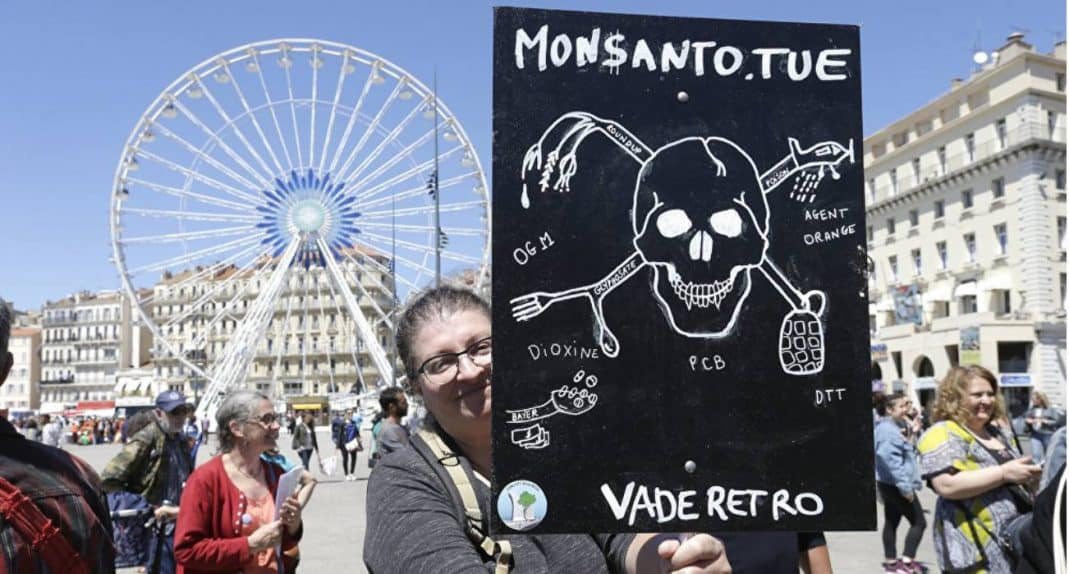
Agent Orange, White Phosphorus… Roundup: Monsanto’s Killer History in Full

Quote

A Californian court has found chemical giant Monsanto’s weedkiller caused a 46-year-old man’s terminal cancer and ordered the company to pay almost US$290 million in compensation, in a landmark ruling which could open the door to thousands of similar cases being brought the world over. For the company’s critics, the news is a long-time coming.

The jury found the firm failed to warn clients about cancer risks associated with the product’s main ingredient, glyphosate, and Judge Suzanne Ramos Bolanos ruled the company “acted with malice, oppression or fraud and should be punished”.

The 46-year-old plaintiff, DeWayne Johnson, came in contact with the substance for years as a school groundkeeper, using up hundreds of gallons at a time. He was diagnosed with non-Hodgkin’s lymphoma in 2014, a cancer affecting white blood cells, a year prior to World Health Organization concluding glyphosate was probably carcinogenic. At least 220 other actions are currently ongoing against the company in San Francisco alone, brought by similarly affected individuals.

Influencing Policy

The hazardous potential of glyphosate was well known to Monsanto, but the company went to significant efforts to suppress and/or distort its lethal potential. In 2017, it was revealed the European Food Safety Authority’s (EFSA) finding two years earlier that Roundup, glyphosate’s trade name, was safe to use was based on scientific papers heavily influenced by the company. In one instance, a paper was even written by company staff outright, and published under academics’ names.

The revelation emerged from hundreds of internal Monsanto emails released by a US court. In a February 2015 missive, then-Head of Product Safety at the firm William Heydens proposed in-house scientists write a study, and independent academics “edit and sign their names” to the document without disclosing Monsanto’s involvement, an approach he dubbed “ghostwriting”. Subsequent communications indicate it was not the first time the firm had employed the tactic, saying it was “how we handled Williams Kroes & Munro“. Claiming authorship for work done by others is a serious ethical breach in the academic community, as is not disclosing conflicts of interest.

In another, Monsanto toxicologist Donna Farmer says “you cannot say Roundup does not cause cancer” — and a separate glyphosate study was also “redesigned” with the help of company scientists, in order to create a more favorable outcome.

Both studies were used in 2015 by EFSA when it evaluated the safety of glyphosate as part of the chemical’s licence renewal process — the body concluded there was insufficient evidence glyphosate caused cancer in humans, and the chemical lacked the mechanism capable of damaging DNA in living cells and subsequent cancer in humans.

The email trove indicates the studies influenced by Monsanto deliberately ignored and downplayed glyphosate’s deleterious health implications — even staff were compelled to concede the papers “stretched the limits of credibility”. Despite this, the company paid independent toxicology consultant Dr. David Kirkland to attach his name to one of the papers to boost its legitimacy.

As a result of the disclosure, Monsanto lobbyists were banned from entering European parliament, with company officials precluded from meeting MEPs, attending committee meetings or using digital resources on parliament premises in Brussels or Strasbourg.

Controversial History

In a sense, it’s perhaps unsurprising Monsanto products have such a devastating impact on human health. The company was a leading provider of ‘Agent Orange’ to the US government, a ‘defoliant’ widely used by US forces during the Vietnam war as a highly destructive chemical weapon.

While its primary purpose was theoretically strategic deforestation, the destruction of jungle cover and food resources necessary for the  sustainability of North Vietnamese forces’ guerilla campaigns, Agent Orange’s hazardous implications for human health were well known.

Subsequent scientific research has made clear the agent’s carcinogenic nature, with even passive contact with the chemical producing devastating repercussions not merely for the individual in question, but those they come into subsequent contact with, and their offspring. A 2002 study of dioxin levels in the city of Bien Hoa, a city in southern Vietnam located near an air base used for spray missions, indicated noticeably elevated blood dioxin levels three-decades after hostilities ceased, with Agent Orange specifically found in blood samples — even those sourced from post-war emigrants to the city.

Moreover, Agent Orange is intimately connected to birth defects, with several meta-analyses of contemporary studies concluding there is a statistically significant correlation between an individual being exposed to Agent Orange at any point in their life, and their likelihood of either possessing or acting as a genetic carrier of birth

Monsanto’s prevalence in chemical warfare persists to this day, with the company providing the US — and thus Israel — with white phosphorous. The chemical weapon is extremely lethal, igniting upon contact with skin and burning until it runs out of fuel, or is cut off from oxygen. If inhaled or swallowed it can cause severe damage to mucous membranes with which it comes into contact.

Moreover, absorption through skin means even a 10 percent burn can cause damage to vital organs such as the heart, liver, or kidneys. Even after healing from an initial exposure, victims suffer from long-lasting health problems, such as birth defects and neurological damage. . .

Via Veterans Today.


Treason, Impeachment, Emoluments: This is How We Know for Certain We’re Played by the Media — O Society

Quote

Just because something is unconstitutional does not mean anything is going to be done about it. Furthermore, the mediots on TV and on the Internet news lie to us. These people either are too sloppy to do their jobs or think we’re too stupid to notice. No. Trump isn’t going to be tried, much less convicted for treason, no matter how many times CIA man CNN talking head John Brennan yells about it in Twitter.

This is all a show. The Apprentice White House Edition. No one is going to cancel this show as long as its ratings are good.

I figured this out before Trump was even inaugurated. By asking real attorneys how this stuff works.

The Constitution was set up to protect rich white landowners. Trump is a White Supremacist billionaire real estate salesman.

Do the math. It ain’t calculus, Sunshine.

Trump is who the Constitution was written for, by people like himself. By people who thought only rich white landowners have a right to have any say in how things go.

So stop the madness. Just stop it. The powers that be aren’t going to get rid of him.

Somebody might remove DJT the JFK way – but again – do the math. All the John Hinckley nutters out there love Trump.

He isn’t going to be removed from office by the Congress or Supreme Court or none of that jive.

Those are soap opera storylines sold to us by the media. They play us. The take your sense of hope and KA-CHING! sell us magical thinking.

Don’t let them play us. They have reasons to keep us sedentary full of hope someone is going to “do something about it.”

They haven’t done anything about it and they won’t.

Magical. Thinking.

For the most part, the mainstream media are National Enquirer level reporting now. Tabloids. Gossip. Celebrity trash. Infotainment.

The News section, the Sports page, the Entertainment section… they’re all the same thing now.

Editorials and Factual Statements are the same thing now.

Journalism and Op-Eds and advertising are all the same thing now.

Indistinguishable.

And because the truth was plain to the real experts with experience from the beginning of the Trump saga, this is how we know for certain the media lie to us. Selling false hope. Selling sensationalism. For big ratings and cash and prizes.

Trump isn’t the only one constantly lying…

Scofield figured it out within weeks of the election. She made me realize how the media is playing us with this “get Trump” narrative back in Dec ’16. . .

via Treason, Impeachment, Emoluments: This is How We Know for Certain We’re Played by the Media — O Society

Kushner’s Secret Plan Is To Decertify Palestinians As “Refugees”

Quote

White House Senior Advisor Jared Kushner stands with U.S.. Ambassador to the United Nations Nikki Haley at a U.N. Security Council meeting on Middle East issues on Feb. 20. (Drew Angerer / Getty Images)

White House Senior Advisor Jared Kushner stands with US Ambassador to the United Nations Nikki Haley at a UN Security Council meeting on Middle East issues on Feb. 20. (Drew Angerer / Getty Images)

Jared Kushner, US President Donald Trump’s son-in-law and senior adviser, has quietly been trying to do away with the UN relief agency that has provided food and essential services to millions of Palestinian refugees for decades, according to internal emails obtained by Foreign Policy .

His initiative is part of a leader to push by the Trump administration and its allies in Congress to strip these Palestinians of their refugee status in the region and take their issue off the table in negotiations between Israel and the Palestinians, according to both American and Palestinian officials . At least two bills now making their way through Congress address the issue.

Kushner, who Trump has charged with resolving the Israeli-Palestinian conflict, has been contacted to speak publicly about any aspect of his Middle East diplomacy. A peace plan he’s been working on with other US officials for some 18 months has been one of Washington’s most closely held documents.

But his position on the refugee issue and his animus towards the UN Relief and Works Agency for Palestine Refugees in the Near East (UNRWA) is evident in internal emails written by Kushner and others earlier this year.

“It is important to have an honest and sincere effort to disrupted UNRWA,” Kushner wrote about the agency in one of those emails, dated Jan. 11 and addressed to several other senior officials, including Trump’s Middle East peace envoy, Jason Greenblatt.

“This [agency] perpetuates a status quo, is corrupt, inefficient and does not help peace,” he wrote.

The United States has helped fund UNRWA since it was formed in 1949 to provide relief for Palestinians displaced from their homes following the establishment of the State of Israel and ensuing international war. Previous administrations have viewed the agency as a critical contributor to stability in the region.

But many Israel supporters in the United States today see UNRWA as part of an international infrastructure that has artificially kept the refugee issue alive and kindled hopes among the exiled Palestinians that they might someday return home-a possibility Israel flatly rules out.

Critics of the agency point in particular to its policy of granting refugee status not just to those who fled Mandatory Palestine 70 years ago but to their descendants as well-accounting that puts the refugee population at around 5 million , nearly one-third of whom live in camps across Jordan, Lebanon, Syria, the West Bank, and Gaza.

By trying to unwind UNRWA, the Trump administration appears ready to reset the terms of the Palestinian refugee issue in Israel’s favor-as it did on another key issue in December, when Trump recognized Jerusalem as Israel’s capital.

In the same January email, Kushner wrote: “Our goal can not be keep things stable and as they are. … Sometimes you have to strategically risk breaking things in order to get there. “

via Kushner’s Secret Plan Is To Decertify Palestinians As “Refugees”

The Elite Fixation With Russiagate

Quote

By Aaron Mate

The Nation

Helsinki Summit: Handshake between Putin and Trump

No single act of Donald Trump’s presidency has engendered more criticism than his performance at the Helsinki summit with Vladimir Putin. For declining to endorse US intelligence claims that the Kremlin meddled in our election and faulting both countries for the poor state of US-Russia relations, Trump was roundly accused of “shameful,” “disgraceful,” and “treasonous” behavior that has sparked a full-blown “national security crisis.”

But does the American public at large share the prevailing elite assessment? Save for a White House vigil led by two longtime Hillary Clinton staffers and a few scattered rallies—and in stark contrast to mass protests over Trump’s misogyny, Muslim ban, and zero-tolerance immigration policy—Americans have not poured into the streets to confront the “crisis.” A poll by The Hill and the HarrisX polling company found 54 percent support for Trump’s now-scuttled plan for a follow-up summit with Putin at the White House. An NBC News/Wall Street Journal poll found that Trump’s post-Helsinki approval rating slightly increased to 45 percent. While the uptick does not necessarily signal an embrace of Trump’s behavior, it is not difficult to see why his numbers did not plummet. In a recent Gallup poll on problems facing the country, the “Situation with Russia” was such a marginal concern that it did not even register. While an NPR/PBS NewsHour/Marist poll found that 64 percent believe Trump has not been tough enough on Russia, it also saw a near-even split on whether Putin is a foe or an ally, and 59 percent support for better relations.

The gap between elite and public priorities highlights an endemic problem that long predates Trump. Since his election, however, the elite fixation on alleged Russian meddling and the president’s suspected collusion has exacerbated that divide. . .


via The Elite Fixation With Russiagate

Marijuana Legalization Allowed Police to Better Solve Other Cases, Criminology Study Finds — Marijuana

Quote

By Valli Herman

In the states where cannabis legalization measures appeared on ballots, voters were unvaryingly presented with a simple rationale: Legalizing marijuana for all uses will free up police to combat more serious crimes.

There was one problem: The research was scant.

A new study released in the peer-reviewed criminology journal Police Quarterly on July 4, 2018, is among the first in the post-prohibition era to add evidence to that legalization argument, a boon for advocates and police departments hampered by limited resources.

The study, lead by David A. Makin, an assistant professor of Washington State University’s Department of Criminal Justice and Criminology, looked at what authorities call clearance rates to judge police efficiency. Those rates are “the ratio between the number of crimes solved and the total number of crimes recorded by the police,” the report said.

Even though legalization is fairly new, the data suggested that crime clearance rates were increasing more rapidly in states that legalized marijuana, and especially in Colorado.

“Our models show no negative effects of legalization and, instead, indicate that crime clearance rates for at least some types of crime are increasing faster in states that legalized than in those that did not,” the study said.

The most dramatic change was reflected in the steep and immediate drop in arrests for marijuana possession after legalization in late 2012.  Most of the improvements in other types of crime were incremental, with changes of 1 to 2 percent, Makin told Marijuana.com.

“People tend to focus so much on percentages. When you are dealing with the volume of crimes that states report, when you look at a 1 percent change, that is really a large number of offenders being apprehended,” he said.

The overall trend is encouraging, however.

Figure 1. Marijuana possession arrest rate, police agencies reporting drug arrests all 12 years from 2004 to 2015, Colorado, Washington, and states outside the Pacific census region. Includes 86 Colorado police agencies (serving 79.7% of the state’s 2015 population), 131 Washington police agencies (serving 57.8% of the state’s 2015 population), and 6,242 police agencies outside of the Pacific region (serving 56.6% o f the population) that reported drug arrests for all 12 years.

“Specific to public safety, advocates of legalization expected improvements in police effectiveness through the reduction in police time and attention to cannabis offenses, thus allowing them to reallocate resources to more serious offenses,” the study said.

Those offenses included rape, robbery, aggravated assault, burglary, larceny and motor vehicle theft. The authors found statistically significant improvements in clearance rates for those and other crimes. . .

via Marijuana Legalization Allowed Police to Better Solve Other Cases, Criminology Study Finds — Marijuana

High Crimes and Misdemeanors – Not by Trump but Obama and Democrats

Quote

By Ajamu Baraka | Black Agenda Report | July 25, 2018

Increasing evidence emerges that confirms what ex-CIA analyst Ray McGovern suggests was a classic off-the-shelf intelligence operation initiated during the last year of Obama’s presidency against the Trump campaign by employees of, and others associated with, the CIA, FBI, and the NS. Yet the public is being counseled to ignore possible proof of state misconduct.

The historic and unprecedented timing of Special Counsel Robert Mueller’s indictment of twelve Russia military intelligence officers on the eve of Trump’s meeting with Putin, was clearly meant to undercut Trump’s authority. This still did not pique the journalistic curiosity of an ostensibly independent press to at least pretend to question the possible motivation for these indictments at such a specific moment. Instead of critical questions, Democrats, along with the corporate liberal media, flipped the script and suggested that those questioning the allegations of Russian manipulation of the 2016 U.S. elections, which supposedly included the active or tacit support of the Trump campaign, was ipso-facto evidence of one’s disloyalty to the state — if not also complicit with implementing the Russia inspired conspiracy.

This narrative has been set and is meant to be accepted as veracious and impermeable to challenges. Powerful elements of the ruling class, operating with and through the Democratic party in an attempt to secure maximum electoral success, decided that Trump’s alleged collusion with Russia shall be the primary narrative to be utilized by Democrats — from the increasing phony opposition represented by the Sanders wing of the party, to the neoliberal, buck-dancing members of the Congressional Black Caucus. All are expected to fall in line and do the ruling class’s bidding.

When Trump met with the arch-enemy Vladimir Putin in Helsinki and didn’t declare war on Russia for conspiring against Clinton, charges of treason were splashed across the headlines and editorial pages of the elite press with some of the loudest denunciations coming from Black liberals.

Not being at war with Russia, at least not in the technical sense, was just one of those inconvenient facts that didn’t need to get in the way of the main objective, which was to smear Trump.

And while evidence of collusion continues to surface, it’s actually not between Trump and the Russians, rather it’s between intelligence officials in the Obama administration and the Clinton campaign. The latest revelation of this evidence was reported by John Solomon in, The Hill, a Washington insider publication. According to Solomon, former FBI attorney Lisa Page gave testimony to the House Judiciary committee that seemed to confirm the partisan intentions of Peter Strzok and other high officials in the agency.

Page was one of the authors of the infamous text messages between her and Peter Strzok (the two were also in a personal relationship at the time) while they both worked together at the FBI. The texts soon became the objective of endless speculation ever since they were revealed last summer. Exchanges shared between Strzok and Page during the 2016 campaign season, appear to point to Strzok’ participation in a vast conspiracy to gather intelligence on the Trump campaign and then to undermine his presidency on the unexpected chance of his election. . .

via High Crimes and Misdemeanors – Not by Trump but Obama and Democrats

Ukraine Furious After Italy’s Salvini Calls 2014 Revolution “Fake” And “Foreign-Funded”

Quote

Ukraine has summoned the Italian Ambassador to Ukraine Davide La Cecilia over a statement made by the Interior Minister of Italy Matteo Salvini (whose League political party is now the most popular in Italy) on his recognition of the annexation of Crimea by Russia and his slamming the 2014 Euromaidan protests and coup in Kiev as “pseudo-revolution” sponsored from abroad.

“We are responding. On Monday, we will meet with the Italian ambassador. He is a very nice person. I understand that he cannot be responsible for the words of their politicians, especially given that that one politician went to Crimea and just returned from Moscow, where, according to our information, he met with Putin,” Olena Zerkal, Ukrainian Deputy Foreign Minister, told the local Channel 5 on Friday.”

Ukraine was infuriated by Salvini’s comments made during his interview with the Washington Post, published earlier this week. WaPo senior associate editor Lally Weymouth tried to grill the minister over his support for Crimea’s return to Russia, calling the referendum that took place in Crimea in 2014 “fake.”

Q. You said that Russia had a right to annex Crimea?
A. There was a referendum.
Q. It was a fake referendum.
A. [That is your] point of view. . . . There was a referendum, and 90 percent of the people voted for the return of Crimea to the Russian Federation.

Salvini shot back, saying “compare it to the fake revolution in Ukraine, which was a pseudo-revolution funded by foreign powers – similar to the Arab Spring revolutions” adding that “There are some historically Russian zones with Russian culture and traditions which legitimately belong to the Russian Federation.”

Ukraine’s Foreign Ministry angrily responded that Salvini words were “not grounded in real facts and in contradiction of recognized principles and norms of international law.”

Zerkal also downplayed Salvini’s words on Friday by saying that “it was hard to expect any different rhetoric from him,” following the “pro-Russian” Salvini’s recent visit to Crimea as an Italian lawmaker.

The tension goes back to the February 2014 “Maidan” revolution, when then-president Viktor Yanuvkoich was overthrown in a violent, US-assisted coup d’etat. Obama’s Assistant Secretary of State, Victoria Nuland, made numerous trips to Kiev to telegraph US support for the anti-Yanukovich protesters, and was even spotted handing treats to the demonstrators, boasted that Washington had invested $5 billion into the promotion of democracy in Ukraine. In the now infamous leaked recording in which the Asst. State Secretary said “Fuck the EU” over the Union’s lack of support for the US strategy, Nuland was revealed as the mastermind behind the Ukraine unrest.

Victoria Nuland hands out bread to protesters at Independence square in Kiev December 11, 2013.

The new pro-Western government sent tanks to eastern Ukraine in spring 2014 where the population refused to recognize the coup, at which point Russian soldiers were dispatched to Crimea – a critical chokepoint for the US navy – which held a referendum that saw the local population vote overwhelmingly to join Russia.

In response, the US and the EU accused Russia of annexing Crimea and stoking the conflict in Donbass, as they slapped Moscow with several waves of sanctions targeting individuals, companies and whole sectors of economy. The animosity between the US State Department, if not so much the US president, and Ukraine continues to this day.

And while most of Europe had strictly adhered to the conventionally-accepted western narrative, the statement by Salvini indicates that as Europe is washed over by a populist wave, recent history is also being reassessed. . .

via Ukraine Furious After Italy’s Salvini Calls 2014 Revolution “Fake” And “Foreign-Funded”

Electric cars won’t make Seattle green

Quote

There’s still a window where we can limit global warning to 1.5 C rather than 2 C. As David Roberts notes in that article, that half a degree means saving hundreds of millions of lives, prevents inundations of some islands and coastal areas, not to mention the affects on the wider environment. That half a degree seems worth it to me.

What would it mean for Seattle to meaningfully contribute to hitting that number? The main thing we need to do is electrify everything, with the underlying energy generated in a carbon neutral way. In Seattle, our utilities are already pretty good. All but a few percent of our power comes from renewable or non-emitting sources. Transportation and building energy use our are “big” sources:

seattle_carbon_emissions_2014

Half is due to passenger vehicles. This includes our diesel buses, but over 95% of our emissions are due to cars and trucks, not mass transit (see table 1 in this document). Clearly the single biggest way Seattle can help save hundreds of millions of lives worldwide is to drive carbon emissions due to passenger transportation to zero as fast as we can. How fast? Some folks say the United States needs to be carbon free by 2035 to have any hope of holding warming to 1.5C (and the rest of the world by 2050). What would it mean for “passenger transport” in Seattle to not pollute carbon by 2035?

Clearly we will need to electrify all our public transportation. We’re well on the way to that. The light rail and streetcars are already electrified. King County metro has numerous electric trolley buses and is planning to have an all-electric fleet. I believe we’ll manage to electrify public transit rapidly.

I am not so sure we’ll take all the gas-powered cars off the road. Earlier this year, Seattle Mayor Durkan announced a climate plan. The near term action summary was, in my opinion, pretty unambitious for an incredibly wealthy city. In summary, the actions relevant to transportation are (see table 1):

  • Congestion pricing. However, I’m told by many that a mere pilot pricing program is years away.
  • Electric car charging stations.
  • Requiring new buildings to have electric car charging facilities.
  • Encourage for-hire cars to electrify.
  • Electrify city-owned vehicles.

That’s it. 2035 is not very far away. No actions mention transit or walking or biking. Somehow cars will just magically become electrified.

But what would it mean to replace all gas powered cars traveling in Seattle with electric ones? Let’s leave out folks just driving through on I-5 since we can’t actually do anything about that. How many gas powered cars are there anyway? The state doesn’t provide per city data (I emailed for it) but they have reports with county data online. There are about 1.5 million gas powered non-commercial cars and trucks registered in King County in 2017. Lest you overestimate the prevalence of those flashy Teslas, less than a percent of cars and trucks are electric already.

I would hazard to guess that two thirds or more of those vehicles travel in Seattle at least sometimes. Gene Balk estimated in 2017 that the car “population” of Seattle is around 435,000 (cars registered to residents of Seattle). On any given day, many more cars drive into the city from (mostly King County) cities and towns. So let’s be generous and say there are a 750,000 gas cars or trucks that regularly drive in Seattle.

To hit that 2035 number, every one of those cars has to be trashed – meaning they can’t be sold and driven by someone else – and replaced with a fully electric car. I did some quick research and a smallish electric car (four door) costs about $27,000 (before options or taxes). Let’s be conservative and say that over the next decade or so the average cost of an electric car goes down to $20,000 in today’s dollars. I think this is pretty unrealistic for a lot of reasons, not least the huge amount of demand will cause an upsurge in prices for everything involved in electric car manufacturing, but let’s go with that because I like round numbers. (Savvy readers will also note I’m completely glossing over the carbon pollution from car manufacturing.)

Replacing 750,000 cars would thus cost $15 billion. With a B. Now, who is going to pay this? Even if your family can afford it, would you want to replace you relatively new Prius hybrid with a fully electric one? Because even those are polluting. You’re going to need an incentive, and a pretty strong one, to be willing to spend $20k. If you can’t afford a new car, why would you replace it at all? We aren’t going to just tax the poor until they give up their polluting cars (who am I kidding – we might). But the point is, if we are serious about replacing all those carbon polluting cars with electric ones, then the city will have to plan to spend a substantial portion of that $15 billion (note that Seattle’s yearly city budget is currently only about $6 billion, half of which is the city utilities). In, say, the next ten years.

Or we could instead (off the top of my head) take meaningful near term actions:

  • Start prioritizing transit for real: bus lanes for any route on an arterial and certainly any route with 15 minute or greater frequency.
  • Accelerate building out Sound Transit light rail by funding it more.
  • Congestion pricing now.
  • Legalize denser development everywhere in the city, as the vast majority of Seattle is near frequent transit.
  • Real efficiency standards for construction.
  • … And subsidize electric car purchases for low income families, at some point probably.

These would still cost a lot of money, but then we’d be investing in public goods, not subsidizing private ownership of cars that will still be dangerous to everyone using our streets, even if they aren’t as polluting. . .

via Electric cars won’t make Seattle green — Fancy Beans