A CIA lucky break? How suspicious death of the ‘Smiling Pope’ helped Washington win the Cold War

Quote


By Neil Clark | RT | September 28, 2018

The sudden death of Pope John Paul I, exactly 40 years ago today, stunned the world. The ‘Smiling Pope’ had only served for 33 days. His demise and replacement by John Paul II marked an important turning point in the old Cold War.

The year 1978, as I argued in a previous op-ed, was the year today’s world was made.

There was nothing inevitable about the ascendancy of Reagan and Thatcher, the rise of groups like Al-Qaeda and IS, and the downfall of the Soviet Union. The neoliberal, neoconservative world order and its associated violence came about because of key events and decisions which took place 40 years ago. The Vatican was at the heart of these events.

The drama which unfolded there in the summer of 1978 would have been rejected as being too far-fetched if sent in as a film script. In a space of two and a half months, we had three different Popes. There was no great surprise when, on August 6, the first of them, Pope Paul VI, died after suffering a massive heart attack. The Supreme Pontiff, who had served since 1963, was 80 and had been in declining health. But the death of his much younger successor, John Paul I, a radical reformer who wanted to build a genuine People’s Church, has fuelled conspiracy theories to this day.

Cardinal Albino Luciani, the working-class son of a bricklayer (and staunch socialist), from a small town in northern Italy, was a Pope like no other. He refused a coronation and detested being carried on the sedia gestatoria – the Papal chair. He hated pomp and circumstance and pretentiousness. His speeches were down to earth and full of homely observations, with regular references to popular fiction. He possessed a gentle humor and always had a twinkle in his eye. He was by all accounts an incredibly sweet man.

But there was steel there, too. Luciani was determined to root out corruption, and to investigate the complex financial affairs of the Vatican’s own bank, and its connection to the scandal-hit Banco Ambrosiano.

While he had declared communism to be incompatible with Christianity, his father’s egalitarian ethos stayed with him. “The true treasures of the Church are the poor, the little ones to be helped not merely by occasional alms but in the way they can be promoted,” he once said. At a meeting with General Videla of Argentina, he made clear his abhorrence of fascism. “He talked particularly of his concern over ‘Los Desaparecidos’, people who had vanished off the face of Argentinian earth in their thousands. By the conclusion of the 15th minute audience the General began to wish that he had heeded the eleventh-hour attempts of Vatican officials to dissuade him coming to Rome,” noted David Yallop in his book ‘In God’s Name’.

One cleric, Father Busa, wrote of John Paul I: “His mind was as strong, as hard and as sharp as a diamond. That was where his real power was. He understood and had the ability to get to the centre of a problem. He could not be overwhelmed. When everyone was applauding the smiling Pope, I was waiting for him ‘tirare fuori le unghie’, to reveal his claws. He had tremendous power.”

But John Paul I never lived to exercise his “tremendous power.” He was found dead in his bed on the morning of September 28, 1978. The official story was that the ‘Smiling Pope’ had died from a heart attack. But it wasn’t long before questions were being asked. John Paul I was only 65 and had appeared to be in fine health. The fact that there was no post-mortem only added to the suspicions. “The public speculation that this death was not natural grew by the minute. Men and women were heard shouting at the inert form: Who has done this to you? Who has murdered you?” wrote David Yallop.

David Yallop revealed that on the day of his death, the Pope had discussed a reshuffle of Vatican staff with Secretary of State Cardinal Jean Villot, who was also to be replaced. Yallop claimed that the Pope had a list of a number of clerics who belonged to the Freemasons, membership of which was strictly prohibited by the Church. The most sinister of these Masonic lodges was the fiercely anti-communist Propaganda Due (P2), which held great influence in Italy at this time, being referred to as a “state within a state.” The murky world of P2, and its leaders’ links with organized crime, the Mafia and the CIA is discussed in ‘In God’s Name’.

Another writer, Lucien Gregoire, author of ‘Murder by the Grace of God’, points the finger of blame squarely at the CIA. He notes a seemingly strange coincidence, namely that on September 3, 1978, just 25 days before the Pope himself died, Metropolitan Nikodim, the visiting leader of the Russian Orthodox Church, who was later revealed to have been a KGB agent, fell dead at John Paul’s feet in the Vatican after sipping coffee. He was only 48. Gregoire says that the CIA dubbed John Paul I ‘the Bolshevik Pope’ and was keen to eliminate him before he presided over a conference the Puebla Conference in Mexico. “Had he lived another week, the United States would have been looking at a half a dozen mini-Cubas in its back yard,” he writes. . .

via A CIA lucky break? How the death of the ‘Smiling Pope’ helped Washington win the Cold War
North Korea Supports Seoul’s Idea to Hold First Inter-Parliamentary Meeting

Quote

Sputnik – 27.09.2018

North Korea supported on Thursday South Korea’s initiative to organize the first bilateral inter-parliamentary meeting before the end of the year.

The Yonhap news agency reported that the meeting was suggested by Speaker of the South Korean National Assembly Moon Hee-sang.

“The role of the Koreas’ parliaments and political parties is very important in implementing the April and September inter-Korean summit agreements. In this regard, we agreed to the offer in principle,” Chairman of the North Korean Supreme People’s Assembly Choe Thae-bok said in a letter to Moon, which was quoted by the agency.

According to the news outlet, the date of the meeting is expected to be set during high-level government negotiations in the near future.

Earlier in September, South Korean President Moon Jae-in and North Korea leader Kim Jong Un held the third inter-Korean summit, during which the two sides reached a number of agreements on Pyongyang’s military and nuclear facilities and the connection of two of Korea’s roads and railways. Pyongyang and Seoul also signed an accord aimed at the enhancement of mutual trust.

via North Korea Supports Seoul’s Idea to Hold First Inter-Parliamentary Meeting

Guardian: Americans: the next climate migrants

Quote


By

VT Senior Editors

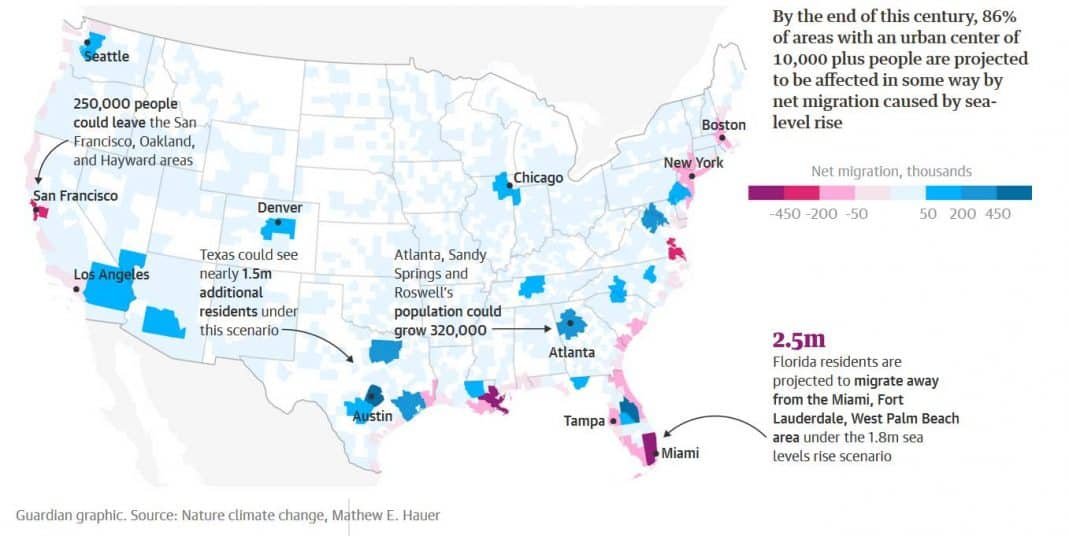
By the end of this century, sea level rises alone could displace 13 million people. Many states will have to grapple with hordes of residents seeking dry ground. But, as one expert says, ‘No state is unaffected by this.’

Boineau is leaving behind a handsome, early 20th-century house in Charleston, South Carolina, the shutters painted in the city’s eponymous shade of deep green. Last year, after Hurricane Irma introduced 8in of water into a home Boineau was still patching up from the last flood, local authorities agreed this historic slice of Charleston could be torn down.

“I was sloshing through the water with my puppy dog, debris was everywhere,” she said. “I feel completely sunken. It would cost me around $500,000 to raise the house, demolish the first floor. I’m going to rent a place instead, on higher ground.”

Millions of Americans will confront similarly hard choices as climate change conjures up brutal storms, flooding rains, receding coastlines and punishing heat. Many are already opting to shift to less perilous areas of the same city, or to havens in other states. Whole towns from Alaska to Louisiana are looking to relocate, in their entirety, to safer ground. . .

Veterans Today via


Guardian: Americans: the next climate migrants — peoples trust toronto

129 countries support Trump’s war on drugs, but not New Zealand

Quote

Reuters: Some 129 countries sign up to Trump’s pledge at U.N. to fight drugs Some 129 countries at the United Nations signed on to a U.S.-drafted pledge to fight the global drug problem on Monday that U.S. President Donald Trump warned presented a public health and national security threat.

In order to attend the brief the brief U.N. event with Trump, countries had to sign the one-page “call to action on the world drug problem.” Trump held a similar event at the annual gathering of world leaders in New York last year, focused on U.N. reform.

Countries signing the nonbinding U.S. statement pledged to develop national action plans to reduce demand for illicit drugs through education, expand treatment efforts, strengthen international cooperation on justice, law enforcement and health, and cut off the supply by stopping production.

“If we take these steps together, we can save the lives of countless people in all corners of the world,” Trump said in brief remarks.

“Illicit drugs are linked to organized crime, illegal financial flows, corruption and terrorism. It’s vital for public health and national security that we fight drug addiction and stop all forms of trafficking and smuggling that provide the financial lifeblood for vicious transnational cartels,” he said.

But New Zealand gets a mention in opposition:

Among countries that did not sign the U.S. drugs pledge was New Zealand. Prime Minister Jacinda Ardern noted that the United States itself was particularly focused on tackling opioids.

“We have a number of challenges that are quite specific to New Zealand and the particular drugs that are present, but also on taking a health approach. We want to do what works and so we’re using a strong evidence base to do that,” Ardern told reporters on Sunday. . .

via 129 countries support Trump’s war on drugs, but not New Zealand — Your NZ

RAND Corp. Study Reveals US Military Mission In Africa A Near Total Failure

Quote

Kenya an exception to failure of US military aid in Africa, study finds


Recce Squad members called in to flush an armed thug out of a house in Muthaiga, Nairobi in 2014. PHOTO | FILE | NATION MEDIA GROUP NATION


In Summary

  • Assessment shows US military aid to African countries appears to have actually worsened conflicts during the Cold War era.
  • Kenya is cited as a seemingly rare example of an African country whose security forces have performed more effectively as a result of US assistance.
  • Study says GSU performed more competently than other units responding to the Westgate Mall attack in 2013.

Advertisement By KEVIN J. KELLEY,  NEW YORK,

US assistance to security forces in African countries has failed to quell political violence on the part of insurgents or terrorists, a think tank has concluded in pair of new studies.

The analyses conducted for the US Defence Department and the US Africa Command reveals that multi-billion-dollar efforts during the past 25 years to train national security forces in Africa have been “highly inefficient.”

During the Cold War era, US military aid to African countries appears to have actually worsened conflicts, the assessment adds.

But when provided in conjunction with United Nations peacekeeping operations, US military aid “has had a significant impact on the incidence of political violence,” adds the assessment carried out by the California-based Rand Corporation.

RARE EXAMPLE

The studies do not examine specific conflicts, but Kenya is cited in one of the analyses as a seemingly rare example of an African country whose security forces have performed more effectively as a result of US assistance.

“The Kenyan security units that have worked closest with US officials have demonstrated their capacity for counterterrorism, including in challenging contexts,” this evaluation finds. Kenyan troops that received US training “performed well in Amisom operations — for example, successfully retaking territory from Al-Shabaab,” the Rand study team adds.

In addition to supporting KDF contingents deployed in Somalia, the US has focused on enhancing the capacity of Kenyan police, including through the creation of specialised anti-terrorism units, this country-specific report notes.

RECCE SQUAD

US assistance has also been directed to institutional police reforms following the 2007-2008 “outbreak of communal violence in which the police were heavily implicated,” the study says.

“Similarly,” the study adds, “the elite paramilitary police General Services Unit, which has received substantial US support, performed more competently than other units responding to the Westgate Mall attack in 2013, although the overall security forces’ response was plagued by ‘significant shortcomings’.”

Kenyan police forces became “less politicised and more professional” due in part to US assistance from 2008 to 2013, “resulting in better performance in the 2013 elections,” the Rand assessment states.

“Also, some evidence suggests that, following US training, the Anti-Terrorism Police Unit is carrying out fewer extrajudicial killings, collecting better evidence, and making more arrests than in the past.”

SHORTCOMINGS

The study acknowledges, however, that there are continuing reports of human rights abuses by this and other Kenyan security units.

Moreover, the country’s current leadership “appears to be backsliding on some of the reforms made since 2008.”

Stephen Watts, an author of both Rand studies, tempered the positive appraisal of KDF operations in Somalia following a query from the Nation. . .


via RAND Corp. Study Reveals US Military Mission In Africa A Near Total Failure

Amazon Is Going to Drown Us in Alexa Crap

Quote

The battle to listen to you all the time lol

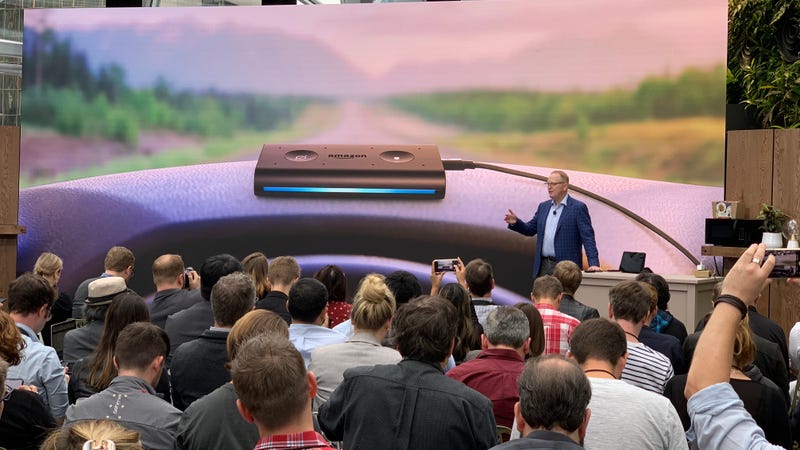
The digital assistant wars are in full swing, and with Google just recently notching the latest victory by finishing Q2 with the top-selling smart speaker in the world, Amazon is revamping its Alexa-powered roster in a very big way.

At the start of its presentation, Amazon’s devices head David Limp set the tone by saying the company had around 70 new devices to talk about, and only an hour to do it. Limp then launched into talking about Amazon’s recent upgrades to Alexa, which in the U.S. includes making Alexa both more opinionated and more approachable for children and adults.

Now, Alexa will know when to whisper a reply back, for those situations when you’re trying not to disturb others, and starting today, Amazon is adding routines to the Echo Dot Kids Edition to help parents create custom Alexa commands for their children.

But the big reveal for Amazon are all the new Echo devices, headlined by an all-new Echo Dot. While the new Dot is retaining its affordable $50 price tag, it sports a new, rounded fabric-covered body with “louder and clearer” sound and both Bluetooth and line-out connectivity.

To help supplement the Dot, Amazon also created the even cheaper (and thinner) Echo Input, which lacks speakers and is instead meant to be plugged directly into existing home audio solutions similar to Google’s Chromecast Audio. Not coincidentally, the Echo Input costs $35, the same as a Chromecast Audio.

And for those who want to augment their speaker setups with a little more thump, Amazon also announced the $130 Echo Sub, which can be used for multi-room audio and synced with a pair of standard Echoes to create your own 2.1 system.

Of course, the audio rabbit hole goes much deeper than just speakers and subs, so Amazon went and made the $200 Echo Link and $300 Echo Link Amp. Neither of these are meant to be standalone products and they don’t include a microphone. Instead, they connect to other Echo speakers and include a dial to help control and fine tune your audio, or in the case of the Echo Link Amp, help boost your sound quality.

But we’re still not done yet, because in an apparent move to better compete against the HomePod and the Google Home Max, Amazon also announced the $150 Echo Plus, which looks vaguely like a HomePod with a blue light ring up top and a built-in smart home hub inside.

On top of featuring better compatibility for smart home gadgets, the Echo Plus has what Amazon is calling Local Voice Control, which means that commands made to devices in your house no longer need to be sent to the cloud before making something happen.

But what about all your existing “dumb” gadgets, you say? Well, Amazon thinks it has a solution for that too with the new $25 Amazon Smart Plug, which plugs into a traditional outlet and lets you turn devices on and off simply by asking Alexa. And to make sure setting all of these devices up is as hassle-free as possible, Amazon is touting a simple setup process that lets you rename a device with your voice during your initial install. . .

via Amazon Is Going to Drown Us in Alexa Crap

Dear Republicans, Your Dark Money Days Are About To Hit A Roadblock

Quote

Could the Republican Party be in receipt for even more negative news? Yes, as many donors of dark monies, (monies they can donate for political purposes anonymously), will have the cloak of anonymity taken away. Again, the courts have stepped in to rule that many of these donors will have to reveal their names to the public, even before the November 2018 elections.

Here is the rest of the story… 

On September 18, 2018, Paul Blumenthal of HuffPost penned the following report, “Dark Money Groups Will Have To Disclose Their Donors In Time For The Midterms” (“A court order invalidating a rule that kept some election spending secret is going into effect.”)

Excerpts:

“There may be a whole lot less dark money in federal elections after the Supreme Court allowed a lower court decision to go into effect on Tuesday invalidating a key regulation that created a loophole for undisclosed spending.”

Image result for photos of americans for prosperity

“The decision came about after Citizens for Responsibility and Ethics in Washington, a liberal watchdog group, fought for the past six years to get the Federal Election Commission to enforce campaign finance laws against Crossroads GPS, a conservative nonprofit group founded by Karl Rove, a senior adviser to George W. Bush when he was president. CREW finally won its battle on Tuesday.”

“As of Sept. 18, any group that runs an independent expenditure ― election ads that expressly call for the election or defeat of a candidate ― in excess of $250 will have to disclose all political donors above $200″. . .
via Dear Republicans, Your Dark Money Days Are About To Hit A Roadblock

Ralph Nader: Questions, Questions Where are the Answers?

Quote

By Ralph Nader  In the Public Interest  September 18, 2018


In an oft-reported exchange between Gertrude Stein, an American widely known for her wisdom and glittering 1920s Parisian literary salon, and one of her earnest admirers, the admirer asked her – “What are the answers, Madame Stein?” She replied “What are the questions?”

Within our media/political/corporate culture of self-censorship and taboo topics, we should restate Ms. Stein’s rejoinder—what are the questions of gravity and relevance that are chronically unasked?

Here are some questions that should be asked, until answered!

  1. Why are Supreme Court nominees, including Judge Brett Kavanaugh, not asked by the Senate Judiciary Committee about corporate crime, tyrannical, one-sided fine print contracts, weakened tort law and U.S. violations of constitutional and international law affecting all Americans?”
  2. Why do reporters and elected and regulatory officials decline to ask questions about peer-reviewed studies concluding a minimum of 250,000 Americans are losing their lives every year due to preventable problems in hospitals? (see Johns Hopkins University School of Medicine’s May 2016 report). Five thousand fatalities a week on the average plus many more preventable injuries and illnesses should be an ongoing subject of urgent inquiry for action.
  3. Computerized billing fraud is rampant. Last year in the health care industry alone, computerized billing fraud amounted to about $350 billion dollars. The leading expert, Harvard’s Malcolm Sparrow, and a Congressional GAO report estimate at least 10% of all health expenditures are a result of fraudulent billings. Why aren’t the TV networks, PBS and NPR, and the major newspapers all over this massive ongoing heist?
  4. Sanctions imposed on foreign agencies and personnel are flying out of Washington. What are these sanctions, how are they enforced, are they legal under international law, is there any due process to protect the innocent or indirect victims, and how are they countered? There are regular stories about the U.S. government announcements of sanctions, but no follow-up questions about this burgeoning unilateral foreign policy.
  5. The Taliban is composed of no more than 30,000 to 35,000 fighters without an air force, navy or heavy ground armor. Why are they holding down for over a decade U.S. forces and their allies many times their number, with advanced weaponry, and enlarging their territorial control? Is it because expelling foreign invaders motivates their astonishing determination? And who are all those suicide bombers and what is motivating them to stand in line waiting for the call?
  6. Why has the Congressional scrutiny of the wasteful, unauditable military budget crumbled as never before with the Democrats voting for more money than even Trump initially asked for in the last funding cycle? Over 50 percent of the federal government operating expenses goes to defense? Both parties act as if adequate money for infrastructure repair in this country is nowhere to be found.
  7. Why aren’t the hundreds of full-time reporters covering Congress demanding to know why members, or their staff, routinely do not reply to substantive letters, calls, or e-mails, without constant hammering by citizens? The exception is if you are a campaign donor. Why are Congressional offices often so unavailable during working hours? If you are lucky you can leave a message on the office voicemail. Inside the heavily guarded Russell Senate Office Building, Senator Rand Paul (R-KY) even locks the door to his suite of offices.
  8. Similar non-responsiveness holds true with government agencies in the executive branches at the federal and state levels. A group of citizens, including me, has been waiting for months to get a reply from the Justice Department about their request for the Department‘s position on starting a long needed corporate crime database. One would think that newspapers, begging for readers, would do regular, random surveys of these agencies who, after all, work for the people they are shutting out. Small wonder citizens are turned off government when they can’t get through to get answers to their critical inquiries. . .

via Ralph Nader: Questions, Questions Where are the Answers?

Despite US Opposition, Joint Liaison Office Opens On Shared Korean Border

Quote

By Tyler Durden – Zero Hedge – 09/15/2018

On Friday an unprecedented development occurred that could put the Korean peninsula on a permanent trajectory of stability should talks between the North and South continue their positive direction, and which signals an intensification of diplomacy between the two.

South Korea has opened a new liaison office in the North Korean city of Gaeseong (or alternately Kaesong), which is to allow for 24-hour communication between the two sides for first time since war. The office is located inside an industrial park and Gaeseong is just inside the North’s side of the border.

It’s being described as allowing “around-the-clock” communication between rival officials on either side the military demarcation line, and could avoid the potential for future misunderstandings or provocations, and further comes amidst a parallel diplomatic push by the United States and its allies for complete North Korean denuclearization.

When the proposal was being finalized this summer, however, the US was opposed to the plan, with the State Department last month saying progress between the two Koreas must occur “in lockstep” with talks on the north’s denuclearization.

According to Bloomberg:

The Aug. 20 announcement of the office’s establishment had raised concerns in the U.S. about whether it would violate sanctions meant to penalize Pyongyang over its nuclear arsenal. But on Thursday, the United Nations Command said it had approved South Korean vehicles and personnel to cross the border into North Korea and begin constructing a communications center at the Gaeseong complex.

Meanwhile the United Nations welcomed the development, with UNC commander Vincent Brooks saying in a statement that communication between two sides is “a way to prevent incidents or crises.”

About 50 South Korean officials crossed into the North to attend the opening ceremony, where South Korean Unification Minister Cho Myoung-gyon told ceremony attendees, “A new chapter in history is starting here today,” and added, “It is a symbol of peace made jointly by South and North Korea.”

The two sides agreed to open the office during the prior historic April summit between South Korean President Moon Jae-in and North Korean leader Kim Jong Un, with the two again set to meet in Pyongyang next week. And meanwhile the White House is reportedly working toward plans for another meeting between President Trump and the North Korean leader.

But even though outlets like the New York Times reported the joint liaison’s office as a positive step in relations, much of the reporting this week has failed to recall that Washington firmly opposed it


via Despite US Opposition, Joint Liaison Office Opens On Shared Korean Border

Treat the Inflammation not the Cholesterol

Quote

dr-dwight-lundell

Dr. Dwight Lundell, former Chief of Staff and Chief of Surgery at Banner Heart Hospital in Arizona told the world not to take statin drugs.  “We physicians with all our training, knowledge and authority often acquire a rather large ego that tends to make it difficult to admit we are wrong. So, here it is. I freely admit to being wrong. As a heart surgeon with 25 years experience, having performed over 5,000 open-heart surgeries, today is my day to right the wrong with medical and scientific fact.

His frontal attack on the field of cardiology tears apart the practice of prescribing medications to lower cholesterol and a diet that severely restricted fat intake. Doctors in this field have been continually bombarded with scientific literature, continually attending education seminars, all of which insisted heart disease resulted from the simple fact of elevated blood cholesterol. They were wrong. Unfortunately for too many people—dead wrong.

Dr. David Brownstein has debated publically about this issue and many people do recognize how off base the world of cardiology actually is. I have gone as far as writing an essay telling people to run from their statin prescribing cardiologist. And I have written an essay about The Statin Disaster and the recent increasing recommendation and prescription of this quite useless drug.

We know that inflammation in the artery wall is the real cause of heart disease. Simply stated, without inflammation being present in the body, there is no way that cholesterol can accumulate in the wall of the blood vessel and cause heart disease and strokes. Without sufficient magnesium in the body inflammation results and it is the inflammation that causes cholesterol to become trapped.

Magnesium, not statin drugs should be the foundation drug of for the prevention and treatment of heart disease, diabetes, and arteriosclerosis; it serves as a natural calcium antagonist, normalizes blood pressure and irregular heartbeat. Magnesium is The Ultimate Heart Medicine!

What are the biggest culprits of chronic inflammation? Quite simply, they are the overload of simple, highly processed carbohydrates (sugar, flour and all the products made from them) and the excess consumption of omega-6 vegetable oils like soybean, corn and sunflower that are found in many processed foods. Low magnesium though is the most basic culprit as is excessive irregular breathing, which reduces both CO2 and O2 levels in the body, both of which cause systemic inflammation. . .

via Treat the Inflammation not the Cholesterol