U.S. House Speaker Touts Benefits of CBD and Industrial Hemp

Quote

The top Republican in the U.S. House has issued a surprise endorsement of a key marijuana ingredient’s medical benefits, as well as the uses of industrial hemp.

“It has proven to work,” Republican House Speaker Paul Ryan said of cannabidiol (CBD) on Oct. 30, 2018, specifying that it “helps reduce seizures.”

“We do this in Wisconsin,” he said, referring to his home state’s limited CBD law. “That that oil, I think works well.”

The speaker, who is not running for re-election and is retiring from Congress early next year, shared that his own mother-in-law used a synthetic form of cannabinoids, presumably the tetrahydrocannabinol (THC) pill Marinol, while dying from melanoma and ovarian cancer.

“That’s off the record,” he said jokingly, referencing TV cameras at the well-attended Kentucky rally where he was appearing in support of Republican Rep. Andy Barr, who is locked in a tight re-election race.

Ryan, responding to a medical marijuana question from a woman whose husband died, also proactively took the opportunity to speak up in support of industrial hemp.

“And by the way, there’s a lot of industrial uses for hemp that I understand from talking to Mitch McConnell is a big deal to Kentucky agriculture,” he said. “And we’re all in favor of that as well.”

Ryan’s endorsement for hemp comes at a key time. Congressional leaders are currently negotiating differences in the House and Senate versions of the Farm Bill. The Senate proposal contains language championed by McConnell, the GOP majority leader, that would legalize hemp. The House bill has no such provisions.

If the top Republican in either chamber is now vocally in support of ending the prohibition on marijuana’s non-intoxicating cousin, it seems more and more likely that the House will accept the Senate’s hemp language. . .

via U.S. House Speaker Touts Benefits of CBD and Industrial Hemp — Marijuana

The UN Has Become a Mercenary Organization Serving US Interests

Quote

FNA, Tehran
https://i1.wp.com/www.islamedianalysis.info/wp-content/uploads/2017/03/Yemen-AFP-Getty-v2.jpg

Political analyst Shabbir Hassanally says the UN has become “a means to legitimize the corruption and excesses of the American regime on humanity”.

Mr. Hassanally, in an exclusive interview with FNA, said that the UN is totally complicit with the genocide of the Yemeni people, and it is possible that the situation in Yemen “would be the final nail in the coffin of the corrupt and impotent United Nations.”

The analyst also said that the Saudi-led coalition’s deliberate targeting of civilians is aimed at making the Yemeni people move against the resistance movement.

Shabbir Hassanally is an Islamic Scholar and political analyst. Mr. Hassanally lectures at various Islamic Centers from time to time and is currently working on a book on the commonalities between Zionism and Wahhabism – from a political and hegemonic perspective, as well as examining historical parallels between the two. He also consults on subjects related to human rights, activism, Islam, anti-sectarianism, and Islamic politics, economics, the Palestine issue and issues affecting Muslims across the world.

FNA has conducted an interview with Shabbir Hassanally about the ongoing Saudi war on Yemen and possible motives behind the war imposed on the impoverished Arab country by Saudi Arabia and its western allies.

Below you will find the full text of the interview. . .

via The UN Has Become a Mercenary Organization Serving US Interests

As the World Turns: 6 Nations Could Legalize Marijuana Next

Quote

By Gene Johnson

SEATTLE (AP) — More than two dozen countries have relaxed their cannabis or other drug laws, and a number could consider legalizing in the not-too-distant future.

The South American nation of Uruguay was first to legalize marijuana in 2013. Canada became the second on Oct. 17, 2018, and its size and global standing likely will encourage others to follow. Here’s a look at other nations that could be influenced by Canada’s legalization:

New Zealand

The government announced in late 2017 that medical cannabis would be allowed, and the country is due to hold a national referendum by 2020 on whether to legalize and regulate adult-use marijuana. The exact language and scope of the referendum question remain unclear.

“That they’ve agreed to have a referendum shows how far the debate has come in New Zealand,” said Steve Rolles, a senior policy analyst at Transform, a global drug law reform organization based in England. “And the fact they have a model in Canada — a country they have good relations with, that they’re quite similar to culturally — can only help the reform cause.”

For now, recreational cannabis remains illegal, with possible penalties ranging from a $500 fine ($327.46 U.S. dollars as of the exchange rate Oct. 22, 2018) for possession to a 14-year jail term for its growth or distribution.

Mexico

Ravaged by drug war violence and corruption, Mexico decriminalized the possession of small amounts of marijuana and other drugs in 2009. A series of Mexico Supreme Court rulings beginning in 2015 began laying the groundwork for marijuana legalization by holding that people should have the right to grow and distribute marijuana for personal use.

The country’s incoming interior minister, Olga Sánchez Cordero, participated in some of those rulings as a Supreme Court justice and has said she will push for broad marijuana legalization. She has the blessing of incoming President Andres Manuel Lopez Obrador, who won office in July 2018 and whose party controls both houses of Mexico’s Congress.

“Mexico is really the significant comer in this debate,” said John Walsh of the advocacy group Washington Office on Latin America. “It’s likely they’ll be debating legislation to regulate their national cannabis market next year.”

Former President Vicente Fox, who calls himself a soldier in the global campaign to legalize marijuana, earlier this year joined the board of directors of High Times to advance his agenda.

Netherlands

Hoping to keep marijuana users away from dealers of harder drugs, the Netherlands in the late 1970s began allowing “coffee shops” to sell cannabis.

The shops remain a popular attraction, especially in Amsterdam, but the drug remains illegal elsewhere in the country and purveyors have long complained about having to resort to the black market to obtain it since cultivation is outlawed. Critics say the system has allowed criminal organizations and money laundering to persist.

That could be changing. The new Dutch government has committed to a trial program by which it will license a producer to provide cannabis in six to 10 cities.

South Africa

South Africa’s Supreme Court ruled in September 2018 that adults can use marijuana and grow it for personal consumption — in private.

It remains a conservative country, but Transform’s Rolles said the ruling, combined with Canada’s move, has “opened the door for a more serious debate about how legalization might proceed in South Africa.”

Italy

Reform advocates have been promoting cannabis legalization in Italy for years without success. But in late 2016, a law legalizing production of hemp, a very low-THC version of cannabis favored for myriad industrial uses, took effect. Since then, the dried flower of those plants has been sold in some shops, giving supporters new hope for future legalization efforts.

A cannabis regulation measure has been making its way through Italy’s parliament and still needs support from more legislators. Italy could be a “dark horse in the race to be the first country to legalize in Europe,” Rolles said.

United States

With its northern neighbor legalizing and its southern neighbor mulling it, can the world’s most influential proponent of the drug war be far behind?

“I don’t think Canada legalizing is going to move the ball with regard to legalization in the U.S., especially with this administration,” says Hannah Hetzer, who tracks international marijuana policy for the New York-based Drug Policy Alliance, which advocates for decriminalization of drug laws.

While President Donald Trump has said he would likely support a congressional effort to ease the federal prohibition, his attorney general, Jeff Sessions, is a marijuana critic and legalization opponent.

For decades, the U.S. required other nations to cooperate in the drug war or risk losing foreign aid, even as some Latin American countries wracked by violence criticized America for failing to curb its appetite for cocaine, marijuana, and other drugs. Now, 31 states have OK’d the medical use of marijuana, and nine states and Washington, D.C., have approved adult use. Two more states — North Dakota and Michigan — have ballot measures on recreational legalization on Nov. 6, 2018.

Canada’s legalization has left proponents in the U.S. calling for Congress to act. Democratic U.S. Sen. Ron Wyden of Oregon, one of the legal marijuana states, called prohibition a “failed policy that wastes resources and destroys lives” . . .

via As the World Turns: 6 Nations Could Legalize Marijuana Next — Marijuana

Canada Exhausts Entire Inventory of Legal Pot In 2 Days…New Production Goal of 1 Million Pounds

Quote

[Trump can’t help but see dollar signs when he sees the untapped potential depicted on the map below…]

Canada is running out of marijuana two days after drug became legal

Canadians were so excited about getting their hands on some legal, recreational marijuana the country is reportedly experience a shortage. Police were called to help shops struggling to handle long queues and with frustrated people unable to buy cannabis.


Bill Blair, a former Toronto police chief who has led the government’s legalisation programme, told public broadcaster CBC the country was unable to supply enough to meet demand.

“We expected, you know, certain strains might run out and there would be a bit of a run on supply,” he said.

“But, you know, they’ve got a pretty good infrastructure in place and I’m confident it will work.”

On Wednesday Canada became the first industrialised nation and only the second country in the world, after Uruguay, to legalise recreational cannabis as part of a controversial experiment in drug policy. . .

via Canada Exhausts Entire Inventory of Legal Pot In 2 Days…New Production Goal of 1 Million Pounds

Should a Collapsing America Just Break Up?

Quote

By Umair Haque

Eudaimonia

America is ripping itself apart. So much so that I couldn’t help but notice another strange, gruesome, and bizarre turning point in American collapse today. On the heels of Trump mocking Dr Ford, many famous and powerful right-wing extremists were bellowing, for the first time I can remember, in unison, a shared, loud, and explicit support of real, physical violence — “I love fighting!! What kind of man hasn’t been in a fight? Not a real one, I’ll tell you that!”

Violence is virtuous, healthy, ennobling, in other words. My friends, this is far, far outside the lines of discourse we should expect from a civilized society. These are the kinds of things the sneering thugs and grandees who become the proud lieutenants and captains in the armies of dictators tend to say just before a democracy collapses. So while all that might strike you as inconsequential, I think it’s indicative of a deeper and truer malaise — because, of course, on the heels of the Kavanaugh debacle, it is a justification for the idea that anything should go. But can anything go in a democracy?

Americans don’t agree on two things anymore. Personhood and violence. They don’t agree that all people are people, or should be, or even can be — and therefore, many Americans appear to believe in many or most of the following things. It’s perfectly acceptable to rape women if you can get away with it, it’s perfectly fine to put children in camps, it’s perfectly desirable to suggest, believe, “know that” some groups are inherently superior to others, it’s quite alright to want to ethnically cleanse a society, it’s perfectly healthy to “debate” ideas like authoritarianism and fascism (as if two world wars hadn’t settled the question). Need I go on?

READ MORE

via Should a Collapsing America Just Break Up?

Awareness The CDC’s Influenza Math Doesn’t Add Up: Exaggerating the Death Toll to Sell Flu Shots

Quote

By Robert F. Kennedy Jr. | Collective Evolution | October 10, 2018

Every year at about this time, public health officials and their media megaphones start up the drumbeat to encourage everyone (including half-year-old infants, pregnant women and the invalid elderly) to get a flu shot. Never mind that more often than not the vaccines don’t work, and sometimes even increase the risk of getting sick.

To buttress their alarmist message for 2018-2019, representatives from the Centers for Disease Control and Prevention (CDC) and other health agencies held a press conference and issued a press release on September 27, citing a particularly “record-breaking” (though unsubstantiated) 80,000 flu deaths last year. Having “medical experts and public health authorities publicly… state concern and alarm (and predict dire outcomes)” is part and parcel of the CDC’s documented playbook for “fostering public interest and high… demand” for flu shots. CDC’s media relations experts frankly admit that “framing” the current flu season as “more severe than last or past years” or more “deadly” is a highly effective strategy for garnering strong interest and attention from both the media and the public.

Peter Doshi (associate editor at The BMJ and a MIT graduate) has criticized the CDC’s “aggressive” promotion of flu shots, noting that although the annual public health campaigns deliver a “who-in-their-right-mind-could-possibly-disagree message,” the “rhetoric of science” trotted out each year by public health officials has a “shaky scientific basis.” Viewed within the context of Doshi’s remarks, the CDC’s high-flying flu numbers for 2017-2018 raise a number of questions. If accurate, 80,000 deaths would represent an enormous (and mystifying) one-year jump—tens of thousands more flu deaths compared to the already inflated numbers presented for 2016 (and every prior year). Moreover, assuming a roughly six-month season for peak flu activity, the 80,000 figure would translate to an average of over 13,300 deaths per month—something that no newspaper last year came close to reporting.

The CDC’s statistics are impervious to independent verification because they remain, thus far, unpublished—despite the agency’s pledge on its website to base its public health pronouncements on high-quality data derived openly and objectively. Could the CDC’s disappointment with influenza vaccination coverage—which lags far behind the agency’s target of 80%—have anything to do with the opacity of the flu data being used to peddle the unpopular and ineffective vaccines?

Fudging facts

There are a variety of reasons to question the precision with which the CDC likes to imbue its flu statistics. First, although the CDC states that it conducts influenza mortality surveillance with its partner agencies, there is no actual requirement for U.S. states to report adult flu deaths to the CDC. (In public health parlance, adult influenza deaths are not “reportable” or “nationally notifiable.”) In fact, the only “flu-associated deaths” that the CDC requires states and other jurisdictions to report are deaths in children—180 last year.

How did the CDC reach its as-yet-unpublished conclusion—widely shared with the media—that 79,820 American adults in addition to 180 children died from the flu in 2017-2018? The agency states that it relies on death certificate data. However, members of the Cochrane research community have observed that “when actual death certificates are tallied, influenza deaths on average are little more than 1,000 yearly” . . .

via Awareness The CDC’s Influenza Math Doesn’t Add Up: Exaggerating the Death Toll to Sell Flu Shots

Adverse health risks increase with proximity to fracking facilities — DES Daughter Network

Quote


Unconventional oil and gas development is rapidly encroaching on heavily populated neighborhoods, posing potential risks to human health.

Dr. Lisa McKenzie presents results from a human health risk assessment that characterized prenatal through adult health risks from exposure to non-methane hydrocarbons in Colorado populations living near oil and gas development. The study found that both air pollutant concentrations and health risks increased with proximity to oil and gas facilities. . .

via Adverse health risks increase with proximity to fracking facilities — DES Daughter Network

Nicaragua: Truth, US Funding and Corporate Shills

Quote

Stephen Sefton
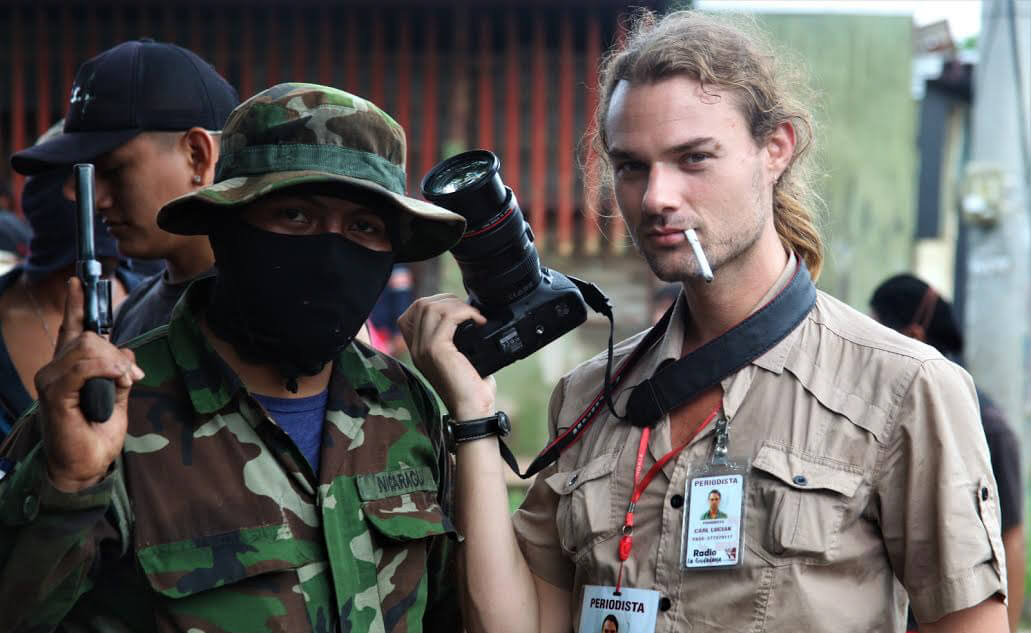
https://www.mintpressnews.com/wp-content/uploads/2018/09/Carl-David-Goette-Luciak_edited.jpgIn a recent activity of the right wing Inter-American Dialogue organization in Washington the moderator Michael Shifter asked guest speaker, Nicaraguan Vice Foreign Minister Valdrack Jaentschke, how he explained the consensus among various foreign news reporters that the attempt to overthrow the Nicaraguan government resulted from popular protest rather than a coup attempt. Jaentschke explained that foreign, mainly US, funding of opposition aligned NGOs facilitated a fake news version of events. That fake news subsequently fed into meretricious reports by the human rights bodies of the Organization of American States and the United Nations.

Jaentschke might have added that the process was identical to the fake news facilitating the infamous NATO country interventions of 2011, with the connivance of the United Nations, in Ivory Coast, Libya and Syria. The same process facilitated US and European Union support for the 2014 coup in Ukraine and sustains the permanent regime change offensive against President Maduro’s government in Venezuela. Reporting on all those events, Western NGOs as well as corporate and alternative media have frequently served as apologists for extremist terrorism and sectarian mass murder. Now those same NATO country media and NGOs have attacked Nicaragua.

The lines of attack are always that the target government is corrupt, anti-democratic and brutally repressive, somewhat like the regime in the United States of North America, but worse. In Nicaragua’s case, the narrative was that peaceful protests led to a brutal massacre of students leading to a nationwide protest movement supported by most of the population, viciously suppressed by means of wholesale human rights abuses. However, that fantasy right wing opposition version has collapsed both inside the country and in the majority world beyond. The Western media and NGO regime change offensive has not gone as well as they might like.

The US fomented coup failed in Nicaragua because the opposition’s lies do not resist common sense scrutiny or day to day reality. Peaceful protests do not result in 23 dead police officers with another 350 or so suffering gunshot wounds. Officers of a police force internationally recognized for its community policing model do not overnight turn into mass murderers. Dozens of public buildings and offices do not spontaneously combust and burn themselves down. Now, confirmed deaths linked to the failed coup attempt total around 200 people between April 18th and July 15th , the great majority of them Sandinistas or bystanders killed by opposition and associated criminal gangs…

While international human rights organizations claim widespread abuses, inside Nicaragua around 200 opposition activists and associated criminals are facing trial on indictments including murder, grievous bodily harm, torture, arson, kidnapping, extortion, robbery with violence, criminal damage, obstructing access to health care, theft and illegal possession of firearms. Amnesty International has championed several of these cases including those of Amaya Eva Coppens and Edwin Carcache, both of whom face damning witness testimony and other evidence very likely to result in conviction. Despite that undeniable context, Amnesty International have doubled down on their false accusations of human rights abuses claiming, as well as denial of due process and prison visits, that prisoners have been tortured and women prisoners have been sexually abused.

The government has rejected all the accusations, either disproving them outright or casting reasonable doubt on their truthfulness. All the accusations are based on unverified testimony from activists of US funded opposition organizations or alleged victims’ relatives co-opted and coached by those organizations. Likewise, regular massive marches of supporters confirming the popularity of the Sandinista government contrast with embarrassingly small turnouts for Nicaragua’s opposition events. For its part, Amnesty International shares its defense of violent criminals and demonstrably false allegations of torture and abuse of prisoners with the Inter American Commission for Human Rights and the UN High Commission for Human Rights both of whom have presented reports based almost entirely on unverified opposition media reports and information collected by US funded opposition NGOs. . .


via Nicaragua: Truth, US Funding and Corporate Shills

Gallup: Hillary Clinton’s Remains More Unpopular Than Trump Two Years After The Election

Quote

While Democratic politicians and groups continue to use Hillary Clinton as a matinee draw for fundraisers and campaign events, a new Gallup poll shows Clinton remains at record lows in the polls.  Indeed, she remains more unpopular than Donald Trump at 36%.   Trump has a 41% popularity.  It is a striking disconnect. Many of us were critical when the Democratic establishment (and virtually every Democratic member of Congress) all but guaranteed the nomination of Clinton despite every poll showing her to be unpopular and the voters seeking an anti-establishment choice.  Now, even after two years of book tours and speeches, Clinton is still distinctly unpopular but Democratic groups continue to make her the face of the Democratic campaign for the midterms.  It shows the hold of the Clintons on some in the Democratic ranks even though she is likely to continue to alienate many who are looking for an alternative this election.

Gallup notes that, according to past polling and trends, Clinton should become more not less popular at this point.

We have previously tracked the polling showing that Clinton would still lose to Trump in prior polls.

I admit that I have never understood the hold of the Clintons who have long been divisive and damaging figures for the party from their various scandals in Arkansas and Washington to the impeachment to the 2016 election.  Nevertheless, they were incredibly nimble in placing loyalists into positions of power and, in one of the most controversial moves, effectively taking over the finances of the Democratic party before the last nomination.  Even with years of worsening polls showing that Hillary Clinton remains politically radioactive for many voters and unpopular with most.  Nevertheless, with both houses at stake, the Democrats are again bringing out Clinton in videos and campaign speeches. . .

via Gallup: Hillary Clinton’s Remains More Unpopular Than Trump Two Years After The Election — JONATHAN TURLEY

Much pollution can be eliminated, and pollution prevention can be highly cost-effective

Quote

How to control and mitigate the effects of pollution on public health

Pollution is the world’s largest environmental cause of disease and premature death. The Lancet Commission on pollution and health brought together leaders, researchers and practitioners from the fields of pollution management, environmental health and sustainable development to elucidate the full health and economic costs of air, water, chemical and soil pollution worldwide.

By analysing existing and emerging data, the Commission reveals that pollution makes a significant and underreported contribution to the global burden of disease, particularly in low- and middle-income countries.

The Commission also provides six recommendations to policymakers and other stakeholders looking for efficient, cost-effective and actionable approaches to pollution mitigation and prevention, Science for Environment Policy reports.

Six Lancet Commission recommendations

  1. Make pollution prevention a high priority nationally and internationally and integrate it into country and city planning processes.
  2. Mobilise, increase and focus the funding and international technical support dedicated to pollution control.
  3. Establish systems to monitor pollution and its effects on health.
  4. Build multi-sectoral partnerships for pollution control.
  5. Integrate pollution mitigation into planning processes for NCDs.
  6. Research pollution and pollution control.

Read The Lancet Commission on pollution and health, October 19, 2017.

via Much pollution can be eliminated, and pollution prevention can be highly cost-effective — DES Daughter Network