How George H.W. Bush Made Guantanamo a Prison, Starting with Haitians

Quote

Kim Ives

Part II

Part I: George H.W. Bush’s Grim Legacy in Haiti

After George Herbert Walker Bush died on Nov. 30 at age 94, the mainstream press favorably contrasted him to Donald Trump, portraying the former Republican president as “kinder” and “gentler,” two watchwords from his inaugural speech.

But, Trump’s signature aggressivity towards immigrants is epitomized through extra-territorial interception and imprisonment and separation of families, brutal policies which were, in fact, pioneered by Bush I during the Haitian refugee exodus following the Sep. 30, 1991 coup d’état in Haiti.
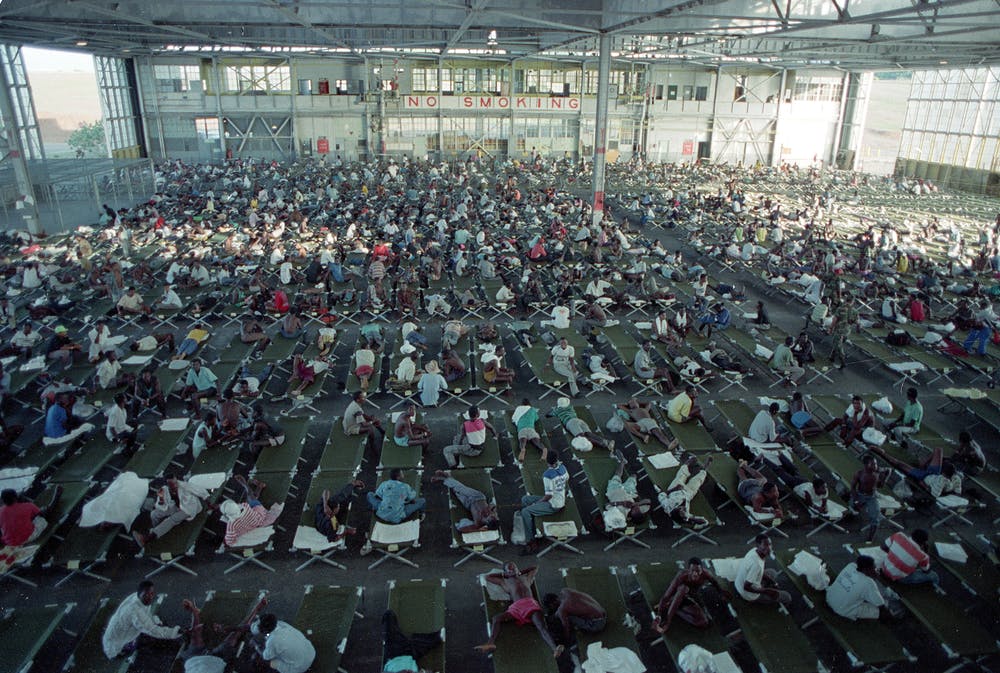
A hangar at Guantanamo Naval Base where Haitian refugees were housed on cots in late 1991 through May 1992. Credit: Chris O’Meara/AP

As we saw in this series’ first article, George H.W. Bush’s administration gave manifest and tacit support to dictator Prosper Avril (1988-1990) and to the first coup d’état against democratically-elected Pres. Jean-Bertrand Aristide.

As a result of that putsch, tens of thousands of Haitians took to the high seas in small boats, many fleeing for their lives. In the first year after the coup, the U.S. Coast Guard intercepted some 38,000 Haitians in international waters.

U.S. interdiction of Haitian refugees had begun in September 1981 under Pres. Ronald Reagan, for whom George H.W. Bush was vice-president. Under the rules laid out by Reagan’s Executive Order 12324 titled “Interdiction of Illegal Aliens,” Immigration and Naturalization Service (INS) agents on board U.S. Coast Guard cutters were supposed to interview and “identify candidates for asylum as political refugees under United States and international law,” explains University of Miami law professor Irwin Stotzky in his new book Send Them Back, about the efforts of crusading lawyers (including himself) on behalf of Haitian refugees during the 1980s.

The screening process was laughable, with interviews which were not private and as short as five minutes, while the snatched-up “boat-people” were often hungry, thirsty, scared, and confused.
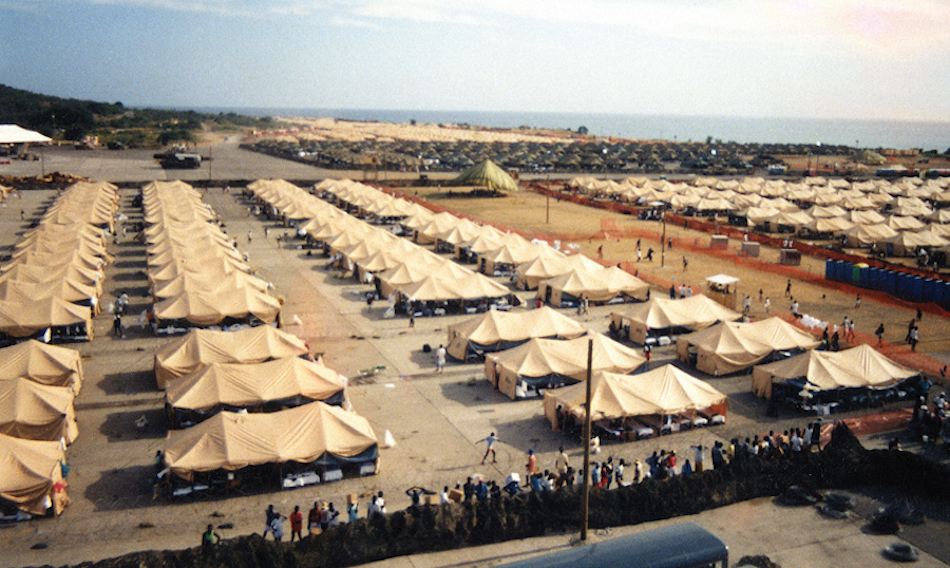
Haitians lived in hundreds of tents at Camp McCalla at Guantanamo under the George H.W. Bush administration.

“As a result of these defective procedures, only 28 of the approximately 23,000 Haitians on vessels interdicted by the Coast Guard from the inception of the interdiction program in 1981 until mid-1991 were identified by INS officials as potential asylees,” Stotzky writes.

During Aristide’s eight months in office in 1991 (Feb to Sep), there was a net human influx back to Haiti, as thousands of joyful expatriate Haitians returned to their homeland to take part in a new democratic experiment after three decades of dictatorship.

But the 1991 military coup cruelly cut short that hope-filled period and provoked a new refugee wave which overwhelmed the U.S. Coast Guard ships stationed off Haiti’s coast. As a result, the Coast Guard began transporting Haitians to the U.S. Naval base at Guantanamo Bay, Cuba, housing them in giant hangars and Camp McCalla, a makeshift city of hundreds of tents set up on Guantanamo’s paved runways and loading docks. At its peak, there were over 12,500 Haitians detained there.

After eight months, the Bush I administration finally dropped all pretense of giving Haitians any due process and discarded the Reagan-era screening protocols, as imperfect as they were. “On May 24, 1992, claiming there were too many Haitians coming, Bush ordered the Coast Guard to intercept all Haitians fleeing in boats and immediately return them to Haiti, without interviews to determine if they were at risk of persecution or death,” Stotzky explained to Haïti Liberté.         
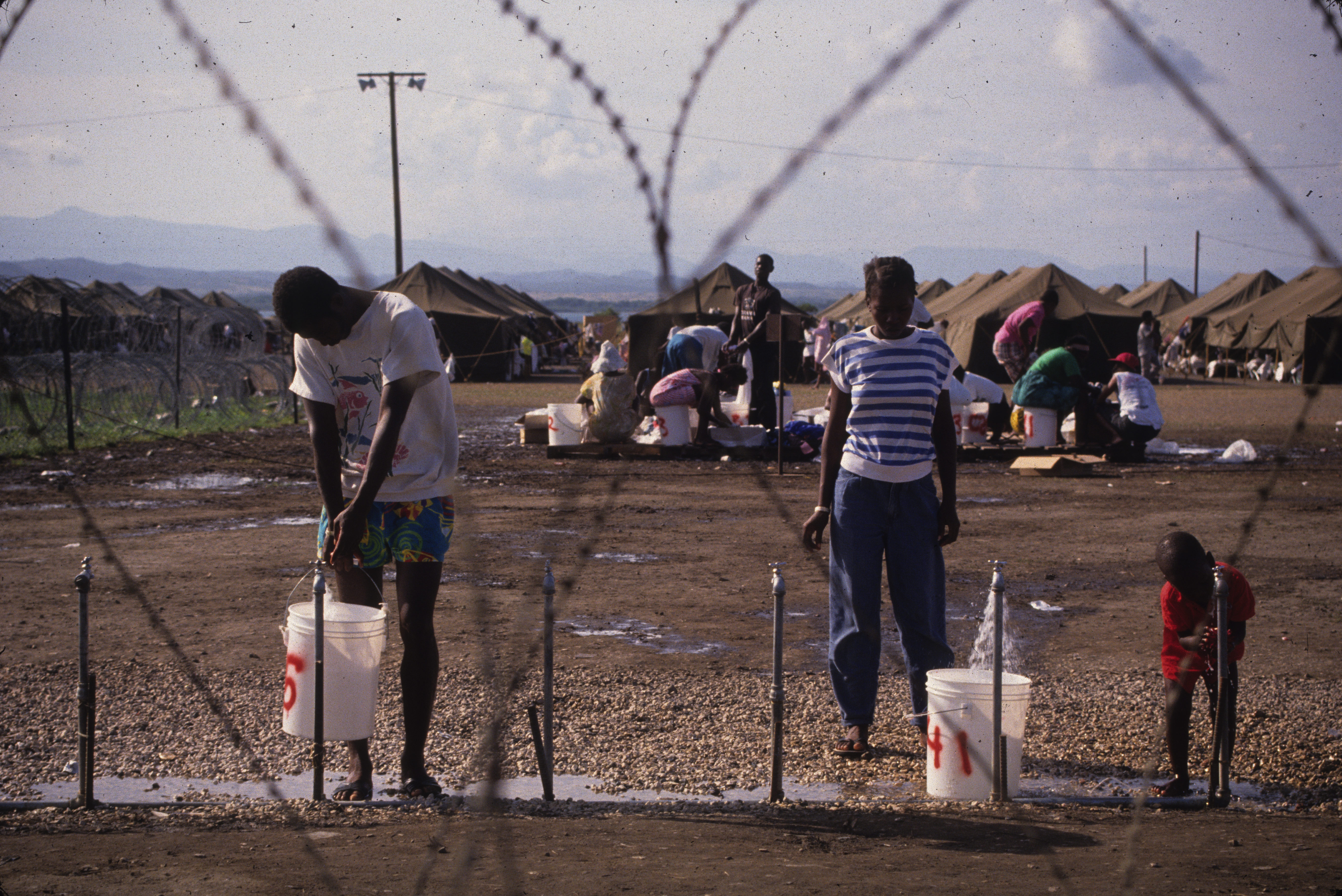
Haitians at Guantanamo’s Camp McCalla on Dec. 31, 1991, three months after the coup d’état which ousted Pres. Jean-Bertrand Aristide. Credit: Carol Halebian

Beginning in 1991, “when the U.S. detained Haitian refugees indefinitely, it set a precedent,” concluded Prof. A. Naomi Paik in a comprehensive article last June about Haitians at Guantanamo on the website The Conversation.

This was the beginning of Guantanamo being used as a prison, for which it would become even more famous in the early 2000s after it was used to hold, in legal limbo, prisoners swept up in George W. Bush’s wars in Afghanistan and Iraq [. . .]

via How George H.W. Bush Made Guantanamo a Prison, Starting with Haitians

What do the protesters in France want? Check out the ‘official’ Yellow Vest manifesto

Quote

What do the protesters in France want? Check out the ‘official’ Yellow Vest manifesto — Society’s Child — Sott.net

  • Constitutional cap on taxes – at 25%
  • Increase of 40% in the basic pension and social welfare
  • Increase hiring in public sector to re-establish public services
  • Massive construction projects to house 5 million homeless, and severe penalties for mayors/prefectures that leave people on the streets
  • Break up the ‘too-big-to-fail’ banks, re-separate regular banking from investment banking
  • Cancel debts accrued through usurious rates of interest

Politics

  • Constitutional amendments to protect the people’s interests, including binding referenda
  • The barring of lobby groups and vested interests from political decision-making
  • Frexit: Leave the EU to regain our economic, monetary and political sovereignty (In other words, respect the 2005 referendum result, when France voted against the EU Constitution Treaty, which was then renamed the Lisbon Treaty, and the French people ignored)
  • Clampdown on tax evasion by the ultra-rich
  • The immediate cessation of privatization, and the re-nationalization of public goods like motorways, airports, rail, etc
  • Remove all ideology from the ministry of education, ending all destructive education techniques
  • Quadruple the budget for law and order and put time-limits on judicial procedures. Make access to the justice system available for all
  • Break up media monopolies and end their interference in politics. Make media accessible to citizens and guarantee a plurality of opinions. End editorial propaganda
  • Guarantee citizens’ liberty by including in the constitution a complete prohibition on state interference in their decisions concerning education, health and family matters

Health/Environment

  • No more ‘planned obsolescence’ – Mandate guarantee from producers that their products will last 10 years, and that spare parts will be available during that period
  • Ban plastic bottles and other polluting packaging
  • Weaken the influence of big pharma on health in general and hospitals in particular
  • Ban on GMO crops, carcinogenic pesticides, endocrine disruptors and monocrops
  • Reindustrialize France (thereby reducing imports and thus pollution)
    Foreign Affairs
  • End France’s participation in foreign wars of aggression, and exit from NATO
    Cease pillaging and interfering – politically and militarily – in ‘Francafrique’, which keeps Africa poor. Immediately repatriate all French soldiers. Establish relations with African states on an equal peer-to-peer basis
  • Prevent migratory flows that cannot be accommodated or integrated, given the profound civilizational crisis we are experiencing
  • Scrupulously respect international law and the treaties we have signed

via What do the protesters in France want? Check out the ‘official’ Yellow Vest manifesto — Society’s Child — Sott.net

Iran says U.S. arm sales turning Middle East into ‘tinderbox’

Quote

December 8, 2018

DUBAI (Reuters) – Iran’s foreign minister Mohammad Javad Zarif said on Saturday that the United States is selling arms into the Middle East which were beyond the region’s needs, turning it into a “tinderbox”, state news agency IRNA reported.

“The level of arms sales by the Americans is unbelievable and much beyond regional needs and this points to the very dangerous policies followed by the Americans,” IRNA reported Zarif as saying.

(Reporting by Dubai Newsroom; Editing by Alexander Smith)


via Iran says U.S. arm sales turning Middle East into ‘tinderbox’

Legal Marijuana Will Create 5 New Professions And 250,000 More New Jobs By 2020

Quote

(THIS ARTICLE IS COURTESY OF CNBC NEWS)

Six years ago recreational marijuana use was illegal in all 50 states — and had been for nearly a century. Following the 2018 midterm elections, anyone over 21 will soon be allowed to legally consume marijuana in 10 states plus the District of Columbia. Overall, 33 states in the past 22 years have passed some form of marijuana legalization, from medical to recreational use.

Despite the ever-present federal threat — the Drug Enforcement Administration still considers marijuana a banned substance, and former Attorney General Jeff Sessions threatened a crackdown — the $8.5 billion U.S. marijuana industry seems poised to grow as rapidly as the law will allow it. And it’s generating jobs just as quickly.

By 2020 the industry is expected to create 250,000 new jobs, according to New Frontier Data, an industry research firm. In 2017 the number of job posts for openings in the marijuana industry increased by 445 percent, outpacing tech (254 percent) and health care (70 percent), according to ZipRecruiter.

The industry is in search of workers across the spectrum, from accounting to compliance, customer service, sales, technology and more. As the industry grows, so too do the opportunities. California, Colorado and Washington currently have the greatest demand for workers, but that could shift as legalization spreads.

Though the total number of marijuana jobs are still far smaller than those other, much older industries, they include several positions that didn’t exist prior to legalization, offering enterprising workers the opportunity to get in on the ground floor of an entirely new career.

Because legalization has come state by state, there is no single association or governing body offering licenses, training or certifications. Workers looking to enter the industry will need to do a bit of research to find out their specific state requirements.

But newcomers don’t necessarily need an encyclopedic nature of weed culture to succeed in the industry. In fact, Karson Humiston, CEO and founder of recruiting firm Vangst, said she decided to start her firm, which specializes in the cannabis industry, after discovering the breadth of talent required by entrepreneurs attending a 2015 industry convention.

“When I asked people what positions they were hiring for, it was everything from a botanist to a chemical engineer to a Ph.D. to a retail store manager to a marketing manager to a human resource manager to a CFO,” she said. “You name it, and these companies were hiring for it.”

Though some may hesitate to join an industry selling a drug that’s still banned by federal law, everyday workers have little to fear, said Morgan Fox, media relations director for the National Cannabis Industry Association. “We haven’t seen any U.S. attorneys make an effort to crack down on businesses that are compliant with state law, even though the former attorney general gave them carte blanche to do so,” he said, referring to Sessions. “If someone is just an employee of a company, I would think there’s pretty much no risk.”

Here are five fast-growing new careers driven by marijuana legalization. Salary data is gleaned from the 2018 Vangst Salary Guide. In most cases the salary ranges are unusually broad due to the industry’s youth and rapid expansion [. . .]

marijuana cultivation

French Police Union Calls on Police to Join Yellow Vests’ Protests

Quote

Sputnik – 06.12.2018

After the surge in fuel prices in France, the so-called Yellow Vests movement has held protests, calling firstly on the government to lower the prices, and then also on French President Emmanuel Macron to resign. On Wednesday, the French National Assembly approved a moratorium on the planned fuel price hike.

The French labour union Vigi has called on its members working in the national police and in the Ministry of the Interior to start an indefinite strike on Saturday, joining the Yellow Vests movement. The statement was placed on Vigi’s Facebook page on Wednesday.

“The demands made by the Yellow Vests movement related to all of us. The time to organize legally and express solidarity with them for the benefit of all has come”, Vigi’s post reads. “We are being perceived as mercenaries, given bonuses for overtime work, but they cannot compensate for the decisions made by the government.”

The call is directed at “administrative, technical, scientific and state workers/cooks from the Ministry of the Interior”, according to the statement.

“Act IV” of the Yellow Vests’ protests, which is to start on Saturday, will make the government take precautions, as during the previous “Act III”, more than 260 people, including some 80 police, were injured. Earlier, French Interior Minister Christophe Castaner announced that he would reinforce security for next Saturday.

Michel Thooris, the head of the France Police labour union, said that the French government had failed to implement security measures in Paris, noting that “a majority of the French continue to back the movement”. She also highlighted that using the armed forces against civilians would indicate that France is heading towards a civil war.

The protests, which started as a movement against a hike in fuel prices, turned violent, leading to more than 600 people being injured and at least two deaths. The three-week demonstration forced the French government to drop the fuel tax rise from the 2019 budget.

“The government is ready for dialogue and is showing it because this tax increase has been dropped from the 2019 budget bill”, Edouard Philippe, the French prime minister, said on December


via French Police Union Calls on Police to Join Yellow Vests’ Protests

California governor signs legislation to bail out utility that sparked deadly fires

Quote

Dec. 2018 Fire ruins Malibu (AP)By MARC ROME

In October, the United Nations’ Intergovernmental Panel on Climate Change (IPCC) reported that the effects of climate change are already happening, making natural events like wildfires more intense. A month later, the Camp Fire, fueled by Diablo winds and drought conditions, incinerated Paradise, Calif., killing 88 people with nearly 800 unaccounted for. More than 16,000 structures, mostly homes, were destroyed, forcing at least 52,000 to evacuate and leaving tens of thousands of people homeless throughout the 150,000 acre burn zone in Butte County. It is the deadliest fire in the state’s history, and was nearly as destructive as the previous 10 record setting California fires combined.

As the fires raged in Paradise, an area covering hundreds of miles was an ominous and forbidding landscape full of smoke darkened skies that affected millions with hazardous air or nearly two weeks. Air Quality Indexes measured from upwards of 400 in Sacramento and 238 in San Francisco. Smoke plumes were detected as far away as Philadelphia.

Factoring in the Woolsey fire in southern California, which left three dead and upwards of 2000 homes and structures destroyed or damaged, nearly 150,000 people have been displaced, leading to a humanitarian/housing crisis in a state where affordable housing is already extremely difficult to find for working and poor people. Ed Mayer, executive director of Butte County’s housing agency, said, “Big picture, we have 6000, possibly 7000 households who have been displaced and who realistically don’t stand a chance of finding housing again in Butte County. I don’t even know if these households can be absorbed in California.”

Lawsuits have been filed by victims against PG&E for their suspected responsibility in starting the Camp Fire. The AP reported, “PG&E told state regulators that it experienced a problem on a transmission line in the area of the fire just before the blaze erupted. In its filing Thursday [Nov. 8] with the state Public Utilities Commission, it said it had detected an outage on an electrical transmission line. It said a subsequent aerial inspection detected damage to a transmission tower on the line.” PG&E’s practice of cutting labor costs (which boosts profits) led to poor maintenance of its electrical grid, and, according to state fire investigators, caused 17 of 21 wildfires in 2017, including the 2017 Tubbs Fire in Sonoma County, which killed 24 and destroyed more than 5300 homes.

A series of lawsuits have also been filed against Southern California Edison alleging that the Woolsey fire began due to poor maintenance of their equipment near the flashpoint. To shield three California utility monopolies—Pacific Gas and Electric, Southern California Edison, and San Diego Gas and Electric—from financial ruin, Governor Brown recently signed SB 901 to pass off the utilities’ liabilities to rate payers for fires attributed to equipment owned by these billion-dollar corporations. PG&E alone is facing $15 billion in liabilities for the 2017 fires, and SB901 allows them to issue bonds paid for by increasing fees for ratepayers.

Their liabilities may be as high as $30 billion if it’s determined that the utility is responsible for the Camp Fire, which could lead to PG&E’s collapse without another state government bailout. SB 901 was proposed by Brown and passed the State Assembly and Senate with virtually no resistance from Democratic Party legislators (nine Democrats opposed it in total). There is no comparable bailout legislation for the victims of the most destructive fire in U.S. history in a century [. . .]

via California governor signs legislation to bail out utility that sparked deadly fires

Trump’s $12 billion bailout of farmers hurt by his trade wars has been a massive bust

Quote

Trump’s $12 billion bailout of farmers hurt by his trade wars has been a massive bust: NYT | Alternet

According to the Times, the bailout program “has done little to cushion the blow” of the president’s trade wars, “with red tape and long waiting periods resulting in few payouts so far.”

In fact, the Times estimates, just $838 million of the $6 billion worth of bailout funds that have been authorized so far has been paid out.

Among the problems with the program, the paper reports, is that farmers cannot apply for relief funds until they complete their harvests for the season, which has harmed farmers whose harvests have been delayed due to bad weather.

Jim Mulhern, president of the National Milk Producers Federation, tells the Times that most dairy farmers hit hard by the tariffs haven’t seen any significant relief since the program was announced.


via Trump’s $12 billion bailout of farmers hurt by his trade wars has been a massive bust: NYT | Alternet

Chicago 1969: When Black Panthers aligned with Confederate-flag-wielding, working-class whites

Quote

by

This is how it needs to be. One thing this article doesn’t mention is that the Rainbow Coalition was also oriented toward building relationships with Chicago gangs like the Blackstone Rangers. Both the Nixon-Hoover FBI and the Chicago police thought this idea was so dangerous and threatening that they literally assassinated the project’s leaders, Fred Hampton and Mark Clark.

“In his short time as a Black Panther leader, Fred Hampton wanted to advance the group’s goals by forming a “Rainbow Coalition” of working class and poor people of all races…

Former members of the Chicago Panthers and YPO tell different versions of the same story of how the groups connected: Each attended the other’s organizing meetings and decided to work together on their common issues. Over time, the Black Panthers learned to tolerate Confederate flags as intransigent signs for rebellion. Their only stipulation was that the white Young Patriots denounce racism…

In the end, the Illinois Panthers brought together various elements of the black community, Confederate flag-waving southern white migrants (Young Patriots), Puerto Ricans (Young Lords), poor white ethnic groups (Rising Up Angry, JOIN Community Union, and the Intercommunal Survival Committee), students and the women’s movement. The disparate groups under the coalition’s umbrella pooled resources and shared strategies for providing community services and aid that the government and private sector would not. Initiatives included health clinics, feeding homeless and hungry people, and legal advice for those dealing with unethical landlords and police brutality.”

Interestingly, it only seems to be tendencies like Attack the System and National-Anarchist Movement that have any interest in going this route today.

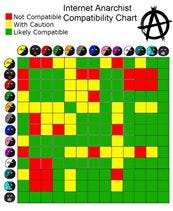
Recently, this meme was posted on an N-A page:

And these were some of the comments in response by leading N-As:

“This chart would be an overview of interaction between various N-AM communities, which serves as an umbrella for, sometimes mutually exclusive, ways of life.”

“I agree, but I doubt whether some of these variations would be quite as tolerant as we are. Agreeing to disagree is one thing, but true Anarchism should never venture into the realms of coercion. In other words, the squares to avoid should never become squares upon which to impose your own views.”

“The chart is also very atheistic/materialistic in that it leaves out a vast multitude of Anarchist variations centred on spirituality. Think of all the Christian, Islamic, Jewish and Occult groups, for example. And there is always room for thematic Anarchists, too, who may base their communities on sexual (beyond homosexuality), musical, dietary, historical, fictional or cinematic themes. The list is endless and the N-AM is the only movement on the planet that caters for such diversity.”

These ideas are important as well because race and ethnicity are hardly the only forms of “identity.” A modern Rainbow Coalition might just as likely include the Gamer Panthers, the Goth Lords, the Young Incels Organization, the Vegan Berets, the Medieval Knights, the Red Shirts Legion (in honor of the “red shirts” perpetually getting bumped on on Star Trek: TOS), the Queer Guards, the Otherkin Federation, the Transracials Alliance, the Heavy Metal Tribal Confederation or whatever other kinds of identifies and affiliations people choose for themselves [. . .]

via Chicago 1969: When Black Panthers aligned with Confederate-flag-wielding, working-class whites

No More Water for #Fracking! Resource Colonialism in New Mexico and the Issue of Contaminated Water

Quote

A must read article from November 5 about a conference that took place November 15 and 16. In the high desert of the Southwest, water is a precious resource that is sacred to Indigenous peoples. Water is also the lifeblood of the fracking industry. To drill for oil and gas reserves, millions of gallons are needed. Water has to be stolen from Indigenous peoples, and water that is contaminated by fracking fluids also pollutes vital freshwater sources such as aquifers and rivers. Industry experts call this “produced water,” which is a nice way to say dirty frack water.Originally published by The Red Nation. Written by Berkley Carnine.

Note: Enough is Enough is not organizing any of these events, we are publishing this text for people across the US and Europe to be able to see what is going on and for documentation only.

This November 15 and 16 at Hotel Santa Fe Hacienda and Spa, officials from the state, the EPA (the Environmental Protection Agency), and the Department of Interior will gather with representatives from the oil and gas industry, produced water companies, and private equity, legal, and infrastructure experts to “clarify the existing regulatory and permitting frameworks related to the way produced water from oil and gas extraction can be reused, recycled, and renewed for other purposes (NM Produced Water Conference events website).” Put another way, they will rewrite regulations in order to guzzle up the region’s scarce and sacred fresh water resources and will “re-introduce” produced water into the hydrologic cycle. This means that water used for hydraulic fracturing (fracking) that is contaminated with brine, toxic medals, and radioactivity will be dumped into fragile watersheds. [. . .]

via No More Water for #Fracking! Resource Colonialism in New Mexico and the Production of Contaminated Water — Enough is Enough!

MASS INCARCERATION – A MEANS TO OPPRESS BLACK PEOPLE

Quote


by Al Simpsonbars image

The Domestic War on Black Workers

In 1982, President Ronald Reagan officially announced the start of War on Drugs. This was rather interesting timing because drug use in the United States was declining at that time.[i] Within a few years after the War on Drugs was announced, the scourge of crack-cocaine was spreading rapidly across the country. We will show that the transport and sale of vast quantities of cocaine was, in fact, carried out simultaneously by the very same government that was supposedly responsible for the War on Drugs. While dollars from the sale of crack were used to finance reactionary foreign policies, the repression justified by drug usage was used to imprison and impoverish poor black workers. Today, the United States has the world’s highest incarceration rate of 773 per 100,000 people. Compared to 118 in China, 655 in Russia, and 193 in Brazil.[ii] In 1980 the number of people imprisoned for drug offenses in the in the U.S. was about 41,000, and by 2010 it had zoomed up to about half a million people. People of color were especially targeted for incarceration by a variety of methods.

First, Some History. Meet Klaus Barbie, Criminal of World War II – and Beyond

Klaus Barbie, a Nazi war criminal, committed many horrible crimes. He persecuted resistance fighters in Holland, massacred Slavs and Jews on the Eastern Front and headed the Gestapo in Lyons for two years, where he tortured to death resistance fighters and Jews. Barbie participated in the Nazi killing frenzy before the Allies moved in,[iii] which included sending children from a Jewish orphanage to concentration camps to meet their certain death. The list of horrible crimes goes on and on, for which he was known as the Butcher of Lyons –for good reason.

Barbie was recruited and protected by the US Army Counterintelligence Corps after the war, even though he was one of the most wanted criminals in the world. The reason for his hire was to provide information on interrogation methods, to obtain the names of SS men who might be recruited, and to learn about methods of torture. In 1951 he and his family were given a crash course in Spanish, $8000 and a new identity, Klaus Altmann-mechanic. Barbie and his family were then sent to Bolivia, where It turned out that the CIA had a lot of work for him.

Klaus Barbie sold coca paste, weapons, and participated in at least three coup d’états. He also assisted in the murder of Cuban revolutionary Che Guevara in October 1967. During a coup in 1970, he helped place rightist Hugo Banzer Suarez in power. In true Nazi fashion, thousands of leftists and union leaders were interrogated and “disappeared.” Banzer was so pleased with Barbie’s work that he made him an honorary colonel and a paid consultant to the Bolivian Interior Ministry, where he assisted in counterinsurgency work. Barbie also provided the CIA with the names of suspected Soviet and Cuban agents in South America. He assisted in the construction of concentration camps for political prisoners, taught methods of torture and made a fortune selling weapons to the Bolivian military, paid for mostly by the US government.

The Rise of the Drug Cartels

By the mid-1970s the Bolivian economy was in a shambles. Banzer ordered that cotton plantations be devoted to the raising of coca, and from 1974 – 1980 production of coca tripled. This tremendous supply of cocaine was exported from Bolivia and was instrumental in the rise of the Columbian drug cartels. In 1975 the street price of cocaine was $1500 per gram, which fell to $100 to $125 by 1986.[iv][v]

There was an election of a liberal government in Bolivia in 1979, despite massive voter fraud and intimidation by rightwing parties. This was a setup for yet another overthrow, the Cocaine Coup on July 17, 1980, in which Klaus Barbie once again assisted. Leftist newspapers were bombed, and many opposition leaders were arrested, tortured and murdered. The amount of cocaine produced in Bolivia increased from 35,00 metric tons (1 metric ton = 2,205 lbs) in 1980 to more than 60,000 metric tons by the late 1980s, almost all of it intended for sale in the United States.[vi]

The CIAs Effort to Support the Nicaraguan Contras with Money Made by Selling Cocaine in America’s Ghettos

In Nicaragua in 1979 the Sandinistas (Sandinista National Liberation Front), overthrew the U.S. supported dictator Anastasio Somoza. Presidents Jimmy Carter and then Ronald Reagan created the Contras, an organization which operated out of Honduras and whose purpose was to overthrow the Sandinistas. However, this plan was deeply unpopular in Congress, and the Defense Appropriations Bill for 1983, prohibited the CIA from spending any money for “overthrowing the government of Nicaragua.” That year the CIA budget was reduced to about a quarter of what the Reagan administration claimed would be enough for a properly equipped fighting force. So the administration arranged to receive $1 million a month from Saudi Arabia, funds from South Africa, and to acquire major funding through the sale of drugs.

In 1984 the CIA mined the Harbors of Nicaragua. The political uproar that ensued caused Congress to pass an amendment to limit monies for the Contras even further, so that “no funds available to the Central Intelligence Agency, the Department of Defense, or any other agency of entity of the United States involved in intelligence activities may be obligated or expended for the purpose or which have the effect of supporting, directly or indirectly, military or paramilitary operations in Nicaragua by any nation, group organization, movement or individual.” As a result, the year 1985 was the peak year of drug sales to support the Contras, as the Reagan Administration decided that no matter what Congress did the Contras had to be kept together “body and soul”. Operatives running or selling drugs for the support of the Contras lived a charmed life. Every time they would be caught, they would magically be released without charge. After the expiration of the amendment mentioned above in 1986, the CIA budget allocated to the Contras rose to $100 million.

The Contras Got Lots of Money

Drug dealer Oscar Danilo testified that the CIA-supported ring sold almost a ton of cocaine in the United States in 1981, $54 million worth. It was not clear how much of the money found its way back to the CIA’s army, but Blandon testified that “whatever we were running in L.A., the profit was going for the Contra revolution.”[vii] The police knew about Blandon for a long time: “Danilo Blandon is in charge of a sophisticated cocaine smuggling and distribution organization operating in Southern California,” L.A. County sheriff’s Sgt. Tom Gordon said in 1986. “The monies gained from the sales of cocaine are transported to Florida and laundered through Orlando Murillo, who is a high-ranking officer of a chain of banks in Florida named Government Securities Corporation. From this bank the monies are filtered to the Contra rebels to buy arms in the war in Nicaragua.”[viii] Blandon was never arrested, nor was another dealer, Norwin Meneses, until he had been shipping cocaine out of Honduras for 15 years under the eyes of and for the profit of the CIA.

Much of the cocaine was sold in Los Angeles at very low prices, after being transported by the cartels through Columbia, Mexico, and Honduras, all abetted by the Contras and the CIA. The streets of Los Angeles were flooded with crack-cocaine.

Exposé of the Origin of the Crack-Cocaine

In August, 1996 the San Jose Mercury News published three articles entitled “Dark Alliance,” subtitled “The Story Behind the Crack Explosion,” written by Gary Webb, a reporter for the Mercury’s Sacramento bureau [. . .]


via MASS INCARCERATION – A MEANS TO OPPRESS BLACK PEOPLE — The Multiracial Unity Blog