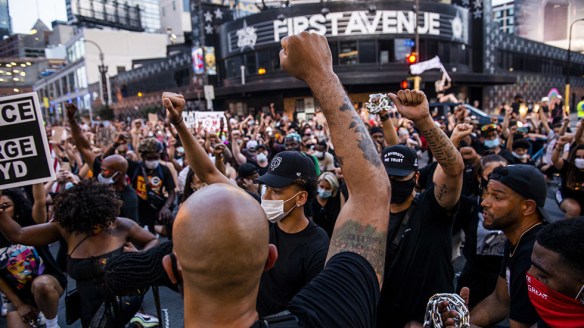
Veteran activists called out BLM as a tool of the Democrats from day 1. But agenda-driven $Millions drown out the grassroots

Quote

Minnesota BLM
By Helen Buyniski | RT | July 6, 2020

Via Aletho News

The Black Lives Matter movement has made millions off black Americans’ suffering. A St. Louis activist explains how it comes from a long tradition of white liberals coopting grassroots movements to push a Democratic Party agenda.

The foundation-funded social justice activism of Black Lives Matter is using black pain to cash in on white liberal guilt, dividing American society in pursuit of a Democratic political agenda, St. Louis activist Nyota Uhura told RT.

Uhura founded her website handsupdontshoot in August 2014 to counter false narratives coming out of the St. Louis suburb of Ferguson following the police shooting of 18-year-old Michael Brown.

Having witnessed BLM’s rise up close as the nascent organization swooped into Ferguson amid the calls for justice triggered by Brown’s killing, methodically co-opting the genuine protest energy while ignoring or even obstructing those protesters’ demands, Uhura has fought to warn others of what the organization really represents – leveraging black activism into a boost for the Democratic Party.

The science of co-opting movements

Plucking a few Ferguson residents from the streets for a veneer of local credibility, BLM raised $33 million on the back of Brown’s death – money Uhura says her community never saw. Six years later, black St. Louis remains poor and plagued with violence, while BLM has found a new community to exploit.

“They overshadow the work of the grassroots, then they insert themselves as leaders and they go out in the media and claim to be leading these movements,” Uhura said.

Outlining the methodology of BLM and other astroturfed movements, she added that sometimes they literally just showed up at a protest they didn’t plan and did a news conference. This is a tradition she traces back to white liberals’ hijacking of the 1963 March on Washington.

That tradition has been boiled down to a science, she says, with organizations like NetRoots turning out phony ‘activists’ with the ruthless efficiency of an assembly line. “NetRoots is where activists go to audition to be puppets of the Democrats, special interest and white elite nonprofit,” she continued.

“It happens so fast that all the pieces are in place before you even have a chance to know what hit you… Before you even know it, you’re watching the news and they have coopted your movement.”

White liberal and progressive groups “use the energy of our movement to push their agenda” – in BLM’s case, weaponizing the concept of “intersectionality” to broaden the movement’s scope from race to feminism, immigrant rights, LGBT issues, and other causes that directly affect white people.

“In order to mobilize people, they need those black faces out front – because what are they going to look like protesting? Just in terms of optics it’ll look like a Klan rally,” Uhura joked. She has a point – just 17 percent of last month’s protesters were black, according to a Pew Research poll published last week, a statistic the organization’s foes are unlikely to let it forget.

Real activists disenfranchised

Uhura is far from the only grassroots activist to publicly speak out against BLM for pulling a bait-and-switch, substituting the Democratic Party’s pet causes in place of justice for the victims of police violence. The group’s Cincinnati chapter dropped the iconic phrase from its name in 2018, alleging the national organization “capitalized off a nameless groundswell of resistance sweeping the nation, branded it as their own, and profited off [black people’s deaths]” without making an effort to get justice for victims’ families.

The Cincinnati chapter also says that BLM’s 2015 conference in Cleveland – where 12-year-old Tamir Rice had just been gunned down by a cop for holding a toy gun – focused almost exclusively on black transgender rights, further dividing a suffering community.

Los Angeles activists slammed BLM’s local chapter for ignoring the killing of Ezell Ford, a mentally-ill man shot by police in 2014, to travel to Ferguson and piggyback on the Michael Brown shooting. Upon their return to Los Angeles, where the activist community was demanding the city’s district attorney indict Ford’s killers, BLM Los Angeles not only continued to ignore the injustice, one of its leaders actually bestowed a ‘Women in Action’ award on the same DA who exonerated the cops who killed him.

Others take issue with what they see as obvious grifting by some of BLM’s most prominent representatives. DeRay McKesson has promoted brands from Apple to McDonald’s, and even got himself arrested in a Twitter T-shirt in what many activists believe was a staged promotion.

Shaun King is so legendary for making large sums of money raised “for the movement” disappear that the Daily Beast wrote a story about it. King recently announced a “Truth, Justice and Reconciliation Commission” in conjunction with three of the same “progressive prosecutors” that activists like Uhura have denounced for failing to police the police.

‘They always march us back into the voting booth’

Like all controlled opposition movements, one of BLM’s primary functions is to derail meaningful change. Uhura explained, “They always march us back into the voting booth.”

Well-heeled movement activists consistently divert money and energy into electing Democratic Party candidates or “progressive” prosecutors, none of whom hold police accountable when they murder innocent black men, whether it’s in Ferguson, Los Angeles, or New York City […]
via Veteran activists called out BLM as a tool of the Democrats from day 1. But agenda-driven $Millions drown out the grassroots

Are the Democrats a Political Party or a CIA-Backed Fifth Column?

Quote

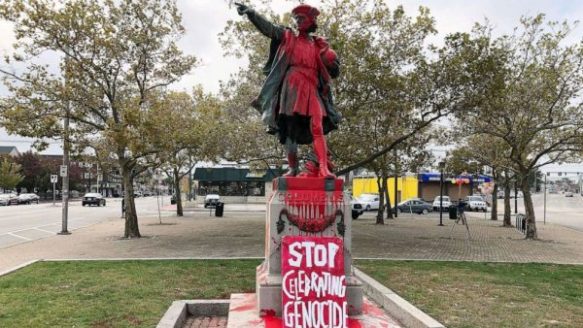
columbus-statue-rhode-island-ap-jt-191014_hpMain_16x9_992-600x338
By Mike Whitney • Unz Review • July 5, 2020

Via Aletho News

How do the Democrats benefit from the nationwide Black Lives Matter protests?

While the protests are being used to paint Trump as a race-bating white supremacist, that is not their primary objective. The main goal is to suppress and demonize Trump’s political base which is comprised of mainly white working class people who have been adversely impacted by the Democrats disastrous free trade and immigration policies. These are the people– liberal and conservative– who voted for Trump in 2016 after abandoning all hope that the Democrats would amend their platform and throw a lifeline to workers who are now struggling to make ends meet in America’s de-industrialized heartland.

The protests are largely a diversion aimed at shifting the public’s attention to a racialized narrative that obfuscates the widening inequality chasm (created by the Democrats biggest donors, the Giant Corporations and Wall Street) to historic antagonisms that have clearly diminished over time. (Racism ain’t what it used to be.) The Democrats are resolved to set the agenda by deciding what issues “will and will not” be covered over the course of the campaign. And– since race is an issue on which they feel they can energize their base by propping-up outdated stereotypes of conservatives as ignorant bigots incapable of rational thought– the Dems are using their media clout to make race the main topic of debate. In short, the Democrats have settled on a strategy for quashing the emerging populist revolt that swept Trump into the White House in 2016 and derailed Hillary’s ambitious grab for presidential power.

The plan, however, does have its shortcomings, for example, Democrats have offered nearly blanket support for protests that have inflicted massive damage on cities and towns across the country. In the eyes of many Americans, the Dems support looks like a tacit endorsement of the arson, looting and violence that has taken place under the banner of “racial justice”. The Dems have not seriously addressed this matter, choosing instead to let the media minimize the issue by simply scrubbing the destruction from their coverage. This “sweep it under the rug” strategy appears to be working as the majority of people surveyed believe that the protests were “mostly peaceful”, which is a term that’s designed to downplay the effects of the most ferocious rioting since the 1970s.

Let’s be clear, the Democrats do not support Black Lives Matter nor have they made any attempt to insert their demands into their list of police reforms. BLM merely fits into the Dems overall campaign strategy which is to use race to deflect attention from the gross imbalance of wealth that is the unavoidable consequence of the Dems neoliberal policies including outsourcing, off-shoring, de-industrialization, free trade and trickle down economics. These policies were aggressively promoted by both Bill Clinton and Barack Obama as they will be by Joe Biden if he is elected. They are the policies that have gutted the country, shrunk the middle class, and transformed the American dream into a dystopian nightmare.

They are also the policies that have given rise to, what the pundits call, “right wing populism” which refers to the growing number of marginalized working people who despise Washington and career politicians, feel anxious about falling wages and dramatic demographic changes, and resent the prevailing liberal culture that scorns their religion and patriotism. This is Trump’s mainly-white base, the working people the Democrats threw under the bus 30 years ago and now want to annihilate completely by deepening political polarization, fueling social unrest, pitting one group against another, and viciously vilifying them in the media as ignorant racists whose traditions, culture, customs and even history must be obliterated to make room for the new diversity world order […]

via Are the Democrats a Political Party or a CIA-Backed Fifth Column?

As It Should Be… — Attack the System

Quote

Now, this is more like it. Black and white, left and right, marching with guns is how you scare the piss out of the ruling class. PHOTOS: Today armed Black Lives Matter and “boogaloo” protesters joined forces for an open carry rally against police violence and government overreach in Richmond, VA. HD Video upcoming. Photos […]

via As It Should Be… — Attack the System

Obama privately admits Biden BARELY up to job, tells him to cut interviews short

Quote


From Attack the System

Some hilarious footage of Biden in this, and a great discussion of what a charlatan Obama is.

via Obama privately admits Biden BARELY up to job, tells him to cut interviews short — Attack the System

The Sickness of American Capitalism Revealed in Our Crippled Food Supply System

Quote


The Sickness in Our Food Supply

“Only when the tide goes out,” Warren Buffett observed, “do you discover who’s been swimming naked.” For our society, the Covid-19 pandemic represents an ebb tide of historic proportions, one that is laying bare vulnerabilities and inequities that in normal times have gone undiscovered. Nowhere is this more evident than in the American food system. A series of shocks has exposed weak links in our food chain that threaten to leave grocery shelves as patchy and unpredictable as those in the former Soviet bloc. The very system that made possible the bounty of the American supermarket—its vaunted efficiency and ability to “pile it high and sell it cheap”—suddenly seems questionable, if not misguided. But the problems the novel coronavirus has revealed are not limited to the way we produce and distribute food. They also show up on our plates, since the diet on offer at the end of the industrial food chain is linked to precisely the types of chronic disease that render us more vulnerable to Covid-19.

The juxtaposition of images in the news of farmers destroying crops and dumping milk with empty supermarket shelves or hungry Americans lining up for hours at food banks tells a story of economic efficiency gone mad. Today the US actually has two separate food chains, each supplying roughly half of the market. The retail food chain links one set of farmers to grocery stores, and a second chain links a different set of farmers to institutional purchasers of food, such as restaurants, schools, and corporate offices. With the shutting down of much of the economy, as Americans stay home, this second food chain has essentially collapsed. But because of the way the industry has developed over the past several decades, it’s virtually impossible to reroute food normally sold in bulk to institutions to the retail outlets now clamoring for it. There’s still plenty of food coming from American farms, but no easy way to get it where it’s needed.

How did we end up here? The story begins early in the Reagan administration, when the Justice Department rewrote the rules of antitrust enforcement: if a proposed merger promised to lead to greater marketplace “efficiency”—the watchword—and wouldn’t harm the consumer, i.e., didn’t raise prices, it would be approved. (It’s worth noting that the word “consumer” appears nowhere in the Sherman Anti-Trust Act, passed in 1890. The law sought to protect producers—including farmers—and our politics from undue concentrations of corporate power.)1 The new policy, which subsequent administrations have left in place, propelled a wave of mergers and acquisitions in the food industry. As the industry has grown steadily more concentrated since the 1980s, it has also grown much more specialized, with a tiny number of large corporations dominating each link in the supply chain. One chicken farmer interviewed recently in Washington Monthly, who sells millions of eggs into the liquified egg market, destined for omelets in school cafeterias, lacks the grading equipment and packaging (not to mention the contacts or contracts) to sell his eggs in the retail marketplace.2 That chicken farmer had no choice but to euthanize thousands of hens at a time when eggs are in short supply in many supermarkets.

On April 26, John Tyson, the chairman of Tyson Foods, the second-largest meatpacker in America, took out ads in The New York Times and other newspapers to declare that the food chain was “breaking,” raising the specter of imminent meat shortages as outbreaks of Covid-19 hit the industry.3 Slaughterhouses have become hot zones for contagion, with thousands of workers now out sick and dozens of them dying.4 This should come as no surprise: social distancing is virtually impossible in a modern meat plant, making it an ideal environment for a virus to spread. In recent years, meatpackers have successfully lobbied regulators to increase line speeds, with the result that workers must stand shoulder to shoulder cutting and deboning animals so quickly that they can’t pause long enough to cover a cough, much less go to the bathroom, without carcasses passing them by. Some chicken plant workers, given no regular bathroom breaks, now wear diapers.5 A worker can ask for a break, but the plants are so loud he or she can’t be heard without speaking directly into the ear of a supervisor. Until recently slaughterhouse workers had little or no access to personal protective equipment; many of them were also encouraged to keep working even after exposure to the virus. Add to this the fact that many meat-plant workers are immigrants who live in crowded conditions with little or no access to health care, and you have a population at dangerously high risk of infection.

When the number of Covid-19 cases in America’s slaughterhouses exploded in late April—12,608 confirmed, with forty-nine deaths as of May 11—public health officials and governors began ordering plants to close. It was this threat to the industry’s profitability that led to Tyson’s declaration, which President Trump would have been right to see as a shakedown: the president’s political difficulties could only be compounded by a shortage of meat. In order to reopen their production lines, Tyson and his fellow packers wanted the federal government to step in and preempt local public health authorities; they also needed liability protection, in case workers or their unions sued them for failing to observe health and safety regulations.

Within days of Tyson’s ad, President Trump obliged the meatpackers by invoking the Defense Production Act. After having declined to use it to boost the production of badly needed coronavirus test kits, he now declared meat a “scarce and critical material essential to the national defense.” The executive order took the decision to reopen or close meat plants out of local hands, forced employees back to work without any mandatory safety precautions, and offered their employers some protection from liability for their negligence. On May 8, Tyson reopened a meatpacking plant in Waterloo, Iowa, where more than a thousand workers had tested positive.

The president and America’s meat eaters, not to mention its meat-plant workers, would never have found themselves in this predicament if not for the concentration of the meat industry, which has given us a supply chain so brittle that the closure of a single plant can cause havoc at every step, from farm to supermarket. Four companies now process more than 80 percent of beef cattle in America; another four companies process 57 percent of the hogs. A single Smithfield processing plant in Sioux Falls, South Dakota, processes 5 percent of the pork Americans eat. When an outbreak of Covid-19 forced the state’s governor to shut that plant down in April, the farmers who raise pigs committed to it were stranded.

Once pigs reach slaughter weight, there’s not much else you can do with them. You can’t afford to keep feeding them; even if you could, the production lines are designed to accommodate pigs up to a certain size and weight, and no larger. Meanwhile, you’ve got baby pigs entering the process, steadily getting fatter. Much the same is true for the hybrid industrial chickens, which, if allowed to live beyond their allotted six or seven weeks, are susceptible to broken bones and heart problems and quickly become too large to hang on the disassembly line. This is why the meat-plant closures forced American farmers to euthanize millions of animals, at a time when food banks were overwhelmed by demand.6

Under normal circumstances, the modern hog or chicken is a marvel of brutal efficiency, bred to produce protein at warp speed when given the right food and pharmaceuticals. So are the factories in which they are killed and cut into parts. These innovations have made meat, which for most of human history has been a luxury, a cheap commodity available to just about all Americans; we now eat, on average, more than nine ounces of meat per person per day, many of us at every meal.7 Covid-19 has brutally exposed the risks that accompany such a system. There will always be a tradeoff between efficiency and resilience (not to mention ethics); the food industry opted for the former, and we are now paying the price.

Imagine how different the story would be if there were still tens of thousands of chicken and pig farmers bringing their animals to hundreds of regional slaughterhouses. An outbreak at any one of them would barely disturb the system; it certainly wouldn’t be front-page news. Meat would probably be more expensive, but the redundancy would render the system more resilient, making breakdowns in the national supply chain unlikely. Successive administrations allowed the industry to consolidate because the efficiencies promised to make meat cheaper for the consumer, which it did. It also gave us an industry so powerful it can enlist the president of the United States in its efforts to bring local health authorities to heel and force reluctant and frightened workers back onto the line […]


via The Sickness of American Capitalism Revealed in Our Crippled Food Supply System

Finding the Thread that Binds Us: Three Mutual Aid Networks in New York City

Quote

Posted by Internationalist 360°

CrimethInc

Fundamental social change involves two intertwined processes. On the one hand, it means shutting down the mechanisms that impose disparities in power and access to resources; on the other hand, it involves creating infrastructures that distribute resources and power according to a different logic, weaving a new social fabric. While the movement for police abolition that burst into the public consciousness a month ago in Minneapolis has set new precedents for resistance, the mutual aid networks that have expanded around the world since the beginning of the COVID-19 pandemic point the way to a new model for social relations. The following report profiles three groups that coordinate mutual aid efforts in New York City—Woodbine, Take Back the Bronx, and Milk Crate Gardens—exploring their motivations and aspirations as well as the resources and forms of care they circulate.

This is the first installment in a series exploring mutual aid projects across the globe.
Food distribution at Woodbine, a social center in New York City.
With politicians such as Rep. Alexandria Ocasio-Cortez calling for the people to engage in mutual aid in order to survive the COVID-19 crisis, those not previously familiar with the term might never guess it was coined by an anarchist scientist who advocated against central government. As economies collapse and the institutions of state and capitalism fail to protect people’s health and livelihoods, communities have been left no choice but to rely on each other. This has led to a proliferation of spontaneous mutual aid networks in communities where none previously existed, often cohering around Facebook groups and Google documents.

Many communities, particularly those of poor and working class people, have long understood that we cannot rely on governments to meet our needs and have been providing for each other through autonomous grassroots collectives since well before anyone heard of the coronavirus. Now, the question is how to use the momentum of mutual aid’s recent popularity to transform the status quo and make these principles the basis for a new way of living together. An important first step will be to establish a clear distinction in the public consciousness between real mutual aid projects, which are founded on the principles of autonomy, horizontality, and solidarity, and initiatives that promote mutual aid in name only—those based more on a charity model, which serve to supplement and stabilize, rather than disrupt, state and capital.

In New York City, mutual aid networks have sprung up online since March in neighborhoods throughout the five boroughs. Existing mutual aid groups that have established deep roots in their communities, however, are in a unique position to meet people’s immediate needs and organize for long-term change in the midst of the current crises. The recent influx of enthusiasm and energy around this work, combined with our shared experience of disillusionment, anxiety, and rage, makes the unprecedented situation a potent crucible in which to build dual power […]


via Finding the Thread that Binds Us: Three Mutual Aid Networks in New York City

The Co-opting of Activism by the State — OffGuardian

Quote

by

By Dustin Broadbery

It is well documented that members of the police and intelligence communities have been infiltrating activist groups since the sixties. With covert spymasters rising in the ranks to hold influential leadership positions, guiding policy and strategy, and in some cases, radicalising those movements from within, in order to damage their reputation and weaken public support.

A judge-led public enquiry in the UK revealed at least 144 undercover police operations had infiltrated and spied on more than 1,000 political groups in long term deployments since 1968.

These days, rather than using coercion to suppress sedition, there is a body of evidence to suggest the state has devised more nefarious methods for countering subversion. Involving the co-opting of grassroots movements, in its bid to transform the unbridled ideals of activism into genuflections of corporate and political interest.

Indeed, the denaturing of our social movements has engendered a culture of advocacy whereby it is no longer forged in the backyard of community and instead through a series of state sponsored global debates, on authorised issues only, such as climate change […]

via The Co-opting of Activism by the State — OffGuardian

Trump slams Guaidó while expressing openness to speaking with Maduro

Quote

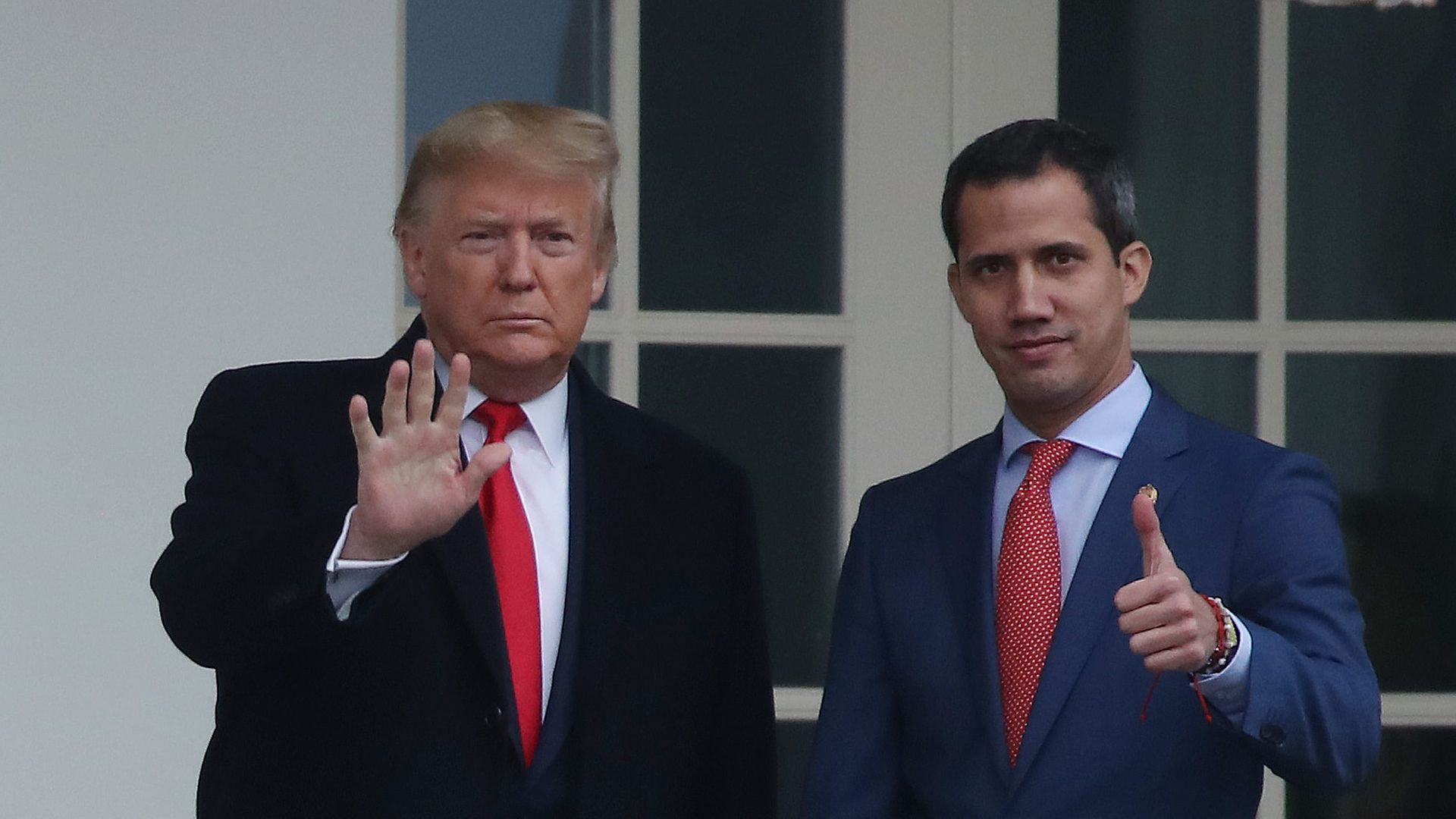
Trump and Juan Guiado
By Paul Antonopoulos | June 22, 2020

In what potentially could be a radical change in Washington’s policy towards Venezuela, U.S. president Donald Trump confessed that he has had doubts about his decision to recognize opposition leader Juan Guaidó as president of the South American country. Trump revealed in an interview with Axios in the Oval Office what he thinks about the self-proclaimed wannabe president of Venezuela, Guaidó, and even confessed that he “would maybe think” of meeting personally with Venezuelan President Nicolás Maduro, who has already publicly expressed his willingness to talk with the American president.

“Maduro would like to meet. And I’m never opposed to meetings — you know, rarely opposed to meetings. I always say, you lose very little with meetings. But at this moment, I’ve turned them down,” Trump said.

In a preview of the interview published by Axios, Trump revealed how little confidence he has in Guaidó because the politician failed to take control of the Venezuelan government despite the strong support provided by the U.S. and another 60 countries that recognize him as the legitimate president.

Asked by Axios whether he regretted his decision on backing Guaidó on the advice of John Bolton, his former National Security Advisor, Trump initially said “not particularly,” but then went on to say, “I could have lived with it or without it, but I was very firmly against what’s going on in Venezuela.”

In another part of the interview, Trump speaks directly of the moment when he decided to recognize the opposition leader as president: “Guaidó was elected [ED NOTE: Maduro is Venezuela’s elected president – Guaidó was only elected president of the National Assembly], I think that I wasn’t necessarily in favor, but I said — some people that liked it, some people didn’t. I was OK with it. I don’t think it was — you know, I don’t think it was very meaningful one way or the other” […]


via Trump slams Guaidó while expressing openness in speaking with Maduro

One Reported Dead, One Wounded in Overnight Capitol Hill Protest Zone Shooting — South Seattle Emerald

Quote

by JSeattle

(This article originally appeared on Capitol Hill Seattle Blog and has been reprinted with permission.)


One man was reported dead and another person was shot and wounded in an overnight shooting at the Capitol Hill protest zone.

Police have confirmed the shooting but have not released further details. It was not clear if any suspects were in custody.

UPDATE 10:10 a.m.: Seattle Police have confirmed CHS’s early reports on the shooting and say that a 19-year-old is dead and that there have been no arrests:

On June 20th, at approximately 2:30 AM, East Precinct officers responded to a report of shots fired in Cal Anderson Park. This is inside the area referred to as the Capitol Hill Organized Protest (CHOP). Officers attempted to locate a shooting victim but were met by a violent crowd that prevented officers safe access to the victims. Officers were later informed that the victims, both males, had [already] been transported to Harborview Medical Center by CHOP medics. Officers responded to Harborview and were informed that one of the victims, a 19-year-old male, had died from injuries. The other victim, also a male, unknown age, remains in the hospital with life-threatening injuries. The suspect or suspect(s) fled and are still at large. There is no description at this time. Homicide detectives responded and are conducting a thorough investigation, despite the challenges presented by the circumstances.

Police are asking for the public’s assistance in gathering evidence. Anyone with information about the shooting or who may have video from the incident is asked to contact the Seattle Police Department’s Violent Crime tip line at (206) 233-5000.

Multiple people reported hearing three to six gunshots from the area of 10th Avenue and East Pine Street around 2:20 a.m. Police radio updates described people seen fleeing to the north on 11th Avenue from East Pine Street and through Cal Anderson Park.

One victim was reported undergoing CPR in front of the Rancho Bravo restaurant at 10th and Pine before he was transported to Harborview by the protest camp medical volunteers. According to Seattle Police radio updates the man was dead when he arrived at Harborview. Livestreams from the camp in the wake of the shooting also showed a video of an announcement of the man’s death to the protest camp.

Screen capture of Google Map results for 921 E. Pine St., where Omari Salisbury reported on Twitter the incident took place. (Google Maps map data 2020)

A second victim was reported with a gunshot wound to the arm and chest. Seattle Fire was called to treat the victim but the victim was also driven by private vehicle to Harborview. We do not have more information on the second victim’s condition. UPDATE: Police say the second victim is a male who suffered life-threatening injuries.

Arriving police reported encountering hostile crowds after a large force assembled on the edge of the protest zone and entered the area on East Pine Street to secure the victim. He had already been driven from the scene by the time police arrived, according to East Precinct radio updates.

Police were collecting shell casings and evidence in the area and East Precinct radio reported video of the incident was being provided.

UPDATE: A security employee working in the area reported the shooter had been in a black SUV that arrived in the area on East Pine Street. A 911 caller told police a man carried a rifle out of the SUV before gunfire erupted, according to East Precinct radio updates. The man who was killed was hit by multiple shots on the southwest corner of East Pine Street in front of the Odd Fellows building. Camp security was reported following the suspect after the shooting. There have been no reported arrests by police.

The early Saturday shooting marks the second major gun violence incident at the Capitol Hill protests. Nikolas Fernandez has been charged with one count of first degree assault after police say he drove into a crowd of protesters at 11th Avenue and East Pine Street and shot a man, Daniel Gregory, attempting to disarm him in a June 8 incident.

The latest shooting comes at the start of a second week of occupation by protest crowds after police pulled out of the East Precinct building amid growing criticism of heavy-handed crowd-control tactics and an ongoing standoff with protesters marching against law enforcement violence and racism.

With the protest camp as a center, the Seattle effort had marked a handful of gains and promises from Seattle Mayor Jenny Durkan and SPD Chief Carmen Best of ongoing talks with activists and community groups and a review of police crowd control tactics. Since its formation upon the exit of police from the East Precinct building and the barriers at 12th Avenue and East Pine Strett on June 8, the camp was celebrated as a center of protest and also for its art and community even as there were also reports of open-carry enthusiasts joining the crowds and a regular presence of armed sentries posted around the area as part of camp security. The city worked out a new layout plan with protesters to better open the area to traffic and emergency vehicles but there was also a growing unease about Seattle Police’s limited presence in the zone around 11th and Pine and Cal Anderson Park […]

via One Reported Dead, One Wounded in Overnight Capitol Hill Protest Zone Shooting — South Seattle Emerald

Scientists’ Warning: Consumerism is the Leading Cause of the Environmental Crisis

Quote


Consumerism exists to sustain a widely adopted economic model built on the imperative of constant economic growth. A new study identifies consumerism in the wealthiest countries as the foremost cause of climate change, biodiversity loss and ecological collapse. Alternative economic systems are there and need to be embraced by public and political discourses.

A new study1 published in Nature Communications, led by Dr Thomas Wiedemann of the University of New South Wales, Australia, stresses that the issue of overconsumption especially in the wealthiest countries lays at the roots of the current environmental crisis, more so than population growth.

The study highlights that “it is clear that prevailing capitalist, growth-driven economic systems have not only increased affluence since World War II, but have led to enormous increases in inequality, financial instability, resource consumption and environmental pressures on vital earth support systems”. “The strongest pillar of the necessary transformation is to avoid or to reduce consumption until the remaining consumption level falls within planetary boundaries, while fulfilling human needs”.

It thus follows that tackling the environmental crisis would require a direct downscaling of economic production and consumption in the wealthiest countries. The study points out that “the world’s top 10% of income earners are responsible for between 25 and 43% of environmental impact. In contrast, the world’s bottom 10% income earners exert only around 3–5% of environmental impact”. The affluent lifestyles of the world’s wealthiest societies not only determine and drive global environmental and social impacts, but also disproportionally impact on the poor, who are most heavily affected by environmental catastrophes and in the worst positions to cope with them.

“Since the level of consumption determines total impacts, affluence needs to be addressed by reducing consumption, not just greening it”, reads the study. Envisioning future economies based on sustainable or green growth may be nothing but illusory, as the decoupling of economic growth from environmental impacts has never been achieved before. We need a shift away from prioritising economic growth in order to come out of the current crises triumphant […]


via Scientists’ Warning: Consumerism is the Leading Cause of the Environmental Crisis — Conservation in a click