Another Failed U.S.-Backed Coup Attempt in Venezuela Goes Unnoticed

Quote

Republished from MintPress News

Fresh off a successful military coup deposing leftist President Evo Morales in Bolivia last week, the United States attempted to overthrow the government of Nicolás Maduro in Venezuela this weekend. The events, however, went barely noticed outside the South American nation, as the attempt proved to be a complete fiasco.

U.S.-backed self-declared President Juan Guaidó, who had tried multiple times earlier in the year to depose Maduro to no avail, had long publicly targeted November 16 as the date of his latest insurrection, calling on all Venezuelans to rise up and fight in the streets against the “dictatorship.” That way, he explained on social media, they could build up national and international pressure on Maduro

The United States lent its considerable weight to the attempt. Secretary of State Mike Pompeo gave his blessing to the coup, stating:

Vice President Mike Pence took to Twitter to openly call for the military to overthrow Maduro as the Bolivian army had done to Morales:


U.S. Southern Command, responsible for all American military activity in Latin America and the Caribbean, effectively turned its social media accounts over to the coup, constantly sharing or retweeting pro-regime change messages from American officials or from Guaidó himself.

Yet, despite this enormous signal boosting online, the coup attempt fell completely flat, like in January, Venezuela’s armed forces failed to defect to Guaidó’s side. Furthermore, he was unable to muster significant public support in the streets, his demonstrations poorly attended with large counter-demonstrations neutralizing his efforts […]

via Another Failed U.S.-Backed Coup Attempt in Venezuela Goes Unnoticed — Red Revolution Media

Vote To Federally Legalize Marijuana Planned In Congress Next Week

Quote

By Tom Angell

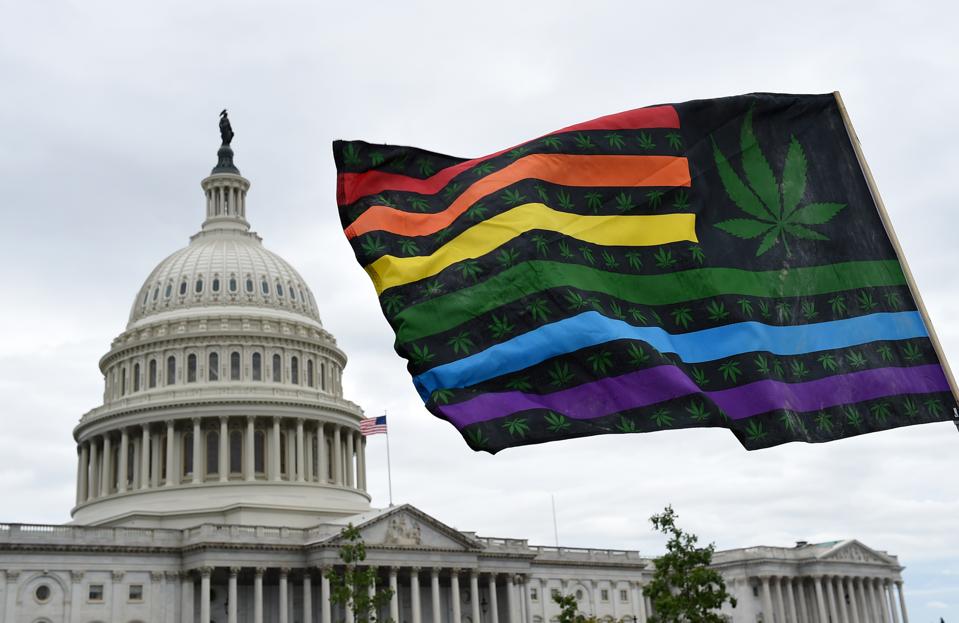
A key congressional committee plans to hold a historic vote on a bill to end the federal prohibition of marijuana next week, two sources with knowledge of the soon-to-be-announced action said.

US-POLITICS-CANNAIBIS
AFP VIA GETTY IMAGES

The legislation, sponsored by House Judiciary Committee Chairman Jerrold Nadler (D-NY), would remove cannabis from the Controlled Substances Act (CSA) and set aside funding to begin repairing the damage of the war on drugs, which has been disproportionately waged against communities of color.

Those programs—such as job training and legal aid for people impacted by prohibition enforcement, loans for small cannabis businesses owned and controlled by socially and economically disadvantaged individuals and efforts to minimize barriers to licensing and employment in the legal industry—would be paid for with a new federal five percent tax on marijuana sales instituted under the bill, and some of them would be administered by a new Cannabis Justice Office in the Department of Justice.

The proposal, the Marijuana Opportunity Reinvestment and Expungement (MORE) Act, would also provide for resentencing and expungement of records for people previously convicted of cannabis offenses and would shield immigrants from being denied citizenship status over marijuana.

It currently has 55 cosponsors, all but one of whom are Democrats.

A Senate companion is being led by Sen. Kamala Harris (D-CA), a 2020 presidential candidate, though it has not yet been scheduled for action in the GOP-controlled chamber.

via Vote To Federally Legalize Marijuana Planned In Congress Next Week

IACHR Denounces Bolivian De facto Government Releasing Military from Criminal Responsibility

Quote

Sputnik-América Latina
https://cdnmundo1.img.sputniknews.com/images//108934/12/1089341286.jpgThe Inter-American Commission on Human Rights (IACHR) denounced that the de facto government of Jeanine Áñez in Bolivia approved a decree that authorizes the military to participate in tasks of restoring internal order with “all means available” and exempts them from criminal responsibility […]


via IACHR Denounces Bolivian De facto Government Releasing Military from Criminal Responsibility

Bolivia: Coup-Born Government Threatens Independent Journalists

Quote

Supporters of Bolivia's President Evo Morales carry Wiphala flags as they block roads in El Alto, Bolivia, Nov. 15, 2019

Supporters of Bolivia’s President Evo Morales carry Wiphala flags as they block roads in El Alto, Bolivia, Nov. 15, 2019 | Photo: Reuters

Four Cuban officials were also accused of demonstrating against a de facto regime headed by Senator Jeanine Añez, who self-proclaimed president on Tuesday.

Independent journalists who are covering protests in Bolivia were accused of carrying out “sedition” by Communications Minister Roxana Lizarraga, who was paradoxically appointed by a US-backed government that emerged from a coup d’etat against the socialist President Evo Morales.

“Law will be fully enforced against those journalists or pseudo-journalists who are seditious, whether they are nationals or foreigners,” Lizarraga said and took the opportunity to blame Cuba and Venezuela for the ongoing social unrest in Bolivia.

“They want to put us on their knees,” she added and warned that the Interior Ministry already has a list of the journalists who are stirring up resistance or rebellion against the coup-born regime.

After these announcements, four Cuban officials were arrested and accused of demonstrating against the interim government headed by Senator Jeanine Añez, who self-proclaimed president on Nov. 12.

According to identity documents to which international journalists had access, however, the detainees are cooperating technicians who are part of the Cuban Medical Brigade.

Physician Ramon Emilio, economist Idalberto Delgado and electromedical engineer Amparo Lourdes are currently being held at the Police Operations Tactical Unit (UTOP) in La Paz. The fourth detainee’s identity is not yet known […]


via Bolivia: Coup-Born Government Threatens Independent Journalists

Google sucks up & analyzes healthcare data on millions of Americans in secret AI project… after voluntary opt-in flops

Quote

RT | November 12, 2019

Google has teamed up with one of the largest health providers in the US to gather detailed medical records on millions of patients across the country without their knowledge, in a secret project the firm tried to keep under wraps.

Dubbed “Project Nightingale,” the secretive program brought together Google and healthcare giant Ascension in an effort to collect medical records on patients across 21 states, according to a report in the Wall Street Journal. The data sharing began last year, and has only accelerated in recent months.

At least 150 employees at Google’s Cloud division now have access to the bulk of the data, which amounts to information on tens of millions of patients, according to a source familiar with the records.

The details shared include patient names and dates of birth, hospitalization records, lab results and doctor diagnoses, which together provide a complete medical history for many of the patients – all without their consent.

Google says it hopes to use the data to develop an application employing AI and machine learning to track patients and recommend treatments, and ultimately has its eye on creating a search engine that can aggregate disparate patient data in one place.

“Wow – this is downright alarming. Do you trust Google with your blood test results, diagnoses, sensitive health information?” asked attorney and Republican National Committee member Harmeet K. Dhillon in a tweet. “Google’s secret ‘Project Nightingale’ gathers personal health data on millions of Americans.”

The company launched Google Health in 2008, but shuttered it less than four years later after failing to persuade enough users to hand over their medical records willingly, perhaps uncomfortable with the firm having access to such sensitive information. The tech giant has since cut individual consent out of its quest to amass healthcare data, going over the heads of patients to make deals with health providers instead […]

via Google sucks up & analyzes healthcare data on millions of Americans in secret AI project… after voluntary opt-in flops

US Shale Oil Boom Rapidly Going Bust

Quote

“U.S. shale is slamming on the brakes”

by Nick Cunningham via OilPrice.com,

A few high-profile shale executives say the glory days of shale drilling are over

In a round of earnings calls, the financial results were mixed. A few companies beat earnings estimates, while others fell dramatically short.

But aside from the individual performances, there were some more newsworthy comments from executives on the state of the industry. A common theme emerged from several notable shale executives: the growth frenzy is coming to an end.

The chief executive of Pioneer Natural Resources, Scott Sheffield, said that the Permian basin is “going to slow down significantly over the next several years,” and he noted on the company’s latest earnings call that the company is also acting with more restraint because of pressure from shareholders not to pursue unprofitable growth.

“I’ve lowered my targets and my annual targets, a lot of it has to do with…to start with the free cash flow model that public independents are adopting,” Sheffield said.

But there are also operational problems that have become impossible to ignore for the industry. He listed several factors that explain the Permian slowdown: “the strained balance sheets lot of the companies have, the parent-child relationships that companies are having, people drilling a lot of Tier 2 acreage,” Sheffield said. “So I’m probably getting much more optimistic about 2021 to 2025 now in regard to oil price.” In other words, U.S. shale is slamming on the brakes, which may yet engineer a rebound in global oil prices […]


via US Shale Oil Boom Rapidly Going Bust

Communiqué of the Movement to Socialism (MAS-IPSP)

Quote

Posted by Internationalist 360°

Against the backdrop of the media siege that confronts the truth in our country, the Movement Toward Socialism communicates to the Bolivian people and the international community that since November 10, 2019 a plan of assassination by the UMOPAR and the Bolivian Police was activated during the final phase of the coup d’état against our leaders Evo Morales and Álvaro García, which is why the Mexican government’s offer of asylum was accepted.

During the entire day of November 11, the coup plotters put the lives of our leaders Evo and Álvaro at serious risk, first with public threats from police to proceed with operations to apprehend them, then with the closure of our air space, preventing the entry of the Mexican plane that came to pick them up with administrative obstacles under the responsibility of the Bolivian Air Force.

The Bolivian people are living through terrible moments, with police officers and motorcyclists storm the streets and the military high command deciding to attack the citizens as a means of pacification, including preventing prominent people, religious leaders and political leaders from finding constitutional and democratic solutions to the crisis we are facing.

The military are in the streets, shooting at our people from helicopters in Cochabamba, mobilizing tanks, troops and weapons in La Paz to annihilate our people simply for resisting injustice and outrage, racism, violence and the infamous strategy of preventing our leaders from continuing to lead the country.

The coup d’état was a construction of several stages, first installing the idea of electoral fraud to generate disorder in the streets, denying our victory, and using the OAS audit report, distorting its content, when it categorically speaks of irregularities and not fraud; then asking for the nullification of the elections, then the resignation of our leaders, to finally concretize their strategy with the police mutiny, coordinating the anti-democratic plan, installing a regime of terror, threats and persecution […]

via Communiqué of the Movement to Socialism (MAS-IPSP)

Fascist Senator Appoints Herself President of Bolivia

Quote

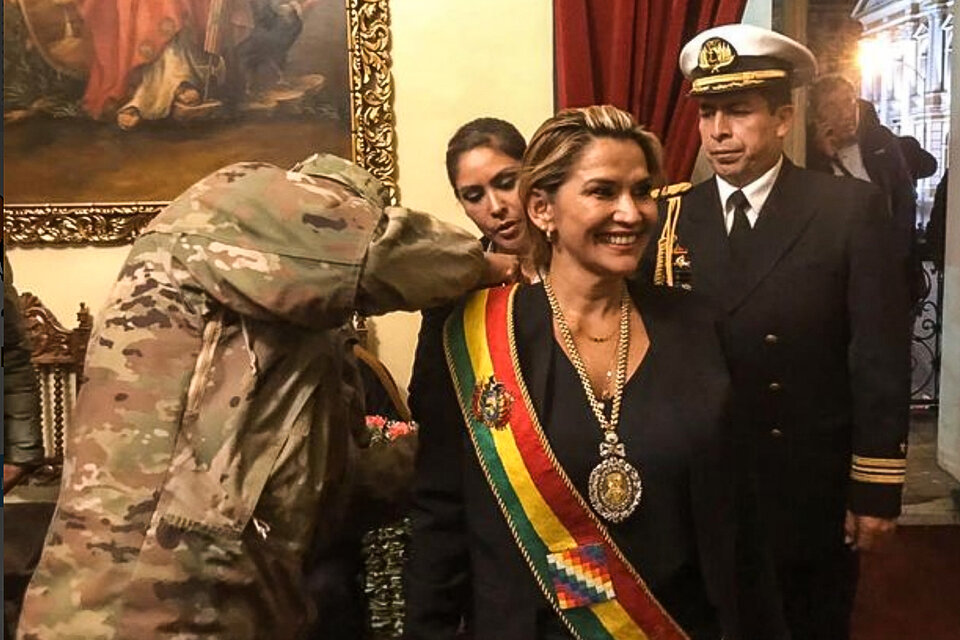
Marco Teruggihttps://images.pagina12.com.ar/styles/focal_3_2_960x640/public/media/articles/29837/banda.jpg?itok=ZgOchmZB“It was possible,” said Jeanine Añez at the end of her speech after proclaiming herself president of Bolivia. As she spoke, you could hear them whispering to her what to say. Then she went to the presidential balcony and saluted wearing the tricolor sash. Thus ended one of the most important phases of the coup d’état in Bolivia: building an institutional fiction.

Añez proclaimed herself outside the Constitution and without a quorum. It was known that this was the only way to do it, since the majority in both chambers belong to the Movement Towards Socialism (MAS) and that the decision was made not to hold a session.

Añez, therefore, first proclaimed herself president of the Senate – a figure who must assume the position of interim president after the resignation of the president and vice-president – and then proclaimed herself president. There followed the applause of the few people present in the precinct.

This step was essential in the strategy of a coup d’état that always had the objective of presenting itself as democratic. From the beginning, this presentation had the backing of the United States, as well as the Secretary of the Organization of American States, Luis Almagro, who on Tuesday accused Evo Morales of carrying out a coup d’état, accompanied by a protective media machine.

However, even with those endorsements, the absence of a formal presidency created a governmental vacuum – and the real authorities continued to function – that had to be resolved. The leading bloc then decided to accelerate the process by jumping over all legality to place the sash on the shoulders of their chosen person.

None of this would have been possible without the participation of those who hold the actual power. Morales, who arrived in Mexico in the morning with Álvaro García Linera, denounced that Añez proclaimed herself “surrounded by a group of accomplices and supported by the Armed Forces and Police that repress the people”.

It was not a political image: the police and the military repressed while Añez and the entire right wing celebrated in Bolivia. It happened in the center of La Paz, around Plaza Murillo, where all afternoon there was a mobilization led by those who came down from the city of El Alto, one of the places where the country’s biggest protests took place.

The mobilization of El Alto was one of the points of greatest conflict. On Monday the first moment of the uprising took place -its genesis had been on Saturday night- with thousands of men and women in their great majority belonging to the Aymara nation. That day ended with three dead. The images were of blood stains on the streets.

On Tuesday the arrival to La Paz was announced, and the residents of the city center locked themselves in their houses, while others went out to applaud the massive mobilization holding the Whipala flag.

The street action again showed the power of El Alto, at the same time that it evidenced a directional struggle, similar to the one that occurred in the days before the coup d’état was consummated and where now the different parts of the process of change are.

In El Alto, where daily town meetings are held, the demonstrations are not the only events in progress. The Coordinadora de las Seis Federaciones del Trópico called for mobilization on Thursday, and the Confederación Sindical Única de Campesinos de Bolivia decreed a plan of struggle to block the country’s highways and generate a siege on the city of La Paz that, 48 hours after the coup, has begun to present difficulties in the supply of gasoline and food due to the fact that many stores are closed.

Against this backdrop, the Central Obrera Boliviana (COB) announced “48 hours to re-establish constitutional order”. Will the COB consider what happened with Añez a re-establishment of constitutional order or will it embark on a general strike?

There are many questions regarding the situation in Bolivia, advances made by those who lead the coup bloc, as well as the growth of resistance in a situation where information channels are few. It is difficult to know what is happening, both in the political epicenter of the debates, and in different areas of La Paz, El Alto, and in particular in the most remote, rural areas of the country.

There are numerous reports of deaths, repression, humiliation, persecution, within the context of a coup offensive which, before overthrowing Morales, unleashed a wave of violence with armed shock groups, which, once in power, with or without a government, has maintained its offensive in order to decapitate the process of change […]


via Fascist Senator Appoints Herself President of Bolivia

Bolivia: President Evo Morales Resigns Amid Right-Wing Coup

Quote

Bolivian President Evo Morales was forced to resign Sunday after two weeks of right-wing violence.

Bolivian President Evo Morales was forced to resign Sunday after two weeks of right-wing violence. | Photo: teleSUR

His resignation came after senior army heads asked them to resign amid right-wing violence and coup attempt for weeks since the Oct. 20 elections.

Bolivian President Evo Morales was forced to resign Sunday after senior army and police chiefs called on him to do so following weeks of right-wing unrest and violence against his Oct. 20 elections victory, in what his government has called a coup by opposition forces in the country.

“I decided to resign from my position so that Carlos Mesa and Luis Camacho stop abusing and harming thousands of brothers … I have the obligation to seek peace and it hurts a lot that we face Bolivians, for this reason, so I will send my letter of resignation to the Plurinational Assembly of Bolivia,” the former president of Bolivia said in a press release.

Bolivian Vice President Alvaro Garcia Linera also said that he was resigning from his position. The two leaders said that they would be handing their resignation letters to the country’s National Assembly.

Since both President and Vice Presiden resigned, the president of the Senate, a position held by Adriana Salvatierra of the MAS party was supposed to assume the post but she later issued her resignation as well as the president of the Chamber of Deputies.

Currently, the line of succession is broken in Bolivia.

Morales and Garcia Linera will stay in Chimore in the central Department of Cochabamba to work with the people.  “We will come back and we will be millions as Tupac Amaru II said,” Morales declared.

The resignation comes after Morales proposed a dialogue process with the opposition parties but was rejected and even accepted the Organization of American States’ (OAS) call for new elections.

However, due to strong violent onslaughts against militants and leaders of the Movement To Socialism (MAS), intimidation of journalists, burning of residences and betrayal of political allies and members of the National Police, Morales and his Vice President decided to leave the government in order to prevent more violence.

In the interview with teleSUR’s correspondent in Bolivia Freddy Morales, the former president said the decision to call new elections was to preserve the peace in Bolivia “so that we do not confront the Bolivian family,” while calling on the opposition protesters to end the strikes and remove roadblocks in order to not harm the economy of the country […]

via Bolivia: President Evo Morales Resigns Amid Right-Wing Coup

“It’s Now or Never”: Bolivian Elite Destroying the Country

Quote

By Edu Montesanti
A protester against Bolivia's President Evo Morales fires a weapon during clashes with government supporters in La Paz, Bolivia November 7, 2019.

A protester against Bolivia’s President Evo Morales fires a weapon during clashes with government supporters in La Paz, Bolivia November 7, 2019. | Photo: Reuters

To the Bolivian upper classes, President Evo Morales has to resign even if forced by extreme violence, or through a civil war.

“It’s now or never!”, said a family in Santa Cruz de la Sierra, gathered close to Christ the Redeemer statue where thousands of demonstrators and road blockers stay seven days of the week, night and day.

That statement was in response to this reporter’s observance, that circumstances in Bolivia were getting out of control leading to a civil war. Answering that, the family laughed and did not hesitate in declaring: “We want things to get out of control. This is the only way to overthrow this president, once and for all.”

Violence, Our Daily Bread

For almost 20 days, the South American country is at an economic standstill, as opposition groups block roads and prevent trade, with a few short exceptions for markets.

However, walking by The Ramada commercial center in downtown Santa Cruz de la Sierra, one sees almost every business with open doors, an act of defiance towards the rebel leaders of the national strike.

“Nobody in this area supports the strike,” one merchant told this author. “In the city, generally, not everybody opposes the President. On the contrary, I could say people are divided,” added the old woman, who owns a large store in The Ramada.

The owner’s daughter added: “Nobody did for Bolivia what President Evo Morales has done. He has granted several rights to workers, as no president did before. This is one thing that angers the elite.”

Everybody has been afraid to speak publicly, given the uncertainty and virulence of the currently protests. Recently, in this area, a woman spoke out against the strike saying people want and need to work as there is no money nor food anymore. She was beaten and obliged to kneel and ask demonstrators for forgiveness.

In regions like Cochabamba, Potosi, and La Paz, the situation is more tense, with frequent clashes between pro-government and opponent groups, and several wounded. In Cochabamba, a 20-year old man was killed last Wednesday, a victim of severe head injury, skull base fracture and brain death due to confrontations, which grow more and more. The civil war is fastly advancing in Bolivia.

Fury without Rationality

The following has been a rule in Bolivia, before the last presidential election: the opposition spills their hate against the local government, especially against President Evo Morales but when confronted with some official data, internationally recognized in favor of the first indigenous president of the nation, criticism change its direction.

What had seen strong condemnations against the “situation of the country”, quickly changed to “a future dictator if many years in power.” So they start to explain their political theories about more than two or three mandates in the Presidency. And so, they create their conjectures.

Angela Merkel has been the German Prime-Minister since 2005, as her country has a solid democracy not questioned in Bolivia nor nowhere around the world. What determines a strong democracy in a country, is the solidity of its institutions.

Last Monday evening, the biggest demonstration against President Evo Morales since the elections on Oct. 20, took place in Santa Cruz de la Sierra.

“We will siege every government institution including tax collectors ones, and national borders, so the government won’t collect one cent. Evo is going to be a president without a State!”, said in the demonstration Luis Fernando Camacho, the leader of the current national strike based out in Santa Cruz de la Sierra.

Camacho’s biography and ancestry, outlined below in this report, is another serious indication that what is advancing in Bolivia is a Color Revolution, idealized by the American Gene Sharp [see The CIA and Nonviolence] to overthrow governments all over the world who refuse to align to the Washington regime.

President Evo Morales has challenged the opposition to give evidence of fraud to the Organization of American States (OAE), which has been auditing the Bolivia election. So far, nobody presented any piece of evidence of fraud regarding the last presidential election; the opposition claim, since OAS arrival to audit the elections, they do not want any audit nor a runoff anymore, but Morales’ resignation and new elections.

This reporter has checked people lost in their observances, as emotions overflowed. One of the features of a Color Revolution. It has been this way in Syria, Egypt, Tunisia, Libya, Brazil, and other countries lately.

There are other features in these protests is in Bolivia, clearly pointing to a Color Revolution.

Paying for Demonstrators

There have been witnesses that road blockers have gotten 200 bolivianos (US$29) per day. A woman confirmed that information to this author, who says she has met a road blocker who has spoken to her about it.

Camacho has admitted  he paid 1,200 bolivianos (US$174) to a Cruceñista Youth Union member to burn the Electoral Tribunal in Santa Cruz de la Sierra on Oct. 23.

The businessman also funds all kinds of demonstrations against the current government, “and always did [before the elections],” which included the attacks against several official party’s head offices across Santa Cruz de la Sierra, on Sept.12.

U.S.-Backed Groups

Recent revelations point to a U.S.-backed plan of shaking the nation. The Radio Education Network of Bolivia (Erbol) has released 16 audios, which uncover talks between U.S. officials, Bolivian opponents, and former military.

In a three-part plan outlined by U.S. officials, former President Gonzalo Sanchez de Lozada (2002-2003) is mentioned. Lozada had Carlos Mesa (the principal opponent of Morales in the last election) as his vice-president and currently lives in the U.S.

U.S. senators Bob Menendez, Ted Cruz, and Marco Rubio are some of the American officials mentioned in the audios, linked to the Bolivian opposition planning a coup against President Evo Morales.

Officials of the State Department accredited in the country, such as Mariane Scott and Rolf A. Olson, have been meeting with high level diplomatic officials from Brazil, Argentina, and Paraguay, in order that they organize and plan destabilization actions against the Bolivian government, as well as delivering the U.S. funds to the Bolivian opposition […]
via “It’s Now or Never”: Bolivian Elite Destroying the Country