With Trump/Democrat Encouragement, Hong Kong Protest Spreads To Mainland

Quote

Police and protesters stand off outside government offices in Wenlou, Guangdong
Police and protesters stand off outside government offices in Wenlou, Guangdong 

A Chinese town has been forced to abandon plans to build a crematorium after residents took a cue from protesters in Hong Kong by taking to the streets, chanting a similar slogan and setting up barricades.

Hundreds of people in Wenlou clashed with riot police after learning that the authorities had included a crematorium in a proposed £8 million ecological park without notifying the public. In China crematoria are seen as inauspicious.

The demonstrators in Wenlou, which is about 60 miles from Hong Kong, chanted “revolution now”. One villager told a newspaper: “Just like Hong Kong, the protests have broken out throughout the township.” A township is a municipality with its own governance […]


via With Trump/Democrat Encouragement, Hong Kong Protest Spreads To Mainland

Iran arrests 8 ‘linked to CIA’ during unrest

Quote

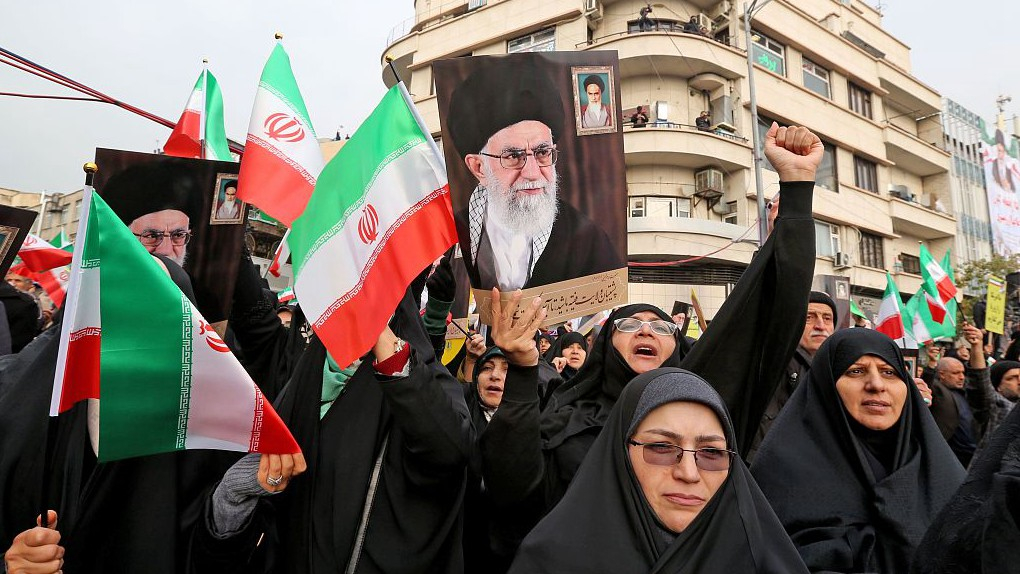
Iranian women holding national flags and pictures of the Islamic republic’s supreme leader, Ayatollah Ali Khamenei, take part in a pro-government demonstration in Tehran, November 25, 2019. /VCG Photo


Iranian security agents arrested at least eight people linked to the U.S. Central Intelligence Agency (CIA) during last week’s unrest over gasoline price hikes, the official news agency IRNA reported on Wednesday.

“These elements had received CIA-funded training in various countries under the cover of becoming citizen-journalists,” the Intelligence Ministry told IRNA.

Among them, “six were arrested while attending the riots and carrying out (CIA) orders and two while trying to… send information abroad,” said ministry authorities.

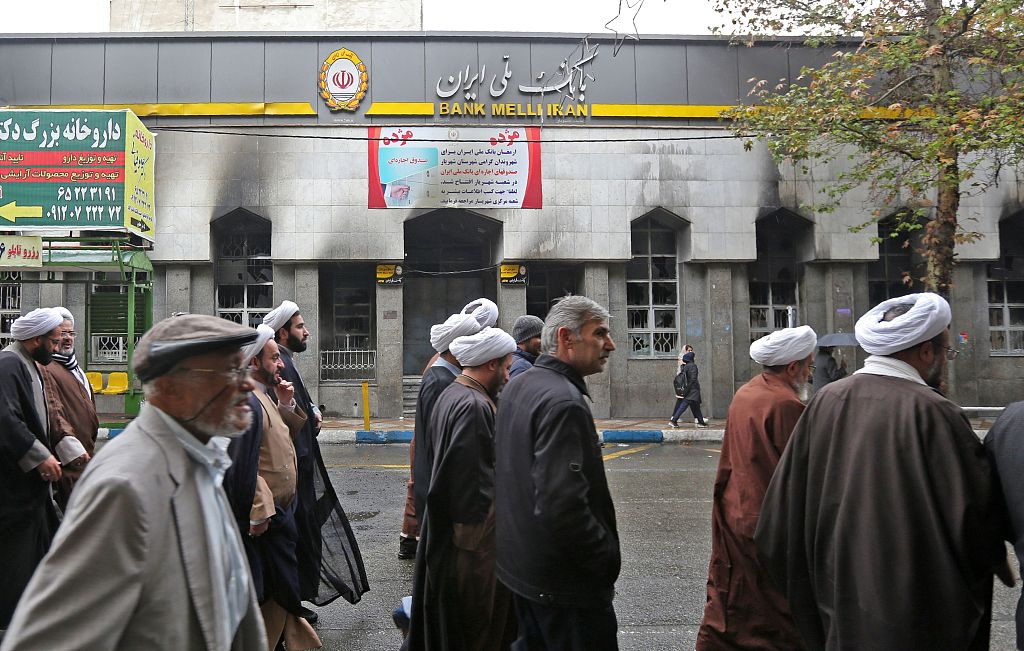
The unrest, which began in October, soon lost control with banks, petrol pumps and police stations vandalized in some areas by protesters.

Iranian officials have so far confirmed five fatalities and around 500 arrests, while some organizations gave largely different numbers indicating more deaths.

The branch of a local bank that was damaged during demonstrations against petrol price hikes in Shahriar, west of Tehran, November 20, 2019. /VCG Photo


Upon the end of the fuel protest, Iranian Supreme Leader Ayatollah Ali Khamenei said on Wednesday that the violent turnout following the oil price hike was a plot set by the United States.

“The people foiled a deep, vast and very dangerous conspiracy on which a lot of money was spent for destruction, viciousness and the killing of people,” said Khamenei on the state TV.

Condemning the U.S. interference in the unrest and showing support for the Iranian government, large numbers of Iranians across the country went on the street holding slogans and images of their leaders on Wednesday.

It was not the first time that the ministry claimed that they identified CIA affiliated spies in the nation.

Back in July, the agency said that they had arrested in total 17 by March 2019, the end of last Iranian calendar year. Some received death penalty and some were sentenced to long imprisonment […]


via Iran arrests 8 ‘linked to CIA’ during unrest–state media

Smash Patriarchy to free Women, curb Climate Change and save the Planet

Quote

shared from Al Jazeera. ….Smash the patriarchy to save the planet Most illustrations added

The same forces that feed into the violence against migrant women are also undermining climate action.

Belen Fernandez

by Belen Fernandez 25th Nov 2019

Maria Meza, a migrant woman from Honduras, runs away from tear gas with her five-year-old twin daughters Saira and Cheili at the US-Mexico border on November 25, 2018 [File: Reuters/Kim Kyung-Hoon]

Last December, the Trump administration enacted a scheme requiring Central American asylum seekers to remain in Mexico while their legal proceedings drag on indefinitely in the United States.

The Migrant Protection Protocols policy – a handily perverse euphemism – is the approximate equivalent of calling the Exxon Valdez oil spill the Marine Life Protection Initiative. As various human rights and advocacy organisations have pointed out, the border programme has exposed tens of thousands of asylum seekers to violence; including rape, kidnapping and assault, in the unsure border regions of Mexico.

In light of the surplus of rapes and other abuses already documented as a result of so-called “protection”, the International Day for the Elimination of Violence against Women – marked annually on November 25 – is an ideal occasion to reflect on the violence facing migrant women in an era of mass migration.

Pervasive violence

As the UN Women website observes : ” Rape is rooted in a complex set of patriarchal beliefs, power, and control that continue to create a social environment in which sexual violence is pervasive and normalised.”

The feminist revolution in Rojava, N.Syria, shows how patriarchy can be defeated, even in a rural and strictly religious society. The revolution is now being destroyed by a Turkish invasion with a strongly patriarchal mentality. The Rojava kurds formed the SDF (Syrian Democratic Forces) in 2015 and welcomed dozens of Arab, Assyrian, yazidi, Christian..militias into a common front, spreading their revolutionary methods (eg in Manbij Council).Yazidi women victims have formed their own militia within SDF and recently the first arab women’s militia has been formed (July ’17). There are profound feminist implications in the context of previous extreme social repression.

For an idea of the extent of normalisation, just recall Patriarch-in-chief President Donald Trump‘s own previous advice about fondling women without their consent: “Grab ’em by the p****.”

Migrant women, of course, are particularly vulnerable to “grabbing” – and much worse – especially given that crimes against migrants are not generally reported or prosecuted. And for Central American women transiting Mexico to the US border, sexual assault is frequently par for the course.

Lest anyone assume that this validates the Trumpian vision of Mexico as composed of rapists and criminals , however, just recall the epidemic of rape in the US’s own military – not to mention rampant claims of sexual abuse of immigrant children held at US detention facilities […]


via Smash Patriarchy to free Women, curb Climate Change and save the Planet

Finally Charged and Lacking a Mandate to Govern, Netanyahu’s Days are Numbered

Quote

By Jonathan Cook – The National – November 25, 2019

The decision to indict Israeli Prime Minister Benjamin Netanyahu on three separate criminal counts pushes the country’s already unprecedented electoral stalemate into the entirely uncharted territory of a constitutional crisis.

There is no legal precedent for a sitting prime minister facing a trial – in Netanyahu’s case, for bribery, fraud and breach of trust. Former Israeli prime minister Ehud Olmert was charged with corruption in 2009 but only after he had resigned from office.

Israeli commentators are already warning of the possibility of civil war if, as seems likely, Netanyahu decides to whip up his far-right supporters into a frenzy of outrage. After a decade in power, he has developed an almost cult-like status among sections of the public.

The honorable thing would be for Netanyahu to step down quickly, given that the two elections he fought this year ended in deadlock. Both were seen primarily as plebiscites on his continuing rule.

He is now the country’s caretaker prime minister, in place until either a new government can be formed or an unprecedented third election is held.

His departure would end months of governmental near-paralysis. The path would then be clear for a successor from his Likud party to negotiate a deal on a right-wing unity government with rival Benny Gantz, a former army general […]


via Finally Charged and Lacking a Mandate to Govern, Netanyahu’s Days are Numbered

Bolivia Coup Regime Agrees to Withdraw Military from the Streets

Quote

https://images.pagina12.com.ar/styles/focal_3_2_960x640/public/media/articles/32154/documento.jpg?itok=dH8hlvF0


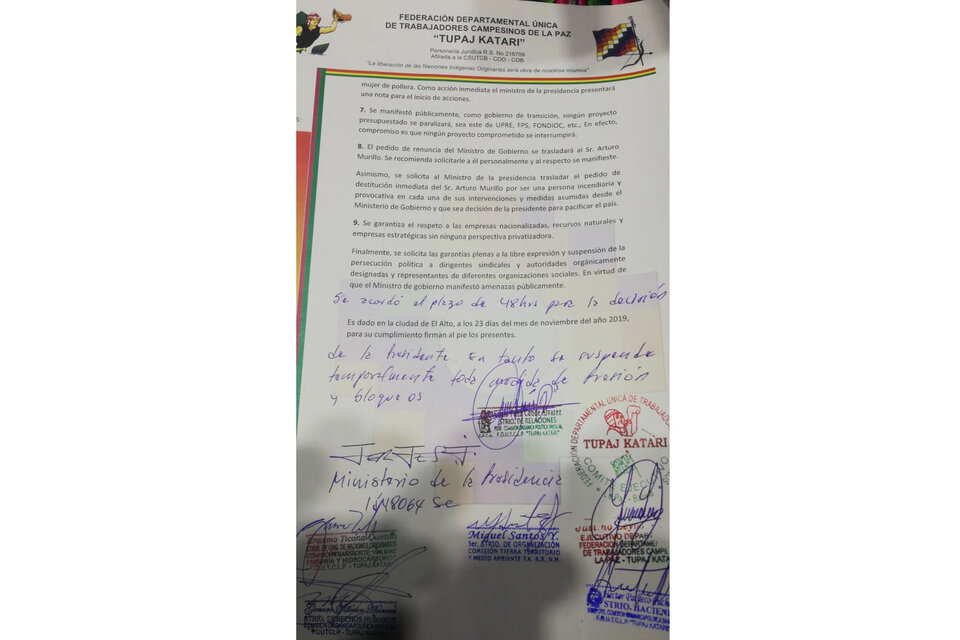
Yesterday, the Minister of the Presidency of the Bolivian coup regime accepted eight of the nine demands presented by the peasant and social organizations of La Paz. The agreement, signed by Minister Jerjes Justiniano, removes the military from the streets of the country, frees those arrested in the protests, promises economic reparations to the victims of the repression and the continuity of certain policies of the government of Evo Morales. The pact was signed by Minister Justiniano on stationery of the organization Tupaj Katari (see facsimile), which is the Departmental Federation of Peasant Workers of La Paz, along with representatives of social organizations.

The points of the pact are:

* Abrogation of the decrees that exempt the Armed Forces from criminal responsibility in the repression.

* Immediate withdrawal of the military.

* General elections before January 22.

* Release of those detained in law enforcement operations, guarantees to union leaders and no persecution.

* Economic compensation and medical care for the wounded and compensation for the families of the victims of police and military repression.

* Respect for the Whiphala (the indigenous flag) and prosecution of the policemen who mistreated the patriotic symbol.

* Continuity of the projects of Evo Cumple and others of the previous government.

* Removal of Arturo Murillo from the post of Minister of Government.

* Respect for natural resources and not dispossession.

[…]

via Bolivia Coup Regime Agrees to Withdraw Military from the Streets

Anti-Russian sanctions based on fraudster’s tales? Der Spiegel finds Magnitsky narrative fed to West by Browder is riddled with lies

Quote

RT | November 24, 2019

British investor Bill Browder has made a name for himself in the West through blaming Moscow for the death of his auditor, Sergey Magnitsky. Der Spiegel has picked apart his story and uncovered its major credibility problems.

For years Browder – Russian President Vladimir Putin’s self-proclaimed “enemy number one” and head of the Hermitage Capital Management fund – has been waging what can only be described as his personal anti-Russian campaign.

The passionate Kremlin critic relentlessly lobbied for sanctions against Russian officials everywhere from the US to Europe – all under the premise of seeking justice for his deceased employee, who died in Russia, while in pre-trial detention, where he’d been placed while accused of complicity in a major tax evasion scheme.

Browder, who was himself sentenced in absentia by a Russian court to nine years in prison for tax evasion, and was later found guilty of embezzlement as well, presented Magnitsky as a fearless whistleblower who exposed a grand corruption scheme within the Russian law enforcement system, and who was then mercilessly killed out of revenge.

The investor has succeeded in feeding this narrative to the Western governments and the mainstream media alike, prompting the US to adopt the Magnitsky Act in 2012, which allowed the US to sanction numerous Russian officials and businessmen over alleged human rights violations. Some American allies, including Canada and the UK, later followed suit and passed similar motions, which either allowed the sanctioning of Russian officials or called on their governments to do it.

Yet, the businessman, who has over the years donned the mantle of a human rights campaigner, does not plan to stop at that and is now lobbying for an EU-wide equivalent of the Magnitsky Act, which would allow the banning of Russian officials from the bloc’s countries and the freezing of their accounts.

On the tenth anniversary of the auditor’s death, the German weekly Der Spiegel has decided to take a closer look at Browder’s story about Magnitsky. And the paper found out that the narrative doesn’t quite flow as smoothly as Western politicians and the MSM would like it to.

No hero

The whistleblower image Browder has built for Magnitsky starts splitting at the seams from the very beginning, as Browder appears to be dishonest, even in minor details like his claim that Magnitsky was his lawyer, Der Spiegel’s Benjamin Bidder reveals in his investigative bombshell.

The problem is that he was not. The man was an auditor, who was hired by Browder’s company as a tax specialist and then worked in this capacity for years with the US-born British investor. Browder himself had to admit this fact when he was questioned in a US court while seeking to make the US impose sanctions on yet another group of Russian entrepreneurs.

Magnitsky’s role as a whistleblower also comes into question as the deceased auditor’s former lawyer confirmed to Der Spiegel’s Bidder that his client had, in fact, been summoned by Russian investigators to provide testimony in a tax evasion case that opened at least months before he came up with his corruption allegations.

Other documents obtained by Der Spiegel, including Magnitsky’s unpublished emails, also suggest that Magnitksy acted not of his own volition but on the instructions of Browder’s senior lawyer, at a time when the Russian authorities had already been investigating dubious letterbox companies Browder supposedly had used in his tax evasion scheme for years.

Finally, the records of Magnitsky’s interrogation, released by Browder’s own people on the internet and seen by Der Spiegel, show that he’d never explicitly accused Russian police officers Artyom Kuznetsov and Pavel Karpov, whom Browder declared to be the masterminds behind the supposed corruption affair, and ultimately behind the auditor’s murder.

This fact was also implicitly confirmed by a UK court, which issued a ruling on a libel lawsuit filed by Karpov against Browder in 2012. Although the court ruled that Karpov simply had no prior reputation to defend in the UK and rejected his claim, it still called Browder a “storyteller,” arguing that he could not even come “close to substantiating his allegations with facts.” The British media, however, presented the verdict as a resounding victory for Browder.

No murder

The German weekly also found similar inconsistencies in the story of the auditor’s supposed murder, as told by Browder. In his claims, the businessman constantly refers to a report by the Moscow Public Monitoring Commissions (PMC) – an independent, non-governmental body consisting of rights advocates that conducted its own thorough investigation into Magnitsky’s death.

Browder maintains that Magnitsky was deliberately murdered. Yet, the commission’s report, which is still freely available on its website, contains no claim of this sort. The commission does decry the harsh jail conditions which the auditor was kept in, and accuses the Russian authorities of failing to fulfill its duty to protect his life. However, it says nothing of murder.

It is not just the text of this report that Browder has apparently distorted, though. In August, the European Court of Human Rights (ECHR) issued a ruling on Magnitsky’s case, ordering Russia to pay his widow and mother €34,000 ($38,000) in damages.

Browder was quick to hail this decision as “destroying the Russian government’s narrative” and proving that “the Russian government murdered Magnitsky.” However, it would seem Browder’s own narrative was dealt a blow instead.

The ECHR never even mentioned the word “murder” in its ruling. Instead it said that Russia basically failed “to protect Mr Magnitsky’s right to life” by providing inadequate medical care and failed “to ensure an effective investigation into the circumstances of his death.”

It even concluded that Magnitsky’s arrest “was not arbitrary, and that it was based on reasonable suspicion of his having committed a criminal offence” – though it did also say there was no “justification” for his lengthy pre-trial detention […]


via Anti-Russian sanctions based on fraudster’s tales? Spiegel finds Magnitsky narrative fed to West by Browder is riddled with lies

Why paper planners are making a comeback

Quote

By Nicole Karlis

Those of us born in the 1990s or earlier likely have fond memories of our paper planners from our grade school days. Though ostensibly designed for keeping track of homework assignments and due dates, I used mine to count down the days to field trips and school dances, to write myself short notes in the moment, and to scribble the initials of my crushes. Indeed, picking out my yearly planner was the highlight of my back-to-school shopping ritual. Initially, the blank pages were exciting — they implied a big adventure ahead. Yet by the end of the year, those pristine pages looked like they had been scorched in a fire: edges torn up and ripped apart from getting caught on backpack zippers; tasks written over with notes by friends. Still, that degradation told a story of a year of life, one that I could look back on and remember.

By the time I got to college, Outlook and Googles’ e-calendars supplanted my paper planner habit. Like most elder Millennials, my life transitioned from analog to digital right as adulthood set in. And though it’s been over a decade since I made the jump to full-digital planning, I am not convinced my organizational means are superior. So last month, I made the transition —  back to paper.

I’m not the only one of my generation to go paper. In fact, I’m late to the trend. On Instagram, #planneraddict has nearly 4.8 million mentions. Sales of paper planners increased 10 percent between 2015 and 2016, when the market hit $342.7 million in sales.

What accounts for this shift? I have my own personal experience I can speak to, but I can only speculate as to why others have gone paper. There are benefits to the physicality of paper, but it also seems to be an exercise in simplicity and nostalgia. Paper planners don’t constantly interrupt us with notifications; they don’t demand our attention; they don’t want anything from us, and they don’t ask us to charge them every evening.

My paper experiment seems to have worked well in my own life. Since I’ve transitioned to paper, I haven’t double-booked a night out. I schedule in exercise, writing, and walking the dog. I rarely miss an appointment, as my calendar has its own dedicated physical space, rather than occupy an ephemeral smartphone screen for a few seconds. It would appear, then, that my childhood methods of planning were superior to Google Calendar.

Researchers of consumer culture have argued that the rise in popularity of analog devices and physical media — for example, vinyl’s paradoxical comeback— extends beyond nostalgia. Instead, researchers say consumers are attracted to analog’s perceived sense of coolness; likewise, the resurgence of physical formats relates to younger generations’ curiosity for a pre-digital era. Moreover, nostalgia is a powerful emotion and it can be used as a coping mechanism for anxiety and transitions, both of which apply to this moment in time.

Amy Baker, a mediator based in Seattle, said she tried for years to use iCal and Google Calendar, but it was always a “bust.”

“Either I entered the wrong date, or my iPhone just freaked out and changed the date,” Baker told Salon. “I can build a website and write killer academic papers accessing libraries around the world, so I don’t just think it’s a technophobe problem when I say that switching back to a paper planner has made my life so much better and easier.” […]

via Why paper planners are making a comeback -NICOLE KARLIS NOVEMBER 22, 2019 11:59PM (UTC) — Just Sayin’

For the First Time Ever, Marijuana Legalization Bill Clears Congressional Committee

Quote

Vote To Federally Legalize Marijuana Planned In Congress Next Week

For the First Time Ever, Marijuana Legalization Bill Clears Congressional Committee

Photo: Ed Andrieski (AP)


A bill to remove marijuana from federal controlled substances lists, expunge federal convictions and arrests, and allocate resources to communities that have suffered under the U.S. government’s war on drugs passed 24-10 in the House Judiciary Committee on Wednesday, ABC News reported.

Passing a bill through committee is just one step on the road towards a piece of legislation becoming law. Rolling Stone reported that it must pass through several other House committees, and the Republican-controlled Senate is unlikely to move on it. But the Marijuana Opportunity Reinvestment and Expungement Act of 2019 (MORE Act) is the first marijuana-legalization bill to ever pass committee stage in the federal legislature. In addition to the aforementioned provisions, the MORE Act would also create a Cannabis Justice Office and levy a five percent tax on the sale of marijuana in states which have already legalized the drug. The bill would still leave it up to individual states as to whether to remove their own penalties against marijuana—federal authorities have already loosened enforcement in those states.

Polls have shown overwhelming public support for ditching weed prohibition. Gallup recently released a report finding that support for legalization held steady at 66 percent in 2018 and 2019. Meanwhile, the supposed scientific case for marijuana criminalization, which largely relies on the argument that weed is a “gateway drug” that leads users down the path to riskier drugs like meth or heroin, is falling apart even as weed convictions have helped explode U.S. prison populations. Marijuana is currently listed as Schedule I by the U.S. government, which has also restricted scientific research into its effects.

“States have led the way—and continue to lead the way—but our federal laws have not kept pace with the obvious need for change,” Nadler said in a statement. “We need to catch up because of public support and because it is the right thing to do.”

One Republican on the committee was more circumspect.

“I don’t think a majority of the Republicans will support this bill,” GOP Representative Ken Buck, a member of the Judiciary Committee, told CNBC. “It is even less likely that the Senate would take it up. Therefore, I would just suggest that we deal with other bills that we can get a much larger bipartisan support from.”

Virtually all of the leading Democratic candidates for president support marijuana legalization, with former Vice President Joe Biden mocked on the debate stage Wednesday night for expressing his support of the gateway drug theory and running on a platform that would keep marijuana as a Schedule II drug. With Pew Research Center polling about 78 percent of Democrats and Democratic-leaning independents saying marijuana should be legal, and another recent poll by Data for Progress and Civis Analytics finding even a majority of Trump supporters are in favor, Biden seems to have staked out an extremely unpopular position at a very bad time […]


via For the First Time Ever, Marijuana Legalization Bill Clears Congressional Committee

Problematic question of Fukushima food at the Olympic Games

Quote

Japan grapples with serving Fukushima food at Olympics, Channel News Asia, 20 Nov 19, FUKUSHIMA:

For years, Japan’s government has sought to convince consumers that food from Fukushima is safe despite the nuclear disaster. But will it serve the region’s produce at the Tokyo Olympics?

It’s a thorny subject for the authorities. They pitched the Games in part as a chance to showcase the recovery of areas affected by the 2011 tsunami and nuclear disaster.

Government officials tout strict checks on food from the region as evidence that the produce is completely safe, but it remains unclear whether athletes and sports teams from around the world will be convinced.

In the Fukushima region, producers are keen to see their products served at the Olympic village and have submitted a bid to the organisers.

“The Fukushima region has put forward food from 187 producers and is second only to Hokkaido when it comes to meeting the specified criteria in terms of range of products,” said Shigeyuki Honma, assistant director general of the local government’s agriculture and forestry planning division.

“Fukushima wants to serve athletes its rice, its fruits, beef and vegetables. But the committee still has to decide.”……

The figures have only gone some way to reassuring foreign officials: numerous countries including China, South Korea, and the United States maintain restrictions on the import of some or all produce from Fukushima.

South Korea, which is currently locked in a dispute with Japan over wartime issues, has been vocal about its concerns ahead of the Olympics, even raising the possibility of bringing in its own kitchen and food.

“We have requested the Olympic organisers to provide objective data verified by an independent third body,” the South Korean Sports and Olympic Committee said in a statement earlier this year.

“Since Japan repeatedly said its food from Fukushima is safe, we have demanded they provide statistics and data to back up their claims,” an official with the committee told AFP.

The position underlines a long-running problem for Japan: while it points to its extensive, government-mandated checks as proof of safety, many abroad feel the government is not an objective arbiter […]


via Problematic question of Fukushima food at the Olympic Games — nuclear-news

Tens of thousands of deaths linked to weak US air pollution rules

Quote

Researchers linked nine causes of death with a certain type pollution when reviewing medical records of deceased veterans


US air pollution rules could be hugely insufficient in preventing deaths, experts are concluding from a new study of the likely causes of death of 4.5 million veterans.

Published in the peer-reviewed journal JAMA, the research finds that 99% of deaths from illnesses linked to a certain type of air pollution occur in people who are exposed to lower levels than the Environmental Protection Agency (EPA) currently deems acceptable.

But Donald Trump’s EPA could be set to maintain the current standard – thus leading to continued air pollution-associated deaths. The agency is also reconsidering the established science linking particle pollution from fossil fuels and other sources with a host of illnesses.

About 200,000 Americans are thought to die from air pollution each year, but scientists previously couldn’t pinpoint the specific causes of death for almost half of those people.

The new research reviewed the medical records of veterans who died and compared them with the air pollution levels in their zip codes. They focused on PM 2.5, or inhalable particulate matter pollution that is 2.5 micrometers or smaller – a fraction of the width of a human hair.

They linked nine causes of death with the pollution: cardiovascular disease, cerebrovascular disease, chronic kidney disease, chronic obstructive pulmonary disease, dementia, type 2 diabetes, hypertension, lung cancer and pneumonia.

Three of those conditions were newly identified associations: chronic kidney disease, hypertension and dementia.

Miles Keogh, the executive director of a group that represents state and local air regulators, said: “We know people are harmed from exposure levels lower than the [current standards].

[…]

via Tens of thousands of deaths linked to weak US air pollution rules – study — Respro® Bulletin Board