
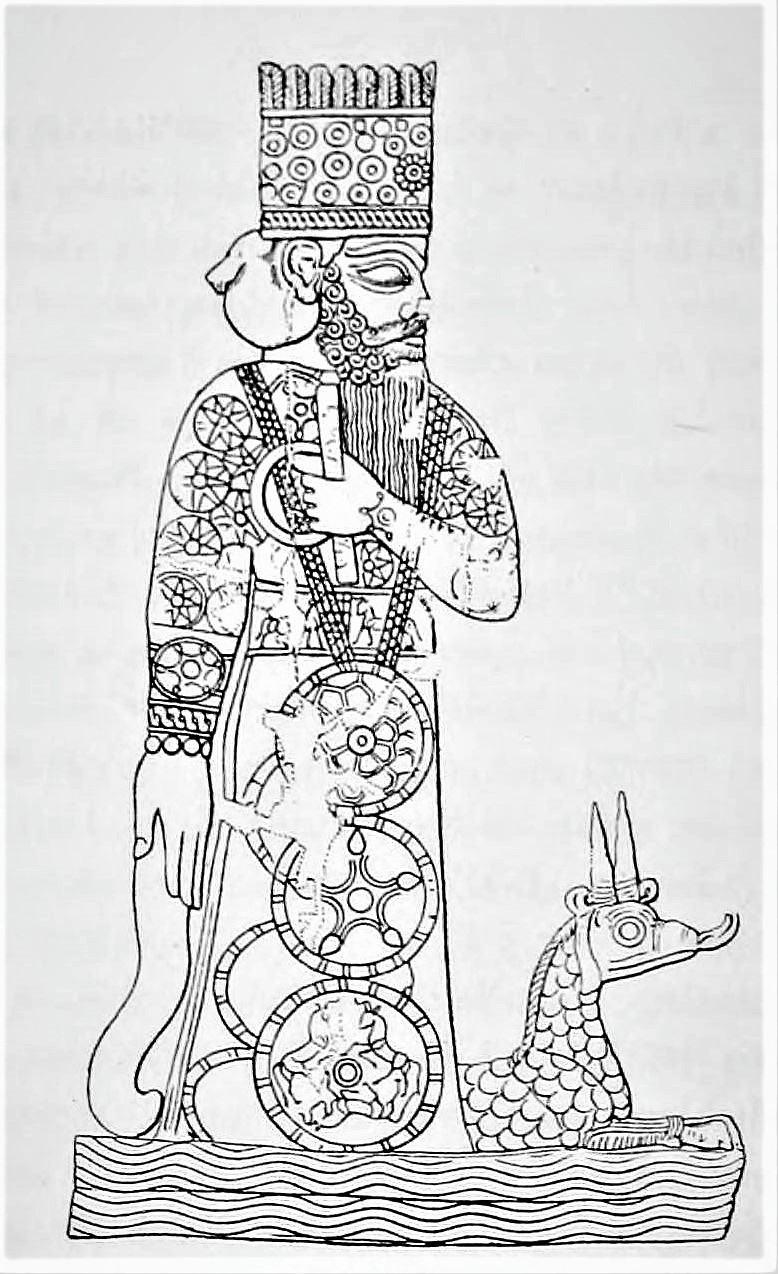
Marduk
Episode 21: Babylon and the New Year’s Festival
Ancient Mesopotamia: Life in the Cradle of Civilization
Dr Amanda H Podany
Film Review
This lecture mainly concerns the semi-autonomous status Babylonia enjoyed following its conquest by Assyria and the participation of the Assyrian emperor in the annual New Years (Akitu) festival in Babylon. During these 12-day festivals secret ceremonies occurred in the temple of Marduk, the king of the gods, in which he officially reconfirmed the Babylonian king’s right to rule. The high point of the festival was a ritual in which the high priest (on behalf of Marduk) slapped and humiliated the Babylonian king.
During most of the period Assyria ruled Babylonia, either the Assyrian emperor or his son (as governor of Babylonia) participated in this annual ceremony to renew the dynasty’s legitimacy in ruling Babylonia.
Podany also describes Babylon’s creation myth in this presentation. In the Babylonian religion, all gods were descended from the salt water goddess and the sweet spring water god. During the period prior to the formation of land masses, there was a war between the good and evil gods. The good god Marduk killed the evil goddess Tiamet and gained control of The Tablet of Destinies (Ammet). He then split her body in half to create the sky and earth, shrines for all the gods, constellations, weather, springs and the Tigris and Euphrates rivers. He ultimately created human beings so the gods wouldn’t have to work so hard looking after themselves.
Film can be viewed free with a library card on Kanopy.
https://www.kanopy.com/en/pukeariki/video/5754284
 The Most Revolutionary Act