Taizong and the Rise of the Tang

Episode 21: Taizong* and the Rise of the Tang

Foundations of Eastern Civilizaiton

Dr Craig Benjamin (2013)

Film Review

The Tang Dynasty (618 – 907 AD) was known for strong benevolent rule, diplomatic prowess, a surging economy (thanks to a resumption of Silk Road trade and a government monopoly on salt, liquor and tea production) and major military expansion.

Lui Huan, the first Tang emperor, was a Sui governor and member of the royal family when he deposed the last Sui emperor Yang Guang. Lui Huan maintained power by establishing an extremely sophisticated Confucian bureaucracy and undermining local nobles by making direct land grants to peasant

He established the very first state schools (which wouldn’t arrive in the West for another 1,000 years) and re-established competitive exams (on Confucian philosophy) for government officials. The Tang Dynasty was also known for a well-maintained transport system (of roads and canals) and a sophisticated courier system relying on hundreds of horses, thousands of human runners and a government network of inns and stables for travelers.

Lui Han continued to improve on the Equal Field System started under the Wei Dynasty. The system operated under the premise that all land belonged to the emperor (rather than a few powerful nobles). Although approximately 1/5 of this land was passed down through families, 4/5 could be reassigned by the state depending on family circumstances.

The Tang Dynasty brought Manchuria came under Chinese control and made Sella in Korea a tributary state. The Tang military conquered Tibet, as well as briefly occupying Vietnam, and their conquests in Western Asia extended as far as the Aral Sea.

Chinese western expansion halted following the 751 AD Battle of Talas (in modern day Kyrgyzstan), in which allied Muslim and Tibetan armies overpowered Chinese troops and forced them to retreat.

The initial Tang emperors were extremely tolerant of the foreign religions (mostly Islam, Judaism, Zoroastrianism and Nestorian Christianity) practiced by hundreds of thousands of foreign immigrants.

The Tang Dynasty is also famous for introducing the first paper money, which began as receipts for its primary industrial products (paper, cast iron, silk and porcelain).

Between 624 -705 AD China was ruled by the empress Wu Zetam, who began as the emperor Gaozong’s concubine and took over the government after he suffered a stroke.


*Emperor Taizong of Tang, previously Prince of Qin, personal name Li Shimin, was the second emperor of the Tang dynasty of China, ruling from 626 to 649. He is traditionally regarded as a co-founder of the dynasty for his role in encouraging Li Yuan, his father, to rebel against the Sui dynasty.

Film can be viewed free with a library card on Kanopy
https://www.kanopy.com/en/pukeariki/video/5808608/5808651

The Collapse of the Han Dynasty and 350 Years of Disunity

Episode 20: The Age of Disunity

Foundations of Eastern Civilization

Dr Craig Benjamin (2013)

Film Review

According to Benjamin, the last decades of the Han Dynasty were characterized by corruption and infighting between the three groups of competing elites: the emperor’s eunuchs, the hereditary nobility and the Confucian bureaucrats. Simultaneously there was also substantial peasant unrest, most notably the Yellow Turban Rebellion (184-205 AD). Ultimately the empire was overrun by militarized nomads, just as Rome was.

After the last Han emperor was deposed in 220 AD, power fell into the hands of regional governments and warlords. Cao Cao, one of the most powerful, is best known for settling landless peasants on state forms. After employing Xiongu horse archers as mercenaries, he also resettled them in Shanxi province in northern China.

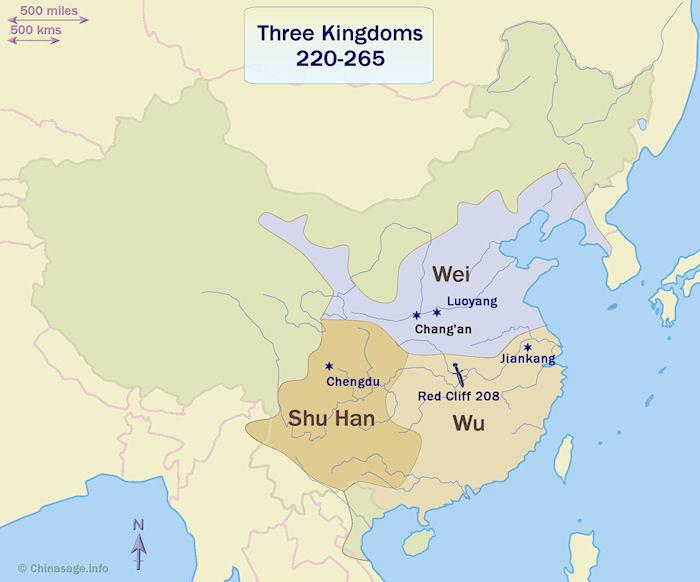
Several warlords attempted to reunify China, only to be thwarted by their rivals. In 220 AD Cao Cao’s son Cao Pi unsuccessfully attempted to reunify China as the Wei Dynasty.

Significant historical periods include

  • 230 – 280 AD – Three Kingdoms period, with the rival Wei kingdom in the North, Shu kingdom in the West and Wu kingdom in the East.
  • 265 AD – the Jin Dynasty captures the Wei kingdom, ruling until 420 AD. They very briefly rule the other two kingdoms as well, but the fleeting Jin Empire collapses due to a conflict with their own civil service.
  • 281 – 305 AD – brutal civil war involving all of China.
  • 311 AD – Xiongnu nomads take advantage of continuing civil unrest, to sack the former capitol of the Eastern Han Dynasty at Luoyang. In 316, they sacked Changan.
  • 304 – 437 AD – era of the 16 kingdoms, characterized by o one of continual war with Xiongu nomads.
  • 420 – 589 AD – Period of the Northern and Southern Dynasties, featuring significant in southern China, previously isolated from the major dynasties.
  • 439 – 534 AD – Shaanxi settlers from Manchuria adopt Han culture and re-established the Wei Dynasty in northern China.
  • 581 AD – militarily superior Sui Dynasty finally reunifies China. The first Sui emperor Wendi, also China’s first Buddhist emperor,* eliminates many of the cruel punishments enacted under the Legalist dynasties.** His son Yangdi builds the Grand Canal linking the Yellow and Yangtze River.

*Buddhism first reached China during the first century AD. During the Age of Disunity, many Chinese Buddhists  temples and monasteries and made pilgrimages to India. Chinese Buddhists periodically experienced vicious attacks by Confucian elites. The celibacy practiced by Buddhist monks was viewed as “unfilial” (under Confucianism, one has a duty to parents and ancestors to produce an heir).

**Legalism was a school of political philosophy that competed with Confucianism and Daoism during the Qin Dynasty (221-206 BC). See China: Ancient Civlization Born in Isolation

Film can be viewed free with a library card on Kanopy.

https://www.kanopy.com/en/pukeariki/video/5808649