How the US Uses War to Protect the Dollar

The Gods of Money

William Engdahl (2015)

The first video is a 2015 presentation by William Engdahl about his 2010 book The Gods of Money. It focuses on the use of US economic and military warfare to maintain the supremacy of the US dollar as the global reserve currency.

As his point of departure, he begins with the 1944 Bretton Woods agreement, in which the Allied powers agreed to use the gold-backed US dollar as the world’s reserve currency. In 1971 when Nixon was forced to end the gold standard,* the gold-backed US dollar was replaced by the “petrodollar.” According to Engdahl, it was so named because of a secret agreement the US made with Saudi Arabia – in return for a guarantee that OPEC would only trade oil in US dollars, the US guaranteed the Saudis unlimited military hardware.

In this way, oil importing nations (most of the world) were forced to retain substantial US dollar reserves. This was the only way they could provide their economies with a continuous supply of oil.

The petrodollar remained supreme until the mid-1980s, when the collapse of the US Savings and Loan industry (a pre-cursor of the 2007 banking collapse) raised concerns in Europe that the US was failing as a super power. Fearing the US economy was collapsing, they created the euro and the Eurozone, to prevent the Soviet Union or China from filling the power vacuum.

The financial warfare unit of the US treasury responded by feeding hedge fund manager and currency speculator George Soros secret information that enabled him to lead an attack on the British pound. This, in turn, destabilized the British economy to the point the UK no longer qualified to join the euro.

In 1997 the US Treasury and Soros made a a similar attack on economies of Southeast Asia (Thailand, South Korea, Indonesia, Hong Kong, Laos, Malaysia, Philippines) that attempted to use currencies other than the dollar as their reserve currencies.

In 2010, after the US government had run three years of $1 trillion deficits, China, Russia and Japan announced their intention of selling US Treasury bonds (which the US government sells to finance its debt) to increase their euro reserves. Concerned this placed the US dollar on the brink of catastrophic collapse, the US Treasury and Soros attacked the Euro directly by collapsing the Greek economy. The mechanism Soros used was to direct his hedge funds to dump the sovereign treasury bonds that financed Greek debt.** When the European Central Bank announced its commitment to a Greek bail-out, the US Treasury and Soros followed up with an attack on Irish, Spanish and Portuguese sovereign bonds.


*A US economic crisis led to massive foreign demand for US dollar redemption that threatened to deplete US gold reserves.

** The immediate effect of bondholders dumping Greek bonds raised interest rates on Greek debt to a level that threatened to bankrupt their government.


The second clip is a Guns and Butter radio interview with Engdahl. It focuses on a second area the Gods of Money covers, namely the long US battle to abolish their private central bank (aka the Federal Reserve) and end the ability of private banks to create money out of thin air (see How Banks Create Money Out of Thin Air).

After a brief explanation of fractional reserve banking, whereby 97% of our money is created by private banks, Engdahl traces the history of the First Bank of the United States, created by Alexander Hamilton in 1791. The latter was the first US central bank, 80% owned by private (mostly Rothschild-controlled) banks in the City of London and 20% owned by the US government. President James Madison’s refusal to renew the bank’s charter in 1811 would result in Britain and the US going to war in 1812.

When the war ended in 1815, the American war debt was so substantial, the US had no choice but to charter the Second Bank of the United States, which once again was 80% controlled by London banks.

In 1832, Andrew Jackson refused to renew the bank’s charter, and the US had no central bank between 1832 and 1913. In 1913 when President Woodrow Wilson secretly colluded with the global banking establishment to create the Federal Reserve.

Both Lincoln and Kennedy challenged the exclusive role private banks play in creating the US money supply – Lincoln by issuing greenbacks (rather than borrowing money from private banks) to pay for the civil war and Kennedy by issuing silver certificates directly redeemable by the US Treasury. In both cases, Engdahl feels their defiance of the international banking establishment played a role in the decision to assassinate them.

The CIA and Congo’s 20-Year Civil War

The following presentation by Friends of the Congo Executive Director Maurice Carney provides an elegant but horrifying summary of the CIA’s 50-year assault on the Republic of Congo. The Congo has the distinct misfortune of having amazingly rich mineral resources (uranium, gold, diamonds, copper, cobalt and especially coltran*). The result has been a single minded determination by Wall Street and the CIA to destroy democratic rule in that country. I was well aware of the importance of CIA and US State Department in destabilizing Latin America, Asia, Russia and the Middle East. Until recently I was less aware of their aggressive machinations in Africa.

According to Carney, their first president Patrice Lumumba became a high priority CIA target it due to joint efforts with Kwame Nkrumah of Ghana to establish a United States of Africa. This presumably would have granted the continent total independence of US corporate rule.

After briefly summarizing the county’s ruthless colonization by Belgium, Carney describes the Congo’s struggle for independence under Patrice Lumumba in 1960, the first and only legitimately elected president. After assassinating Lumumba, the CIA installed a 30 year dictatorship to ensure US corporations continued access to Congo’s resources on their terms.

In 1996, the people of Congo had just overthrown the dictatorship and installed democratic government when the CIA instigated puppet sociopaths ( Paul Kagami of Rwanda and Yoweri Museveni of Uganda) to invade and instigate a 20 year civil war in Congo. In addition to providing them military aid and training, the US government actively covers up Kagami and Museveni’s war crimes, resulting in millions of civilian deaths.

The International Court of Justice (ICJ) has recently ordered to Uganda to pay millions in reparations to Congo. As Rwanda doesn’t belong to the ICJ, Spanish courts (under the authority of universal jurisdiction) have indicted 40 top Rwandan officials for war crimes

Current Congo president Joseph Kabila, also handpicked by the CIA, who succeeded his father Laurent-Désiré Kabila (1997-2001), maintains power by way of a US-rigged election in 2006 and massive electoral fraud in 2011.

See also The US Rape of the Congo


*Coltran is a rare earth mineral essential in the manufacture of cellphones and computers.


Anarchism and the Spanish Civil War

last great cause

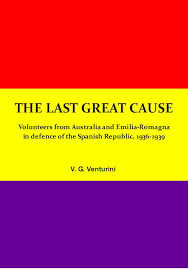
The Last Great Cause

V.G. Tenturini

Search Foundation (2010)

Book Review

The Last Great Cause is a virtual encyclopedia of Spanish political history, starting from the Napoleon’s invasion in 1808. Although I was chiefly interested in the history of Spanish anarcho-syndicalism, the book also provides a comprehensive overview of the fascist coup Franco launched in 1936, the International Brigades who fought (unsuccessfully) to save the second Spanish Republic, the so-called “transition” following Franco’s death in 1975 and more recently efforts by the crusading Spanish jurist Baltasar Garzon to achieve justice for tens of thousands of victims of the Franco regime.

Venturini begins by identifying unique features of 19th century Spanish society that provided fertile ground for a major anarchist movement. Among these were Spain’s failure to achieve industrial revolution (except in Catalonia), the absence of a Spanish middle class and strong separatist movements in Catalonia and the Basque region of Spain. Unlike socialism, which historically develops among middle class intellectuals, Spanish anarchism had its origin in the working class.

The Rise of Spanish Anarchism

In 1868, a group of disconnected generals led the first major effort to depose the Spanish monarchy. The same year, Mikhail Bakunin, known as the father of collective anarchism, sent his disciple Giuseppe Fanelli to Spain to organize Spanish farm laborers. Within five years, the number of anarchists in Spain totaled 50,000.

The resulting “glorious revolution” produced in the First Republic. It lasted eleven months before the monarchy was restored.

Spanish history between 1902 and 1929 was marked by profound political and economic turmoil. During the early 1900s, Spanish anarchists merged with the Syndicalist* movement. In 1911, they formed the CNT.** CNT membership grew from 14,000 to 700,000 by 1919. In 1917, the CNT joined forces with the UGT*** to stage the first general strike.

In 1929, continuing popular unrest would lead to Alfonzo XIII’s removal from power and the creation of the Second Republic in 1931.

The Forces Backing Franco’s Coup

From the outset, the Republic faced powerful opposition from the Catholic Church, the Spanish military, wealthy landholders and Spanish and European Banks. Spain was embroiled in virtual civil war from 1933 on, as the forces of reaction engaged armed thugs (as the Falange Espanola) to thwart governmental efforts to carry out land and other democratic reforms.

These forces of reaction also assisted in planning and implementing the fascist coup Franco launched in 1936. The Republic was at a clear disadvantage in resisting the coup, owing to the major support Franco received from fascist Germany and Italy and the covert support he received from Britain and the US.  According to Venturini, Britain, which had major business interests in Spain, directly aided Franco with intelligence and naval support. American oil companies also provided him with oil (while refusing to sell it to Spain’s legitimately elected government), and Ford and other US manufacturers supplied him with trucks.

The International Brigades

Venturini estimates 40,000-50,000 volunteers from 53 countries participated in the International brigades. When Franco captured Catalonia in January 1939 500,000 Republican soldiers and civilians fled across the border to France. Many of the anarchists joined the Maquis, where they played a vital role in liberating France from the Nazis.

Venturini emphasizes that no allied troops fought in the South of France – that these regions were liberated by the Resistance – in many instances before the liberation of Paris.


*Syndicalism is a type of economic system in which industries are owned and managed by the workers.
**CNT Confederación Nacional del Trabajo National Confederation of workers.
***The Unión General de Trabajadores (UGT, General Union of Workers) is a major Spanish trade union, historically affiliated with the Spanish Socialist Workers’ Party (PSOE).
****Rural guerrilla bands of French resistance fighters.

How Radical Architects are Transforming the Planet

Radical Architecture

Al Jazeera (2014)

Film Review

Rebel Architecture is a six-part Al Jazeera documentary series about architects who are using their skills to serve the public good rather than wealthy corporations.

Part 1 is about a Spanish architects collective that works with activist collectives loosely connected with Spain’s anti-austerity movement. Thanks to the Spanish government’s severe austerity measures and public service cuts, activist collectives have assumed major responsibility for social welfare. Occupation of public and abandoned spaces is a key tactic. The role of the architects collective is to help activists construct safe buildings in these spaces from cheap and recycled materials. In most cases the structures are unpermitted and technically illegal.

Part 2 is about Pakistan’s first woman architect and her role in helping poor Pakistani communities devastated by floods and earthquakes to rebuild flood and earthquake proof homes as cheaply as possible. Unsurprisingly she discovered that traditional building materials, such as mud bricks, lime and bamboo, are a key to the solution.

Part 3 is about an Israeli architect in the West Bank who studies the “intersection” between architecture and violence. He gives a fascinating presentation describing how the Israeli government uses architecture as a weapon against the Palestinians. This includes the deliberate layout of Israeli settlements in such a way that they strangulate Palestinian communities. And the deliberate use of bulldozers in dense urban communities as an instrument of war.

Part 4 is about Nigerian architect and urbanist Kunle Adeyemi, who works with illegal floating communities to design and build (unpermitted) floating schools and community centers.

Part 5 is about the Vietnamese architect Va Tron Nghia, who has dedicated his life to creating more green spaces in Ho Chi Minh city and building cheap durable homes for peasant farmers in the Mekong Delta. Owing to recurrent flooding, typical Delta homes last only three to four years. The film shows Nghia and local residents building a $4,000 bamboo house for a family of four.

Part 6 (my favorite) is about a pedreiro (Portuguese for stone mason) in Rocinha, the largest favella in South America – located in Rio De Janeiro. All the housing in Rocinha, population 180,000, is unpermitted and illegal. The Brazilian government turns a blind eye to all this illegal building because they need the cheap labor and have no resources to build public housing. This last segment shows how Rocinha residents organized to demand a sewage system to replace the open sewer in their streets. Instead the Brazilian government built a cable car for the benefit of tourists attending the 2014 Brazilian World Cup and the 2016 Brazilian Olympics. It was largely angry Rocinha residents who instigated the mass protests before and during the World Cup. Though the protests were widely reported in the corporate media, there was no mention of Rocinha residents’ ongoing struggle to remove the sewer of human excrement from their streets.


How the US Lost Out to Spain in Concentrating Solar Power

concentrating solar power

Renewable energy is a multibilion dollar global industry. One in which the US has fallen rapidly behind. Instead of using his presidency to build a world class renewable energy industry, like Germany, Spain, Italy or China (the world’s leading exporter of  PVC solar panels), Obama has pissed away his six years in office pimping dangerous and environmental destructive practices like fracking and deep sea oil drilling.

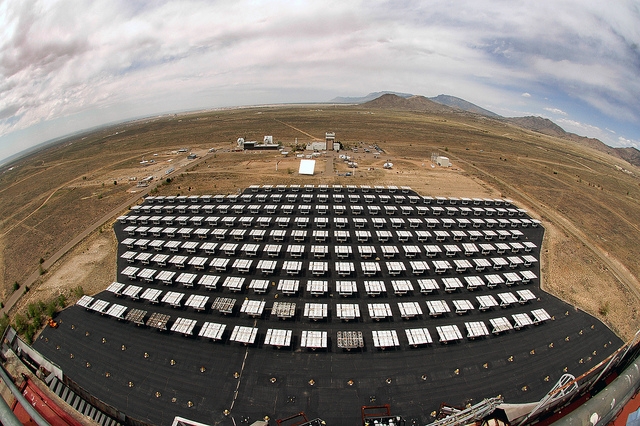
Concentrating solar power, aka Solar Thermal Energy (STE) is a technology that receives scant attention in the US, even in environmental circles. CSP systems use mirrors or lenses to concentrate a large area of sunlight, or solar thermal energy, onto a small area. Electrical power is produced when the concentrated light is converted to heat, which drives a heat engine (usually a steam turbine) connected to an electrical power generator.

The Italian inventor Giovanni Francia designed and built the first concentrating solar plant near Genoa, which first went on-line in 1968. In 1981 the 10 megawatt (MW) Solar One power tower began operation in the Mojave Desert in Southern California. The nearby Solar Energy Generating Systems (SEGS), consisting of nine solar plants with a total of 254 MW generation capacity, went on-line in 1984.

How Spain Became the World Leader in CSP

According to Solar Server, despite a worsening economic crisis, austerity cuts, street protests and general strikes,  Spain met a whopping 42% of its 2013 electricity needs through renewable power generation.

26% of Spain’s electricity comes from solar and wind generation and 16% from hydrogeneration. Globally, Spain has the third highest percentage of solar electricity generation (following Germany and Italy), and the highest percentage of CSP electricity generation.

The main advantage of CSP over rooftop photovoltaic cell (PVC) solar generation is the ability of CSP to generate a load large enough to power a grid. It also has the advantage of providing cheap and efficient thermal (i.e. heat) energy storage, which means it can produce electricity continuously night or day, especially during peak demand periods (summer evening hours or winter mornings).

In 2007 Spain installed Europe’s first commercial concentrating solar power plant, which generates a 11 MW load, near Seville. By 2010, they had surpassed the US as the world leader in CSP production. By October 2011, an additional 420 MW had gone into operation, with an additional 2500 MW anticipated by the end of 2013.

According to the Department of Energy, the US has a current CSP load capacity of 800 MW, with four new plants scheduled to come online in 2014.

Economic Benefits of CSP

In October 2011 the Spanish Association of the Solar Thermal Industry commissioned Deloite, one of the Big Four international financial powerhouses to analyze the economic viability of Spain’s CSP industry. According to the Deloitte report, Macroeconomic Impact of the Solar Thermal Electricity Industry in Spain, the total contribution of the CSP industry to Spain’s 2010 GDP was 1.6 billion Euros.

More importantly, the number of workers employed came to 23,844 in 2010. Many of the jobs created relate to the export of parabolic mirrors and other CSP technology and expertise to the rest of the world.

The five years Spain has spent refining CSP technology has made them the unquestioned leader in the Concentrating Solar Power Alliance. The CSPA is an international industry lobby group formed in March 2012 to to promote the benefits of CSP, specifically to US lawmakers, regulators, utilities and grid operators. With America’s insatiable energy needs, the US is clearly the market they need to penetrate.

Given the iron control the fossil fuel industry exerts over the Congress, White House and media, they have their work cut out for them.

photo credit: SandiaLabs via photopin cc

The Failure of Nonviolence

failure of nonviolence

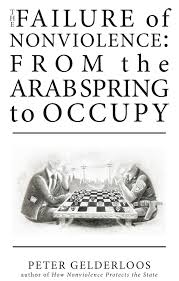
The Failure of Nonviolence: From the Arab Spring to Occupy

 By Peter Gelderloos (2013 Left Bank Books)

Book Review

You occasionally read a totally mind bending book that opens up a whole new world for you. The Failure of Nonviolence by Peter Gelderloos is one of them, owing to its unique evidence-based perspective on both “nonviolent” and “violent” resistance. It differs from Gelderloos’s 2007 How Nonviolence Protects the State in its heavy emphasis on indigenous, minority, and working class resistance. A major feature of the new book is an extensive catalog of “combative” rebellions that the corporate elite has whitewashed out of history.

Owing to wide disagreement as to its meaning, Gelderloos discards the term “violent” in describing actions that involve rioting, sabotage, property damage or self-defense against armed police or military. In comparing and contrasting a list of recent protest actions, he makes a convincing case that combative tactics are far more effective in achieving concrete gains that improve ordinary peoples’ lives. He also explodes the myth that “violent” resistance discourages oppressed people from participating in protest activity. He gives numerous examples showing that working people are far more likely to be drawn into combative actions – mainly because of their effectiveness. The only people alienated by combative tactics are educated liberals, many of whom are “career” activists working for foundation-funded nonprofits.

Gelderloos also highlights countries (e.g., Greece and Spain) which have significantly slowed the advance of neoliberal capitalism via combative resistance. In his view, this explains the negative fiscal position of the Greek and Spanish capitalist class in addressing the global debt crisis. Strong worker resistance to punitive labor reforms and austerity cuts has significantly slowed the transfer of wealth to their corporate elite, as well as the roll-out of fascist security measures.

The Gene Sharp Brand of Nonviolence

Gelderloos begins by defining the term “nonviolent” as the formulaic approach laid out by nonviolent guru Gene Sharp in his 1994 From Dictatorship to Democracy and used extensively in the “color revolutions” in Eastern Europe and elsewhere. This approach focuses exclusively on political, usually electoral, reform. Gelderloos distinguishes between political revolution, which merely overturns the current political infrastructure and replaces it with a new one – and social revolution, which overturns hierarchical political infrastructure and replaces it with a system in which people self-organize and govern themselves.

The nonviolent approach Sharp and his followers prescribe relies heavily on a corporate media strategy to promote their protest activity to large numbers of people. This obviously requires some elite support, as the corporate media consistently ignores genuine anti-corporate protests. As an example, all the nonviolent color revolutions in Eastern Europe enjoyed major support from the State Department, billionaire George Soros and CIA-funded foundations such as the National Endowment for Democracy and the National Republican Institute.

Is Nonviolence Effective?

Gelderloos sets out four criteria to assess the effectiveness of a protest action:

  1. It must seize space for activists to self-organize essential aspects of their lives.
  2. It must spread new ideas that inspire others to resist state power and control.
  3. It must operate independently of elite support.
  4. It must make concrete improvements to the lives of ordinary people.

As examples of strictly nonviolent protest movements, Gelderloos offers the “color” revolutions (see 1 below), the millions-strong global anti-Iraq war protest on February 15, 2003 and 2011 Occupy protests, which were almost exclusively nonviolent (Occupy Oakland being a notable exception).

In all the color revolutions Gelderloos describes, the goal has been strictly limited to replacing dictatorship with democracy and free elections. None attempted to increase economic democracy nor to reduce oppressive work and living conditions. In fact, most of the color revolutions forced their populations to give up important protections to integrate more thoroughly into the cutthroat capitalist economy.

So-called “democracies” such as the US are just as capable as dictatorships of engaging in extrajudicial assassination, torture, and suspension of habeas corpus and other legal protections. However US corporations generally find “democracies” more investment-friendly. Owing to greater transparency, they are less likely to nationalize private industries or arbitrarily change the rules for doing business.

Besides failing to meet any of his criteria, the 2003 anti-Iraq war movement failed to stop the US invasion of Iraq and the 2011 Occupy protests failed to achieve a single lasting gain.

Successful “Combative” Protests

He contrasts these strictly nonviolent  protests with nearly 20 popular uprisings (see 2 below) and two (successful) US prison riots that have incorporated “combative” tactics along with other organizing strategies. Most have been totally censored from the corporate media and history books or whitewashed as so-called “nonviolent” actions (e.g., the corporate media misportrayed both the 1989 Tiananmen Square rebellion and the 2011 Egyptian revolution as nonviolent protests).

The US, more than any other country, uses prison to suppress working class dissent. Most prison struggles employ a diversity of tactics combining work stoppages and legal appeals with property damage, riots and attacks on guards. Nonviolent protest tends to be particularly ineffective in the prison setting. A nonviolent hunger strike usually reflects a situation in which prisoners have so little personal control that the only way to resist is to refuse to eat.

Gelderloos also analyzes a number of historical combative uprisings, pointing out their relative strengths and weaknesses. He devotes particular attention to the Spanish Civil War (a failed working class revolution), the anti-Nazi partisan movements during World War II, combative Indigenous peoples resistance to European colonizers and autonomous liberated zones created in Ukraine, Kronstadt, and Siberia following the Bolshevik Revolution and in the Skinmin Province of Manchuria in pre-World War II China.

Who Are the Pacifists?

He devotes an entire chapter to the major funders and luminaries of the nonviolent movement. Predictably most of the funding comes from George Soros, the Pentagon, the State Department and CIA-funded foundations such as USAID, NED, and NIR. Among other examples, Gelderloos describes the Pentagon running a multi-million dollar campaign to plant stories in Iraqi newspapers to promote “nonviolent” resistance to US occupation.

___________________________________________________________________________________________________

1. Examples of political/regime change color revolutions:
  • Philippines – Yellow Revolution 1983-86
  • Serbia – Bulldozer Revolution 2000
  • Georgia – Rose Revolution 2003
  • Ukraine – Orange Revolution 2004
  • Kyrgyzstan – Tulip Revolution 2005
  • Lebanon – Cedar Revolution 2005
  • Kuwait – Blue Revolution 2005
  • Burma – Saffron Revolution 2007
2. Examples of combative uprisings:
  • 1999 Battle of Seattle – contrary to media whitewashing (I was there), the combative component wasn’t a matter of a few Black Bloc anarchists breaking windows. Numerous “peaceful” marchers joined in destruction of corporate storefronts, looting and throwing rocks at police. Inspired 3rd world WTO delegates to shut down Doha round of WTO negotiations.
  • 1990 Oka Crisis (near Montreal) – in which Mohawk warriors took up arms to stop a golf course expansion on their lands. Successful in defeating the golf course expansion.
  • 1994 Zapitista (Mexico) – armed uprising against NAFTA. Successfully seized space, liberating numerous villages which continue to be run by popular assemblies.
  • 2000 2nd Palestinian Intifada – successful in seizing and defending space, defeating the CIA/Israeli army invasion of Gaza in 2009. Inspired combative insurrections in Tunisia and Egypt.
  • 2001 Kabbylie Black Spring armed protest to liberate Berber territory occupied by Algeria. Successfully seized space to bring back traditional assemblies and reverse erosion of Berber culture. Won increased autonomy of Kabylie, including official recognition of Berber language.
  • 2003-2005 Bolivia Water and Gas Wars against strict water privatization implemented by Bolivian government and Bechtel. Successful in ending years of Bolivian dictatorship, slowing advance of neoliberalism and restoring indigenous autonomy. Received no elite support until 2005 union and political party support elected the movement into government, putting neoliberalism back on track.
  • 2006 Oaxaca (Mexico) Rebellion – coalition of indigenous people, teachers and workers fought police and military and ran Oaxaca by popular assembly for one month. No elite support until assembly taken over by politicians who convinced them not to fight back against the military. Greatly improved quality of life while it lasted.
  • 2006 CPE France – combative (rioting, burning cars, fighting police and occupying public buildings) uprising against new legislation allowing bosses to fire younger workers without cause. Defeated new law.
  • 2008 Athens insurrection – millions-strong armed uprising (consisting of arson attacks on banks and police stations, occupation of vacant lots and buildings to create community gardens, community centers and popular assemblies) triggered by police murder of a teenager. Besides destroying debt and tax records and providing brief period of self-governance, it inspired new cycle of anarchist activity throughout Greece.
  • 2009 Guadalupe General Strike – inspired by poor living standards, especially high cost of living combined with low wages and high unemployment. After three days of rioting, setting fire to cars and businesses and opening fire on the police, demonstrators won an increase of $200 euros per month in the lowest salaries and 19 other demands.
  • 2009 Oscar Grant riots (Oakland) – prompted by police murder of an African American named Oscar Grant. Spontaneous rioting, property damage, looting and shooting back at police. Resulted in first case in California history in which an on-duty police officer was charged with murder. Influenced Occupy Oakland to adopt a diversity of tactics that included combative resistance.
  • 2010 Tunisian revolution – contrary to corporate media white washing, this was a violent uprising in which protestors burned tires and attacked the office of the ruling party. It failed to create any new self-organized spaces. It only received elite support, which pressured Tunisians to accept a purely political solution (i.e. regime change), when local authorities failed to quell popular unrest. Economic tyranny and police abuse/violence remain unaddressed.
  • 2010 15 M Movement and General Strikes (Spain) – millions took part in general strike against austerity measures incorporating sabotage of the transportation infrastructure, blockades, looting, rioting and fighting with police. Established numerous police-free zones (which persisted for months) throughout Spain run by popular assemblies. Occupied numerous hospitals and primary care centers and established urban gardens and collective housing facilities. Prevented privatization of numerous health clinics and inspired anti-capitalist focus of Occupy movement.
  • 2011 Egyptian revolution – combative rebellion (contrary to corporate media claims that it was nonviolent). Protesters burned over 90 police stations and used clubs, rocks and Molotov cocktails to defend themselves against police and government thugs. Set up self-governing assemblies in Tahrir Square and inspired a large number of activists to remain in the streets to fight the repressive Islamic government that replaced Mubarak.
  • 2011 Libyan Civil War – began as spontaneous uprising but quickly transformed into a foreign military intervention. Gelderloos uses Libya to demonstrate why revolutions that wish to end oppressive social relations must never allow military or political revolution to assume precedence.
  • 2012 Quebec student movement – rioting, looting, property damage and fighting back against the police prompted by massive tuition hike. Provided thousands of young people direct experience of self-governing assemblies and successfully spread critiques of debt, austerity and capitalism throughout Canada. Forced government to reverse tuition hike.
  • 2013 Mapuche (indigenous nation occupied by Chile and Argentina) struggle – long history of combative resistance continues to present day. Employs both nonviolent and combative methods, including arson, sabotage against mining and logging companies and armed land occupations. In January 2013 (5th anniversary of unprosecuted police murder of Mapuche teenager) they liberated large tracts of land.

Originally published in Dissident Voice