
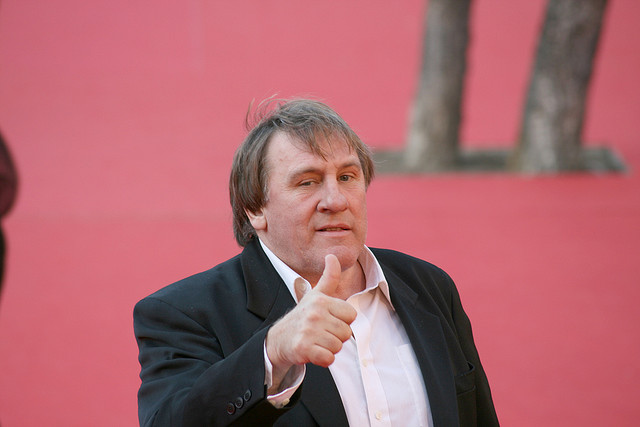
French actor Gerard Depardieu
In January, Forbes reported that Facebook’s billionaire co-founder Eduardo Severin had renounced his U.S. citizenship to move to Singapore, where the top tax rate is 20%. The article about millionaires and billionaires fleeing high western tax rates was triggered by French actor Gerard Depardieu’s renunciation of his French citizenship to move to Russia. He chose Russia based on its top tax rate of 13% on individuals and 20% on corporations (except for the oil and gas industry – see below). France had just enacted a 75% tax on millionaires to pay off the 1.7 trillion euros it owes to international banksters. Socialist president Francois Hollande sees taxing the rich as a better alternative than laying off public servants and cutting health care, education, and pensions like Greece, Spain, Portugal, and Italy.
Forbes clearly disagrees. Predictably the article represents the traditional neo-classical economic viewpoint – slashing public services is always a better alternative than increasing taxes on the rich. They also leave out the most important part of the story – namely why income taxes in Singapore and Russia are so low.
The real reason income is taxed at a low rate in Singapore and Russia is because both countries have adopted a modified Land Value Tax (LVT). An LVT is a tax on unimproved land, resources and the cultural commons (e.g. public airwaves). It was journalist Henry George who first proposed replacing taxes on income and capital with a single LVT in his 1879 international bestseller Progress and Poverty. See Progress and Poverty: the Suppressed Economics Classic.
Singapore’s Economic Miracle
Singapore, a flourishing city-state of 5.3 million people, faced massive unemployment and a major housing crisis when it first gained its independence from Malaysia in 1965. Its leaders immediately launched a modernization program funded by an LVT. Although Singapore no longer relies on a single tax, income taxes still remains extremely low with corporate rates between 8.5 and 17%.
Thanks to the LVT, Singapore recovered much more rapidly than western countries from the 2008 economic collapse. In 2011 a 12% increase in GDP enabled them to pay a dividend to all adult citizens of approximately $269 each (total $1.22 billion).
How Putin Saved Russia’s Moribund Economy
Russia’s LVT, introduced by President Vladimir Putin as part of a 2001 tax reform package, falls more heavily on mineral (e.g. oil and gas) extraction than unimproved land. Taxes on oil and gas revenues amount to approximately 45% of net sales (compared to 12 percent in the construction industry and 16.5 percent in the telecommunications industry). Property owners pay a tax ranging from 0.1 – 0.3% on land value (and a comparable rate on state-owned land that they lease).
Experience with LVT in other countries
Hong Kong (1985) – thanks to LVT, enjoys low taxes, low inflation, high investment and high salaries. Often voted the world’s best city for business and the freest for residents. According to Bloomberg’s they, too, paid a $700 dividend to all adult residents in 2011. Unfortunately since rejoining China, Hong Kong has been gradually replacing land and resource taxes with income tax. This has resulted in a return of land speculation and increasing income inequality. The Hong Kong real estate holdings of China’s multimillionaire president Xi Jinping are valued at more than $24.1 million.
Taiwan (1949) – following the Communist takeover of mainline China, Chinese nationalists under General Chiang Kai-shek fled to Formosa (Taiwan), a brutally poor feudal island controlled by a handful of rich farmers. Chiang Kai-Sheck, a follower of Sun Yat-Sen, the first Chinese president and a great admirer of Henry George, introduced a LVT. When plantation owners found themselves paying as much in taxes as they were collection in rent, they sold off their excess land to peasant farmers. Taiwan went on to set world records with growth rates of 10% per annum.
Denmark (1957) – the small Georgist Justice Party won seats in parliament and a role in the ruling coalition. A year later, inflation had gone from 5% to under 1%; bank interest dropped from 6.25% to 5%. By 1960, 100,000 unemployed (out of a population of 5 million) had found jobs and received the highest average pay increase in Danish history. In the 1960s, a media backlash funded by wealthy bankers and corporations caused the Justice Party to lose its seats. Land taxes were decreased and income tax and sales tax (currently at 25%) drastically increased. Inflation quickly rose to 5% and by 1964 reached 8%. Land prices began to sky-rocket, increasing 19-fold from 1960 to 1981 increasing 19-fold.
Estonia (1990s).- enacted a 2% LVT following the break-up of the Soviet Union. It was much easier to collect than the income taxes enacted by other former Soviet republics, more successful than trying to collect from others, succeeding over 95% of the time. It’s largely the LVT that has enabled Estonia to become the electric car capitol of the world. In addition to installing 165 electric vehicle fast-charging stations country-wide, it provides a 50% subsidy for residents who purchase electric vehicles.
Other jurisdictions that opted for LVT:
- Ethiopia 1990s
- Saudi Arabia, Kuwait, UAR – resource-based LVT on oil and gas exports
- Baja California (Mexico) 1990s
- British Columbia (1912) – resource-based LVT on forestry
- Vermont 1978
- Kansas City 1930s
- Pennsylvania – Pittsburgh and Scranton in 1975 and 18 other cities following suit in the 1990s. Housing costs and crime in both Pittsburgh and Scranton have trended the lowest in the US, despite the collapse of the steel industry. Both avoided the 2000-2007 real estate bubble and 2008 collapse. Foreclosure rates in Pittsburgh remain the lowest in the country.
Single tax colonies founded by Henry George’s American followers:
- Free Acres (New Jersey) 1910
- Arden (Delaware) 1900
- Fairhope (Alabama) 1894
 The Most Revolutionary Act