Oliver Stone’s Untold History of the US – Parts 1-3

Untold History of the United States – Parts 1-3

Directed by Oliver Stone (2012)

Last week, I sat down and binge watched Oliver Stone’s 10 part Showtime series Untold History of the United States. I was pleasantly surprised. Stone is strongly influenced by late historian Chalmers Johnson (see The Impermanence of Empire) and mentions him at several points in the series.

Untold History concerns the hidden history of the “American Century” that we’re never taught in school. Unlike Howard Zinn’s People’ History of the United States, it devotes little air time to the popular resistance movements that shaped the period 1932-2012. Instead it focuses mainly on the presidents who governed during this period.

Parts 1-3, which focus on World War II, unpack the lie that Truman dropped two nuclear bombs on Japan to spare hundreds of thousands of GIs who would have died invading the Japanese mainland.

Stone begins with a broad outline of the German military build-up that began in the early 1930s. I think this segment would have been clearer if Stone had discussed the Wall Street fascists who deliberately armed Hitler in the hope he would invade and destroy the Soviet Union. He delays this discussion until part 9, when he introduces Prescott Bush, the pro-Nazi granddaddy of George W Bush.

The first three parts of this series provide a fairly comprehensive history of the Spanish Civil War and of so-called British “appeasement” of Hitler in the early 1930s. I was extremely surprised to learn that Neville Chamberlain wasn’t motivated by cowardice, as we were taught in school, when he agreed to Hitler’s 1938 occupation of Czechoslovakia. He was merely carrying out the wishes of the US-Anglo elite – they were happy to cede Eastern Europe to Germany if it facilitated the destruction of the Soviet Union.

I was also totally unaware that the Soviets were responsible for destroying the bulk of Hitler’s vast military arsenal while the Allies piddled around in peripheral conflicts in North Africa and Italy (at the cost of 27 million lives in contrast to the 500,000 each lost by Britain and the US).

The real reason for Churchill and Roosevelt stalling for two years (Hitler invaded the USSR in 1941) before opening a second front (in Normandy) was their continuing belief that Hitler would defeat the Soviets. Once the Red Army pushed Nazi forces out of the USSR and began retaking Eastern Europe, the allies were forced to act to limit Soviet expansion.

It was actually this two year delay that caused nearly all of Eastern Europe to end up under Communist control – not ruthless Soviet expansionism as we are taught in school.

Stone agrees with historians who attribute the US nuclear attack on Japan to anti-communist hawks in the Truman administration who sought to use it to intimidate the Soviet Union. He maintains that Henry Wallace (Roosevelt’s vice-president until 19944) would never have given in to War Department hawks.

Wallace, according to Stone, was a true liberal populist in the Roosevelt mold. He was universally hated by Wall Street elites. He lost the 1944 vice presidential nomination to Truman (despite controlling over 65% of the delegates) after Democratic Party bosses rigged the 1944 Democratic Convention.

Part 1 – World War II

https://vimeo.com/136182100

Part 2 – Roosevelt, Truman & Wallace

https://vimeo.com/136182101

Part 3 – The Bomb

A 241 Year Fairy Tale About American Democracy

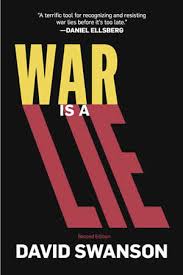
war is a lie


War is a Lie

By David Swanson

Just World Books (2016)

Book Review

In War is a Lie, author David Swanson presents extensive historical evidence that the US has never been a democratic republic – that this is a carefully crafted fairy tale the ruling elite has been telling us since the late 18th century. He also demolishes the myth that warfare is deeply ingrained in human nature. Ninety-eight percent of people are deeply opposed to killing and warfare and require extensive brainwashing to commit to either. Although the species homo sapiens is 60,000 – 1000,000 years old, they have only engaged in war for the last 10,000 years. Many human civilizations (including the people of the Arctic, Northeast Mexico, Australia and Nevada’s Great Basin) had no experience of war prior to contact with Europeans. Among the more astonishing facts Swanson reveals is that 80% of the US troops drafted into World War II declined to kill enemy troops.

Starting with the Revolutionary War, War is a Lie is full of delightful little factoids that are omitted from high school and college US history courses.

Among the high points:

Revolutionary War

The two real goals of the US War of Independence were to 1) remove the King’s representatives from positions of power in North America and replace them with colonial merchants and bankers and 2) to overturn the British ban on western expansion (via the slaughter of indigenous tribes). The Continental Army consisted mainly of poor farmers who were forcibly conscripted, brutally mistreated and rarely paid (even though General Washington was the richest man in the colonies. During and after the war, numerous “democratic reforms” were enacted to motivate these the “recruits, with all being promptly nullified.

War of 1812

Contrary to what we’re taught in school, the US started the War of 1812, with the intention of invading and occupying Canada. They lost this war.

Mexican-American War (1846-48)

Another war about western expansion that resulted in the US annexation of Texas, California, Utah, New Mexico, Arizona, Nevada and parts of Colorado and Oregon. Many Irish and other European immigrants fought for Mexico.

Civil War

Swanson maintains the Civil War was also about western expansion and whether the North or South would control the new western territories. Swanson stresses that Lincoln could have easily freed the slaves without launching a war (other countries did so). The Emancipation Proclamation was issued well after the war started, as public sentiment turned against the war due to high casualties. Swanson reminds us that the Proclamation only applied to states that had seceded – slavery remained legal in Union states.

World War II

Swanson details the deliberate Wall Street strategy of arming Hitler to neutralize the Soviets, highlighting orders US pilots received not to bomb German munitions factories owned by Americans. He also writes at length about the Nazi eugenics experiments that originating in the US under the guidance of Rockefeller, Carnegie and Harrison. I was intrigued to learne the Rockefeller Foundation funded Josef Mengele’s experiments on Jewish prisoners. Swanson attributes Roosevelt’s eagerness to enter World War II to increasing working class militancy in the US (which the compulsory draft ended) and fears of full blown insurrection. He also discusses numerous efforts Hitler made (as late as 1940) to negotiate a peace settlement with the allies – which they rebuffed.

The Tea Party: Brought to You by Wall Street

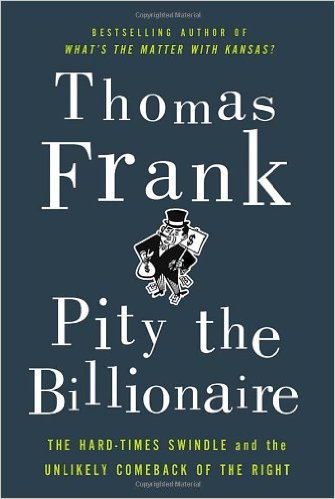
pity the billionaire

Pity the Billionaire: the Hard Times Swindle and the Unlikely Comeback of the Right

By Thomas Frank

Havill Secker (2012)

Book Review

Pity the Poor Billionaire describes how the right wing corporate elite used the 2008 economic crash to build a pseudo-populist movement (aka the Tea Party) to build blue collar support for harsh free market austerity policies that benefited Wall Street at the expense of working people.

According to Frank,  the Tea Party was the fourth conservative uprising in the last half century. The first was the backlash against the anti-Vietnam war movement that resulted in Nixon’s election in 1968 and 1972. The second was the Reagan revolution in 1980; the third the Contract with America revolution that won Republican control of Congress (in 1994) during Clinton’s first term.

The Demise of Unions and the Left

With each of these movements, US political and economic life became increasingly conservative, with all public institutions – churches, hospitals, universities, museums, the US Post Office and even the Army and CIA – succumbing to pressure to operate according to free market principles.

The same period saw the virtual demise of both labor unions and any organized US left. Nevertheless, according to Frank, right wing strategists managed to flood the media with rhetoric ramping up popular fear the left was “on the march.” It mainly  focused on a fictitious behind-the-scenes conspiracy to provoke a crisis – through overspending that would collapse the US economy.

Swaying Popular Anger from Wall Street to the Government

This messaging, crafted by right wing think tanks funded by right wing billionaires like the Koch brothers and delivered by Glenn Beck, Russ Limbaugh and similar right wing celebrities, was spectacularly effective in convincing a majority of Americans that the neoliberal corporatist Obama is really a socialist.

Oil billionaire Charles Koch warned back in 2008 that the global economic downturn could lead to the same “loss of liberty and prosperity” (for billionaires) as the Great Depression did. He and his brother David went on to deliberately manufacture an “astroturf”* movement (ie the Tea Party) to thwart Obama from enacting the same type of public spending projects Roosevelt used to reverse the 1929 depression.**

They did this by using Tea Party protests and right wing media to sway public anger away from Wall Street and onto the government. Via sophisticated psychological propaganda, working people were systematically conned into believing their interests coincide with those of Wall Street corporations.


*Astroturfing is the practice of masking the sponsors of a message or organization to make it appear as though it originates from grassroots participants.

**Frank challenges (with data) the common Tea Party assertion that Roosevelt’s New Deal reforms failed to halt the 1929 depression (ie that it took the World War II mobilization to lift the US out of depression). Between 1929 and 1933 (when Roosevelt took office), the US GDP dropped by more than 50 percent. Following the enactment of the New Deal, it increased by 11% in 1934, 9% in 1935, 14% in 1936 and 13% in 1937. Overall GDP growth 1933-37 was the highest the US has seen outside of war time.

The Fight Against a Jobless Economy and a Citizenless Democracy

People Get Ready: The Fight Against a Jobless Economy and a Citizenless Democracy

Robert McChesney and John Nichols (2016)

Film Review

An extremely inspiring public presentation in which McChesney and Nichols talk about their latest book (of the same name)

McChesney begins with research indicating that 50% of current jobs will be eliminated by robots and artificial intelligence in the next 10-20 years. He also talks about the inherent inability of a scarcity/profit based economic system to address this crisis.

For me, the most interesting part of his presentation was a discussion of Franklin D Roosevelt’s Second Bill of Rights.* According to McChesney, both Germany and Japan incorporated this Second Bill of Rights into their constitutions after World War II. This, in his view, explains why both countries have become economic powerhouses.

Both men talk about the crucial need to form a post-capitalist society and economic system. Nichols talks more about the large global movements which have formed to build this new system. He, like McChesney, has been surprised by the popular candidacies of Donald Trump and Bernie Sanders. The book predicts the appearance of proto-fascist and democratic socialist candidates in response to growing popular resistance movements. However neither expected it to happen so quickly.

The best part of Nichols’ talk is his discussion of the massive Luddite and Chartist movements in Britain (and the populist and progressive movements in the US) that would ultimately lead to universal suffrage, honest elections and the rise of the trade union movement.

Nichols stresses that none of these reforms resulted from the heroic efforts of a political savior – they all resulted from the dedicated and persistent mass organizing of ordinary people.


*Roosevelt’s Second Bill of Rights included the basic right of all Americans to

• Employment (right to work)
• Food, clothing and leisure, via enough income to support them
• Farmers’ rights to a fair income
• Freedom from unfair competition and monopolies
• Housing
• Medical care
• Social security
• Education


The Women Who Brought You the 20th Century

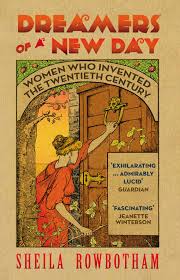
dreamers of a new day

Dreamers of a New Day: Women Who Invented the Twentieth Century

By Sheila Rowbotham (2010)

Book Review

Dreamers of a New Day is about the first international feminist movement in the 1880s and the profound influence feminist organizers and writers had over 20th century life. Most of the women Rowbotham identifies by name are invisible to mainstream society – despite the critical importance of the major social reforms and institutions they fought for and won.

The period 1880-1929 was notable for the wide adoption of mass production and communication, the obliteration of rural life and the treacherous economic instability resulting in recurrent panics and recessions. These major social changes triggered a broad range of anti-authoritarian social movements, including socialism, anarchism, utopianism, populism and numerous other trade union and reform movements. As in the anti-authoritarian sixties, women naturally questioned why the new freedoms men were seeking shouldn’t apply to them, as well. This, in turn, led to the creation of numerous  revolutionary and reformist women-led groups.

The Campaign for Social and Economic Equality

Contrary to what they teach in high school, the first women’s liberation movement fought for far more than the right to vote. Early feminists campaigned (and won) equal access to higher education and professions previously closed to them (eg medicine, law, pharmacy, veterinary medicine) and housekeeping arrangements that enabled mothers to meet their children’s needs while simultaneously pursuing careers. The period 1880-1929 saw a lot of experimentation with cooperative kitchens, laundries, bakeries and child care facilities.

The Feminist Campaign for Clean Drinking Water, Sanitation, Birth Control and the Shorter Work Week

The settlement house movement was a direct outgrowth of the feminist movement. Early women-run settlement houses typically offered communal kitchens, organizing facilities for women’s trade unions (the Working Women’s Union was formed in 1881), childcare and parenting advice. The settlement houses (Jane Adams’s Hull House in Chicago is the best known), which were often linked with universities, were directly responsible for the development of the new fields of social science and social work, which scientifically studied the needs of children and families.

These early feminist groups also led campaigns (which they won) for clean drinking water, sanitation services, clean safe streets, housing more conducive to children’s needs, an end to child labor and sweat shops, a shorter work week, subsidized state housing, and maternity benefits for destitute mothers (established in at least a dozen states before Roosevelt enacted the Aid to Families with Dependent Children program in 1935).

On the sexual front, feminists campaigned for (and won) sexual equality to men, including equal access to divorce and equal access to guardianship of children (prior to 1900 wives and children were viewed as the property of men), the right to dress as they pleased, engage in “free love,” legally access birth control and birth control information (illegal under the Comstock Law in the US and the Obscenity Law in the UK), the right to say “cunt,” “cock,” and “fuck” without going to jail, and medical reforms to reduce maternal mortality (in the 1920s, it was four times as dangerous to give birth as to work in the mines).

Obama’s Privatization Agenda

obama

Guest post by Steven Miller

(This is the 3rd of 6 guest posts in which Miller describes how Obama is re-engineering society on behalf of the ruling elite.)

Part III – Obama’s Privatization Agenda

From Obama’s State of the Union Address:

So, tonight, I propose a “Fix-It-First” program to put people to work as soon as possible on our most urgent repairs, like the nearly 70,000 structurally deficient bridges across the country. And to make sure taxpayers don’t shoulder the whole burden, I’m also proposing a Partnership to Rebuild America that attracts private capital to upgrade what our businesses need most: modern ports to move our goods; modern pipelines to withstand a storm; modern schools worthy of our children.”  (9)

This statement is a call for privatization that follows the speculative agenda described previously. Supposedly “to save taxpayer’s money”, the President offers corporations ownership of the public infrastructure that was formerly built by and for the public. Infrastructure includes roads and bridges, also schools and universities, the electrical grid, water and sewers, parks and ports, airports and dams. Obama even proposes to sell the Tennessee Valley Authority (TVA –  see Republicans Veer Towards Socialism), Roosevelt’s signature project that electrified the South. His plans open the door to the full seizure and privatization of public resources as corporate private property. What was originally built for free public access will increasingly be available only to those who can afford the fees.

Since the financial Meltdown of 2008, the federal government has been “nationalizing” the levers of control of society in the interests of the capitalist class. The Bailout began with the proclamation that “banks are now agents of the government”. It is moot to discuss whether the banks took over the government or the government took over the banks. They are merging together. Mussolini, the theoretician of fascism, held that fascism was the merger of the corporations and the state.

Obama quickly intervened in Detroit to reorganize the auto industry, though he refuses to intervene today to protect the city government or pensions. The federal government is reorganizing both public education and health care. The NSA revelations show that the federal government has also nationalized everyone’s information.

Since 2001, the Department of Homeland Security, financed at an average of some $30 billion a year, has privatized many government functions and outsourced a huge number of police activities to corporations. As Occupy demonstrated to all, DHS has virtually federalized the police.

It is important to understand the state and its powers. The state – including the army, the courts and the police – is distinct from the government. The government collects taxes and decides how to spend public money. This is essentially the administration of things. The state’s role is guaranteed by the rule of law to use coercion and force to protect the property of the ruling class and to guarantee its rule. Hence the state is principally about the control of people. This distinction is fundamental to understanding the maneuvers and powers of capitalism today.

No longer under public accountability or control, the state apparatus today plays a major role in engineering how society will be transformed for the ruling class. Just as in other periods of US history, the state operates to implement the policies of the dominant block of capitalists. Currently this means the state will use its powers of force to facilitate the privatization of everything tangible.

References and Resources

9)  www.whitehouse.gov/state-of-the-union-2013

To be continued.

photo credit: SS&SS via photopin cc

***

Steven Miller has taught science for 25 years in Oakland’s Flatland high schools. He has been actively engaged in public school reform since the early 1990s. When the state seized control of Oakland public schools in 2003, they immediately implemented policies of corporatization and privatization that are advocated by the Broad Institute. Since that time Steve has written extensively against the privatization of public education, water and other public resources. You can email him at nanodog2@hotmail.com

Originally posted at Daily Censored