Homelessness: The Low Income Housing Scandal

Poverty in America

Frontline (2017)

Film Review

Poverty in America is about the massive corruption scandal behind homelessness and the dearth of affordable housing for low income Americans.

Despite the nearly ten years that have passed since the 2008 economic crisis, 2.5 million Americans are made homeless through home eviction every year. The limited stock of affordable housing has no way of absorbing this many new renters. This, in turn, drives up rents at a time when real wages are decreasing. In many cities, families are forced to pay over 50% of their income in rent – a precarious situation leaving them one family emergency away from the streets.

This documentary focuses on two grossly inadequate federal programs dedicated to increasing access to affordable housing. The first is the Section 8 voucher program enacted in 1968. Under this program, the Department of Housing and Urban Development (HUD) awards vouchers to low income renters that pay the different between the rent a landlord charges and the rent a tenant can afford based on income.

There are currently 2 million Americans on the waiting list for Section 8 vouchers and only 25 percent will ever receive vouchers. The filmmakers follow three women who have waited six years or longer to qualify for Section 8 vouchers. None of them can find a landlord willing to accept their voucher within the 90 day limit they are given.

The second federal program Frontline explores is one in which the IRS allocates tax credits to states to grant to developers – who, in turn, sell the credits to investors. An entire tax credit industry has grown up around this scheme. Owing to inadequate IRS monitoring (only seven companies have been audited in 29 years), the scheme has been plagued by bribery and kickback scandals.

In Florida, for example, developers routinely cheat the program by over inflating the cost of development projects and either pocketing the difference of siphoning it off to shell companies (including one in Costa Rico specifically created for this purpose).

Despite heroic efforts of a handful of Department of Justice attorneys and Senator (R) Charles Grassley from Iowa, there seems to be little interest on the part of federal or state authorities to end this corruption. The IRS and HUD declined to be interviewed for this program.

More Babies Die in Cleveland than in North Korea, Sri Lanka, Albania and Guatemala

Behind America’s Infant Mortality Crisis

Al Jazeera (2013)

Film Review

Since the mid-1990s, when Bill Clinton eliminated Aid For Dependent Children (AFDC), the US has enjoyed infant mortality rates among the highest in the world. Rust belt Midwestern cities lead the US in infant mortality. The loss of steel, auto and other manufacturing to third world sweatshops has virtually crushed many of these cities, leaving massive unemployment – particularly among African Americans.

Cleveland is the US city with the highest percentage of babies dying during the first year of life – with an infant mortality greater than third world countries like North Korea, Albania, Sri Lanka and Guatemala.

Trying to identify the cause of Cleveland’s skyrocketing infant mortality, filmmakers interview African American mothers and expectant mothers and neonatal specialists. The neonatologists identify prematurity as the number one cause of infant deaths. Factors that contribute to mothers delivering prematurely include homelessness and lack of access to healthy food (or money to pay for it) and prenatal care. Ohio is one of the states where Republican legislators declined federal funds to expand Medicaid (which pays for prenatal care) to the working poor.

The neonatologists also point out the false economy of this ideological stinginess. Ohio’s Medicaid program spends hundreds of millions of dollars trying to keep premature babies alive in state-of-the-art neonatal ICUs – it would cost taxpayers far less to prevent prematurity by ensuring expectant mothers have warm housing, healthy food and prenatal care.

Belgium’s Miss Homeless Competition

Miss Homeless Documentary: Mathilde’s Misses

Directed by Pieter DeVos

(French and Flemish with English subtitles)

Film Review

This documentary is about a unique Brussels beauty pageant for homeless women. The purpose of the contest is to raise public consciousness about the plight of homeless women. Its sponsors, a long time homeless advocate named Mathilde and her daughter Aline, take the radical position that no woman should be homeless.

The film follows ten finalists as they prepare for the pageant. In addition to finding them temporary housing to help them qualify for government benefits, Mathilde and Aline support them through a variety of health and personal crises.

The documentary offers a rare glimpse into the immense stress confronting victims of homelessness. It’s also extremely touching to watch how the women respond to pampering by professional hair stylists and make-up artists.

Invisible No Longer: Chicago’s Homeless

Street Life: Faces Uncovered

By Neal Karski, George Min, Tyler Dubiak and Scott Hilburn (2016)

Film Review

Street Life is a portrait of the Chicago’s homeless population. It begins by demolishing the myth that homelessness is a lifestyle choice. In addition to a wealth of statistics, the documentary includes interviews with homeless Chicagoans, social service workers, homeless advocates and random passersby. I found it intriguing that none of the women interviewed blamed the homeless for their predicament – while more than half the men did.

On any given night 750,000 Americans are homeless, and yearly 25-35 million spend some nights on the streets or in shelters. Worldwide 100 million people have no housing at all while one billion have grossly inadequate housing. Last year, over a million American children were homeless at some point.

In examining the causes of chronic homelessness, filmmakers identified the following breakdown (in Chicago):

  • 48% suffer from chronic drug or alcohol addiction
  • 32% are mentally ill
  • 25% are victims of domestic violence
  • 15% are unemployed veterans
  • 4% have HIV or AIDS

Because the homeless make huge demands on the public health system, it costs taxpayers far less to pay for their housing than to leave them on the street. After starting a Permanent Supportive Housing program two years ago, Illinois lawmakers reduced emergency room visits by 40%, nursing home days by 975%, inpatient days by 83% and psychiatric services by 66%.


Britain’s Squatters Movement

Give Us Space

Directed by Claudia Tomas (2015)

Film Review

Give us Space is about the grassroots movement which has formed in response to the British housing crisis. It features fascinating interviews with squatters and other housing activists. All are extremely critical of Conservative policies that make it virtually impossible for working people to find affordable housing in London.

In addition to the current recession, which has driven down wages, the mortgage/foreclosure crisis and the government sell-off of subsidized housing, British workers also confront skyrocketing house prices and rents due to speculation by foreign buyers (who purchase homes they don’t intend to live in as assets).

As one activist points out, Asian countries charge foreign buyers a 15% tax to discourage speculation in their property market. In Britain, in contrast, the government actively encourages developers to market their property to foreign buyers.

For me the most interesting part of the film was the history of Britain’s squatters movement, which first began after World War II. At the time, there were insufficient homes to accommodate soldiers returning from the front.

In 1946, squatting in vacant buildings was so widespread that the government permitted local councils to charge squatters rent.

The movement experienced a resurgence in the late sixties with the release of the Ken Loach film Cathy Come Home and again following the 2008 economic downturn.

How Capitalism Causes Mental Illness

Capitalism and Mental Health: How the Market Makes Us Sick

Libertarian Socialist Rants (2016)

Film Review

This 22 minute documentary makes an excellent case that capitalism is the primary cause of most mental illness.

The film begins by demonstrating that capitalist bosses have no incentive whatsoever to keep their workers healthy. Ideally they want their workers to be just healthy enough to do their work. From an employer’s perspective, any excess of health is wasteful and dangerous. Workers who are too healthy generally get restive when they’re forced to work for an abusive and exploitative boss.

In general, the most docile workers are those who are moderately depressed and apathetic. If people stop being depressed, they want to either 1) quit their jobs or 2) rebel.

The film also identifies housing difficulties (homelessness and insecure or poorly maintained housing) as a major cause of anxiety disorders and alcohol and drug addiction. Margaret Thatcher’s austerity policies led to a rampant heroin epidemic, as million of Brits lost jobs and/or secure housing.

The film goes on to cite a wealth of studies linking work and accommodation stress to anxiety and addiction disorders.

US Barbarism Towards the Mentally Ill: A Crime Against Humanity

This is Crazy: Criminalizing Mental Health

Brave New Films (2015)

Film Review

This documentary showcases US policies which are shutting down psychiatric hospitals and community mental health centers and warehousing America’s mentally ill in jails and prisons. It features in-depth interviews with two mentally ill women who survived lengthy incarcerations, as well as commentary by psychiatrists, mental health workers and prison reform advocates.

America’s barbaric treatment of the mentally ill constitutes a crime against humanity under international law. Sadly it’s not a new problem. Thanks to the steady cutbacks in mental health services and housing subsidies that began under Reagan, it was clear by the mid-eighties that most mentally ill Americans were ending up in jails and prisons and on the street.

In 2002, Bush junior made even deeper cuts in mental health funding to finance the wars in the Middle East. Meanwhile, thanks to the 2008 global economic scam (which effectively transferred billions in taxpayer dollars to billionaires), states cut an additional $5 billion in mental health services* and eliminated 4,500 psychiatric beds.

Police Harassment of the Mentally Ill

The documentary begins by highlighting the brutal treatment of the mentally ill at the hands of police. When I practiced in Seattle, police routinely underwent crisis intervention training that enabled them to recognize when suspects were psychotic and to appropriately de-escalate threats of violence. This training also made it far more likely mentally ill offenders ended up in treatment facilities – as opposed to jail or prison.

Thanks to ongoing budget cuts and the militarization of local policing, most cities have abandoned routine crisis intervention training. In recent years, it’s become common for cops to kill psychotic individuals when they create a disturbance on the street – either by shooting them or repeatedly tasering or beating them to death. The lucky ones end up with lengthy prison sentences.

To his credit, New York city mayor Bill De Blasio re-instituted crisis intervention training for New York cops in 2014.

Private Prisons (Housing 1/3 of Mentally Ill Offenders)Are the Worst

This is Crazy continues by examining the brutal treatment psychotic inmates receive from prison guards. There is often no effort, especially in private prisons, to ensure they receive their prescribed medication. Instead guards physically abuse them and put them in solitary confinement in a (mostly futile) effort to get them to comply.

Warehousing the mentally ill in jails and penitentiaries also rips of taxpayers – as it costs $15 billion more annually than outpatient mental health treatment.

Once mentally ill convicts are released from prison, they rarely get appropriate aftercare. Conventional probation services make no effort to ensure that they access housing or appropriate aftercare services. Many end up returning to the streets to live.


*Between 2009 and 2012.

A Rebel Comes of Age by Stuart Bramhall

***

I was really touched by this review, by a teen blogger, of my young adult novel. It gave me a warm fuzzy feeling that “teenage-related problems” made the book seem more real for her. Her revelation that she has never read a book like this also grabbed me. I guess it’s pretty rare to encounter books on protest and political change in modern bookstores and libraries.

In Defense of Smokers

smoking

As a doctor, I’m well aware of the negative health effects of smoking. Studies show a life time of smoking subtracts an average of ten years from your life expectancy. I’m also aware of the considerable health costs of treating smoking-related illnesses, such as chronic bronchitis, emphysema, heart disease and stroke. Other studies suggest that non-smokers actually generate higher health care costs because they live ten years longer. This research receives limited publicity. The Center for Disease Control prudently chooses not to promote the cost savings associated with premature death.

Owing to a chronic sinus condition, I’m also painfully aware of the effects of second hand smoke. Prior to the public ban on smoking, I had no choice but to avoid public areas (restaurants, bars, theaters and even airplanes) where smoking was likely to occur.

The Stigmatization of Smokers

However, as an organizer and civil libertarian, I’m also extremely wary the increasing stigmatization of smokers – especially when I read that employers are using “smoker status” as a justification for not hiring people. In this regard, I think the right wing may be justified in labeling liberals who lobby for smoking bans as “green fascists.” In an era were corporate and government interests are looking for every possible opportunity to pit working Americans against one another, it’s counterproductive to be hypercritical of lifestyle choices.

Most progressives know better than to stigmatize the unemployed and homeless. Yet many of us don’t give a second thought about villainizing smokers, alcoholics, fat people – and, might I add, gun owners. All four are popular targets right now. I blame this on liberals’ willingness to embrace what is essentially conservative ideology – the need to take “personal responsibility” for our lives.

The Cult of Personal Responsibility

Taking “personal responsibility” simply ain’t going to cut it right now. Not for millions of unemployed Americans, nor the million plus homeless, nor for thousands of families facing imminent foreclosure and/or eviction. And singling out designated groups for bad lifestyle choices distracts us from the real problem in the US – a concerted attack by Wall Street and our corporate-controlled President and Congress on working people.

Decades of epidemiological research (see prior blog on Dr Stephen Bezruchka) show that lifestyle choices account for only 10% of the causation of illness. If we’re really serious about improving Americans’ abysmal health status (near the bottom for industrial countries), it’s time to address the real cause of poor health. Study after study shows a direct link between their extreme income disparity and Americans’ high rate of both acute and chronic illness.

It’s time to focus on the real problem – the corporate deregulation and tax cuts responsible for extreme income equality in the US. Instead of scapegoating smokers and fat people.

photo credit: cszar via photopin cc

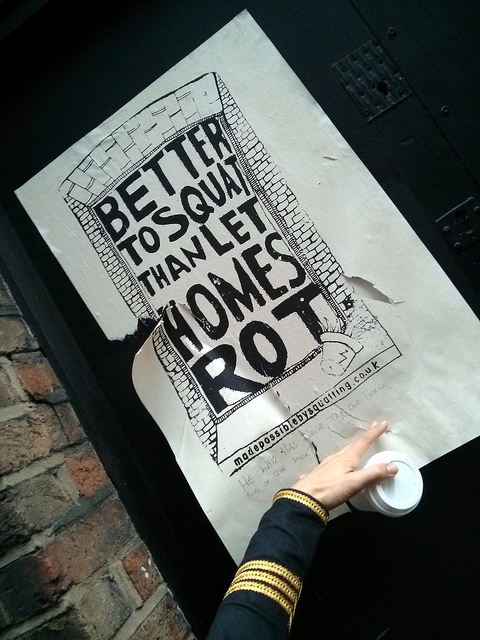
Squatting 101

squatting

(Another post based on my research for A Rebel Comes of Age – with specific advice on how to stop your bank from foreclosing on you. A new ruling in US bankruptcy court means that roughly half the foreclosures which have occurred since 2008 are illegal.)

Squatting is becoming increasingly common with the worsening recession and continuing foreclosures and evictions. The foreclosure crisis has many US cities with whole blocks and neighborhoods of abandoned homes (which are quickly stripped of their plumbing and electrical fixtures). The problem turns out to be extremely expensive, both due to plummeting property values and tax take and higher crime rates and demand for (police and fire) services (see). Thus it’s no surprise that the city of San Diego recently sued Bank of America to stop foreclosures in their city. Prior to their recent bankruptcy proceedings, Detroit was paying people to move into abandoned homes.

The simplest form of squatting is remaining in your home when the bank or mortgage company tries to foreclose on your property. Owing to the recent scandal over illegal foreclosures, mortgagees who miss payments now have a range of legal options they can pursue (see * below).

Grassroots Remedies

Take Back the Land is a Miami-based social justice groups formed in 2006 with local action groups in New York, Boston, Chicago, Madison, Toledo, Portland, Rochester, Washington DC, Atlanta and other cities. Where they can use legal means, these local groups often organize “live-ins,” moving dozens of community activists into foreclosed homes to block evictions. In several cities, Take Back the Land activists work to rehouse homeless families in abandoned foreclosed homes. Volunteers break into the houses, clean, paint, make repairs and change the locks. Then they help move homeless families into them. More often than not, getting off the streets enables homeless parents to keep and find jobs, making it possible to pay rent and move into their own place.

Hands-Off Approach by Police and Banks

For the most part neither city police nor the banks that own the homes interfere. In Miami, for example, the city takes the position that it’s the responsibility of the bank to initiate eviction proceedings. The banks who own the homes seem even less keen to eject squatter than the police. In most states, this requires initiation of formal eviction proceedings in court. Moreover banks know full well that perpetually vacant homes eventually become worthless, due to vandalism, and have to be demolished (at additional cost to the owner).

Meanwhile neighbors concerned about their property values are ecstatic to see foreclosed homes occupied and fixed up (even by squatters), as abandoned property is a magnet  for vandalism, prostitution, drug and gang activity and fires (see and)

In addition to the good work of Take Back the Land and affiliate groups, in many places homeless families are occupying foreclosed properties on their own.

The Law of Adverse Position

Things get really interesting when homeless families occupy abandoned property for five years or more (longer in some states) and attempt to claim title (ownership) under Adverse Possession laws claim title (ownership) under Adverse Possession laws. It has also opened up a lucrative market for ambitious entrepreneurs who fix up abandoned properties and rent them out to tenants. In December 2010 Mark Guerette, the owner of Saving Florida Homes, Inc pleaded no contest second degree fraud for renting out 100 foreclosed properties.

It turns out that Gurette notified all the banks who owned the vacant the homes that he was claiming them under adverse possession – and only received a response from two of them. Owing to the banks’ disinterest, the state of Florida couldn’t really charge him with trespassing. They could only charge him with fraud by finding tenants willing to testify that he had misled them. All his rental agreements included an addendum explaining that he was occupying the property via “adverse possession.” So he ended up with a slap on the wrist – two years probation and a court order not to file any “adverse possession” claims for two years.

The 1862 Homestead Act

The legal principle of “adverse possession” – the origin of the expression “possession is nine tenths of the law” – is recognized in most cultures. In the US, its basis in law dates back to the Homestead Act Abraham Lincoln signed into law in May 1862. The Act stipulated that anyone “improving” unoccupied land could fill out an application and file for a deed of title after five years. The law was abolished in 1976, except in Alaska which continued a state version of the Homestead Act until 1986.

Nevertheless common law and most states provide for a person to obtain land through use. For example, your neighbor puts a driveway between your homes to enable him to get to the rear of his property. In doing so he takes a strip of your property six feet wide. If you do nothing, your neighbor could end up owning that part of your property. In failing to challenge your neighbor with a lawsuit, you technically abandon the rights to your property. This is the foundation of adverse possession. One feature that makes squatting on foreclosure home so attractive is that it falls under civil law, rather than criminal, law. Unless you break in or damage the property in some way, the police can’t file criminal charges. Moreover the rightful homeowner has to go through a formal eviction, which can be very expensive, to get rid of squatters.

In Florida, Take Back the Land and individual squatters are utilizing an 1869 statute that says if a person takes a property (and pays property tax) and the owner does not claim the property for seven years, the squatter gets to keep the property. With the damage done to vacant homes by vandals, improving the property usually means fixing the fences, cutting the grass and repairing broken windows and doors. Requirements differ in other states, although all require you to occupy the property openly and make improvements to it. California, Nevada and Iowa are the most favorable states for squatting as they only require you to occupy property (and pay property tax) for five years before applying for a deed of title.

* Legal remedies against foreclosure:

1. MERS foreclosures

A US bankruptcy court and many states have ruled that roughly half of US mortgages are illegal and that tens of thousands of foreclosures have been fraudulently executed by Wells Fargo, J P Morgan Chase, Bank of America (and other banks), Fannie Mae.

Prior to the 2008 meltdown, mortgages were traded and changed hands so frequently that banks simply registered them with the Mortgage Electronic Recording Service (MERS), rather than executing a title transfer. State lending laws specify that only that actual owner of a mortgage can initiate foreclosure action. In many cases banks are filing fraudulent court documents alleging that they own the loans, when they are merely servicing them on behalf of the lender.

Home owners threatened with foreclosure need to immediately do a Securitization Audit to determine who actually owns the mortgage and deed (and is legally entitled to foreclose).

2. Predatory mortgage loans

Mortgagees victimized by predatory mortgage loans (tricked into accepting mortgages they can’t possibly repay) can request Forensic Loan Document Review. There are federal laws that protect against predatory lending, which you can use to force the bank to negotiate.

3. Fraudulent mortgage charges

Also Bank of America was caught in a related scam in which they were adding backdated insurance charges to mortgage payments to push mortgagees who missed payments into foreclosure. This means it’s essential to check your mortgage statement for unexplained charges.

4. Chapter 13 bankruptcy

Families may be able to save their homes from foreclosure by filing for Chapter 13 bankruptcy.

photo credit: gruntzooki via photopin cc

***

Rebel cover

In A Rebel Comes of Age, seventeen-year-old Angela Jones and four other homeless teenagers occupy a vacant commercial building owned by Bank of America. The adventure turns deadly serious when the bank obtains a court order evicting them. Ange faces the most serious crisis of her life when the other residents decide to use firearms against the police SWAT team.

$3.99 ebook available (in all formats) from Smashwords:

https://www.smashwords.com/books/view/361351