The Hidden History of the US Constitution

towards an american revolution

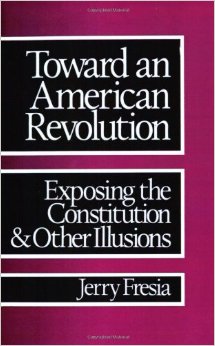
Toward an American Revolution: Exposing the Constitution and other Illusions

by Jerry Fresia

South End Press (1988)

Book Review

This book is a great follow-up for people wanting to know more about the secret machinations behind the US Constitution after watching the film Plutocracy.

I knew virtually nothing about the framing of the Constitution when I first read Toward an American Revolution in the mid-nineties. Fresia reveals how the first Constitutional Convention was actually a secret meeting of rich property owners and merchants whose business interests (expanded trade and personal wealth) were threatened by farmers who had seized control of legislatures in twelve out of thirteen states.

The clear intent of Washington, Hamilton, Madison and the other businessmen and plantation ownders who wrote the Constitution was to transfer power from relatively autonomous state assemblies to a centralized federal government. Most agreed from the outset that they wanted a system of government more like Britain’s, ie one in which the business elite could use government authority to enhance their economic interests.

According to Fresia, the true purpose of constitutional “checks and balances” (ie the three branches of government) was to insure that moneyed interests enjoyed a greater voice than ordinary people. The Senate, a distinctly unrepresentative body, plays a major role in minimizing popular input. The Senate, in which a tiny state like Rhode Island has the same number of votes as an a big state like California, is given sole authority to approve treaties and presidential appointees. Their longer terms (six years) mean senators are less accountable to voters than congress people (who have two years terms). Until 1913, senators were still chosen by the electoral college (as opposed by direct vote) as the president is.

In 2015, more than 200 years after the Constitution was first written, Americans are still denied the right to vote directly for President.

Toward an American Revolution also describes the dirty tricks the founding father used to get 9 legislatures to ratify the Constitution, despite overwhelming opposition from the majority of enfranchised American voters.

The second half of the book fast forwards to the twentieth century to demonstrate how the US has continued to be ruled by a secret political elite. The latter have a specific agenda of suppressing democracy when it interferes with their business interests.

The examples given include America’s “secret police” force under the FBI’s Cointelpo operation, the role played by President Herbert Hoover and US industrialists (represented by Wall Street lawyer Allen Dulles) in financing the rise of Hitler, the subsequent appointment of Dulles to head the most powerful secret police apparatus in history (the CIA), his incorporation of Nazi war criminals into US intelligence networks, the role of “secret government” in the assassination of JFK, the corruption of our democratically elected representatives by corporate lobbyists and Reagan’s illegal war in Nicaragua.

Fresia has kindly made excerpts of this book available at http://cyberjournal.org/authors/fresia/
The Real Vampires: An Insider’s View of Banks

tragedy and hope

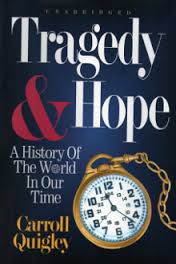
Tragedy and Hope: A History of the World in Our Time

Carroll Quigley* (1966 MacMillan)

Tragedy and Hope is a free download from http://sandiego.indymedia.org/media/2006/10/119975.pdf

(This is a third of a series of posts about stripping private banks of their power to create and control our money supply.)

Book Review

Tragedy and Hope is an exacting account of how the Bank of England, the Federal Reserve, the European central banks, and the investment banks that dominate them (e.g. Goldman Sachs and JP Morgan) came to control all western governments.

According to Quigley, banks have controlled western society – by manipulating the money supply – since the creation of the Bank of England and the fractional reserve lending system in 1694. Moreover, owing to the secrecy under which they operate, Quigley asserts that most elected officials are totally unaware of the immense control central and investment banks exert over the so-called democratic process.

He describes in exhaustive detail how all historical inflationary and deflationary crises, panics, wars, recessions and depressions were orchestrated behind the scenes by the banking establishment, for the purpose of increasing their private wealth. In his epic portrayal of three centuries of western civilization, he also describes how the banking aristocracy financed the rise of Communism in Russia, China and Eastern Europe, as well as bringing Hitler, Mussolini, Stalin and Roosevelt to power and guiding their governments from behind the scenes.

How Banks Create Money “Out of Nothing”

The single act, according to Quigley, that guaranteed Britain’s two century preeminence over the rest of the world was the development (in 1694), by British investment banks, of the fractional reserve lending system. This system allowed English investment banks to be the first in the world to lend money (to industry and the British government) that they created out of thin air. He goes on to list the banking dynasties that have held near absolute control of the global money supply since 1694, starting with banking cartel formed by Frankfurt banker Meyer Rothschild. At the time of his death, Rothschild’s five sons each controlled a major investment bank in Vienna, London, Naples, Paris and Frankfurt. Quigley lists the investment bank formed by the J.P. Morgan family as second to the Rothschild banks in power and influence, followed by the Baring Brothers, Morgan Grenfell, the Lazard Brothers, Erlanger, Warbur, Shroder, Seligman, the Speyers, Mirabaud, Mallet and Fould.

The Council on Foreign Relations

Quigley also writes about the network of secret round tables of international corporate and banking elites started by Cecil Rhodes and expanded by his followers with his sizable estate. At their founding, they had the stated purpose of spreading British the virtues of “ruling class” tradition throughout the English speaking world and solidifying the political power and influence of the British Empire. The US Council on Foreign Relations, one of the secret round tables started by Rhodes’ followers, was started in 1919, with the explicit goal of influencing the foreign and domestic policies of a former colony over which Britain no longer had direct control.

How English Banks Controlled the US Government

According to Quigley, the US was consistently a debtor nation prior to World War I. Following the 1776 revolution, US government and businesses continued to borrow funding for industrial and colonial expansion from English and European investment banks. The American banker, JP Morgan, collaborated with European investment banks to dictate US foreign and domestic policy. They did so by threatening to destroy the US economy by 1) refusing to renew treasury bonds (i.e. money the government borrowed from banks to fund public spending 2) causing a panic by throwing large numbers of shares on the stock market or 3) destroying the value of railroads and other companies the banks owned by loading them up with worthless assets.

As Quigley relates, they engaged in all three tactics at various times throughout the 19th century, resulting in a series of booms, panics, recessions and depressions that wreaked havoc on American economic development.

How Bankers Engineered, World War I, Bolshevism, Nazism and the Great Depression

The most disturbing section of Tragedy and Hope describes how international bankers engineered (he describes their secret meetings) World War I and what Quigley calls the Banker-Engendered Deflationary Crisis of 1927-40 (aka the Great Depression). Following the 1870 unification under Bismarck, Germany experienced a rapid burst of industrialization, generating sufficient profit that they ceased to rely on investment banks to finance either business or government. They also threatened global bankers by competing with England and other European countries for export markets.

While engineering the first world war to put Germany in her place, the world banking cabal simultaneously hatched a scheme to destabilize Russia (which was making claims on Balkan members of the former Ottoman Empire) by secretly funding the Bolsheviks and other Russian revolutionaries.

Financing Hitler and the Nazis

When the the first world war ended in 1918, public debt in Western Europe and the US had increased by 1000%. In 1929, the austerity measures global banks forced on the US, England, France and other European countries led to widespread bankruptcies and unemployment and the virtual collapse of foreign trade.

Except in Germany. The global banking elite used the wealth generated from debt repayment to finance rapid German re-industrialization and militarization and the Nazi movement started by Hitler. The main German corporations funding Hitler were IG Farben, Siemens, Bayer, Daimler Benz, Porsche/Volksvagen and Krupp. In addition to Henry Ford and William Randolph Hearst, the important US banks and corporations who financed Hitler’s rise to power included Kodak, Coca-Cola, DuPont, Standard Oil, IBM, Random House and Chase Bank.

* Late mentor to former president Bill Clinton, Princeton, Harvard and Georgetown professor Carroll Quigley also served as an adviser to the Pentagon and Foreign Service.

Useless Eaters: Stigmatizing Sick People

concentration camp

In western countries, I see a frightening tendency to make sick people personally responsible for being ill. We are all bombarded with constant media messaging that anyone can stay healthy if they eat the right foods, exercise, and manage their stress levels. Meanwhile media pundits who demonize people on disability benefits for being lazy and unwilling to work.

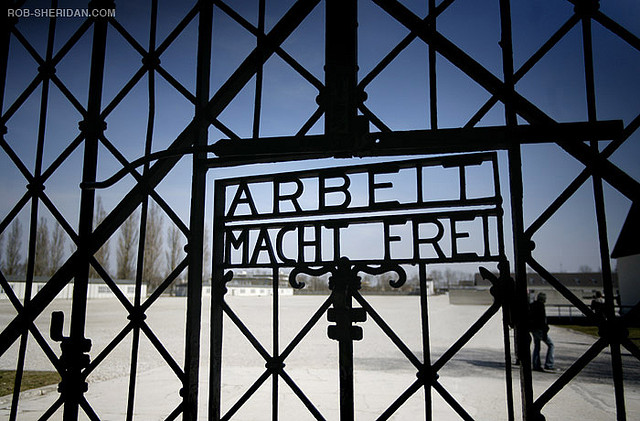
I find all this vaguely reminiscent of Hitler’s “useless eater” policies of the 1930s. Hitler’s definition of a “useless eater” was a German who consumed resources without participating in production. Included in this category were tens of thousands of individuals with chronic physical or mental illness and physical and intellectual handicaps – who would be the first inmates in Nazi concentration camps.

Internalizing this pressure to be and appear well, people blame themselves if they become ill. This attitude is strongly reinforced by the constant TV ads that bombard us for cough and cold remedies that enable people to attend work with colds and even quite serious illnesses, such as bronchitis and the “flu.”

The pressure on kids to attend school or daycare when they’re sick – because their parents can’t afford to stay home with them – is a public health disaster. Sick kids in the classroom expose a lot of other kids, who go on to infect their families. Many children suffer one respiratory after another, a perfect set up for asthma (which is reaching epidemic proportions) and permanent lung disease.

Human Beings Get Sick

Surely it’s healthier and more humane and community-minded to accept that sickness is fundamental to the human condition. Epidemiological studies show that only 10% of illness is accounted for by lifestyle factors (including smoking). Other studies show that people who take time off recover faster and cope better with other life stresses.

38% of US Workers Have No Paid Sick Leave

Advice that sick people stay home and look after themselves is easy in most civilized countries (like New Zealand) owing to national laws requiring that employers provide workers paid sick and parental leave. The US isn’t one of them. Thirty-eight percent  of US workers have no paid sick leave.

There are no federal laws requiring American employers to provide paid sick leave. Only Connecticut, and a few cities (New York, Portland, San Francisco, Washington, Seattle, Newark, Tacoma, and Jersey City) have them. Even more disgusting ten states — Arizona, Florida, Georgia, Indiana, Kansas, Louisiana, Mississippi, North Carolina, Tennessee, and Wisconsin — have enacted preemption bills that blocking cities and towns from passing paid sick leave legislation.

At present only California and Vermont have laws requiring employers to provide paid parental leave. So I guess working parents with sick kids are just out of luck.

The Campaign for Paid Sick Days

Just to be clear here. None of these cities and states have mandated paid sick leave because they were feeling kind and charitable. These laws were enacted because local activists fought for them. You won’t here about the Paid Sick Days for All Coalition on the six o’clock news. The corporate media wants you to believe the war is over and the good guys lost (to quote Leonard Cohen).

The war against corporate fascism ain’t over by a long shot. People can get get involved with the Paid Sick Days for All through their website: http://paidsickdaysforall.org/

photo credit: Rob Sheridan via photopin cc