Did Global Economic Growth End 15 Years Ago?

life after growth

According to London Broker, Global Economy is Shrinking

The main premise of Life After Growth: How the Global Economy Really Works – and Why 200 Years of Growth are Over  is that global economic growth has ended. Western governments conceal this fact through debt creation, inflation and clever manipulation of statistical economic indicators. According to Tim Morgan, leading analyst at the London financial brokerage Tullett Prebon, economic growth ended in 2000 and the economy has been shrinking ever since.

Morgan attributes the end of global economic growth to the high cost of fossil fuels.* This is because the real economy (which many people confuse with the financial economy) is a direct function of surplus energy. In pre-agricultural times, there was no energy surplus: human beings derived exactly the same amount of energy from their food as they expended acquiring it. With the advent of farming, they managed to produce a small surplus of energy that enabled a small minority to engage in work other than food production.

In the 18th century the invention of the heat engine enabled surplus energy (and the real economy) to grow exponentially over the next 200 years. Now that the cheap fossil fuel has been used up, our energy surplus is declining. This, in turn, is reflected in the gradual shrinkage of the global economy.

Measuring Surplus Energy

Energy surplus is measured as EROEI (Energy Returned Over Energy Invested), the ratio between the energy produced and the energy consumed in the extraction or production process. 1930s oil fields had an EROEI of 100:1. Once the easily accessible oil was used up, the EROEI began to decline. It was 30:1 in 2000 and it declines by about 2% a year. In 2014 it stood at 14:1. Unconventional oil sources have an extremely low EROEI (eg tar sands and fracked shale oil have an EROEI of 3:1).**

Declining EROEI’s are always accompanied by a spike in oil prices. This translates into higher prices for everything, due to the energy required for food production and manufacturing. Owing to higher prices, people consume less and the economy slows.

Globalization Has Been Extremely Damaging

Morgan is highly critical of politicians who fail to distinguish between the real economy of goods and services and the shadow economy of money and finance. He also feels globalization and rampant consumerism have been extremely damaging to the real economy. The mistake western countries made with globalization was reducing their production without reducing consumption. Instead they increased consumption levels by increasing borrowing and debt. Globalization was extremely beneficial for banks, due to the voracious demand for their product (loans). Meanwhile the diversion of large sums from production to the finance sector – aggravated by consumerism and the rise of consumer debt – hastened the decline of the real economy.

This wholesale debt creation and the widening split between the real economy and the financial economy is largely reflected in inflation and the destruction of the value of money. The US dollar lost 87% of its purchasing power between 1962 and 2012, which the government systematically conceals through misreporting of key economic indicators.

All economies function best when the financial economy coincides with the real economy. At present the primary methods of debt destruction are quantitative easing*** and inflation (it’s always easier to repay debts with devalued money). Other methods in the wings are cuts in pensions and Social Security payments and eventually bank failures and government defaults. Morgan feels that resource poor countries like Japan and the UK are at highest risk for default.

How Governments Lie with Statistics

My favorite chapter details the decades of statistical manipulations that have made government indicators of inflation, growth, output, debt and unemployment totally meaningless. John Kennedy was the first to exclude “discouraged” workers (who weren’t actively seeking work) from the unemployment rate. Johnson was the first to conceal the size of the government deficit by including the Social Security surplus in the federal budget. Nixon was the first to exclude energy and food costs (which rise the fastest) from core inflation calculations.

I was most shocked to learn that 16% of GDP consists of “imputations” or dollars that don’t actually exist. The largest single imputation the US government adds is “owner equivalent” rent. This is an amount equivalent to the rent all rent homeowners would have to pay if they didn’t own their own home. In 2011, this added up to $1.2 billion (out of a total GDP of $12.7 trillion).

The second largest imputation involves non-cash benefits employers give their workers (medical insurance, meals, accommodation, etc) and free banking services.

The US Government is Technically Bankrupt

This over-reporting of GDP, combined with under-reporting of inflation, makes it appear that the US economy is growing when it’s not. .

Morgan estimates that as of 2011 true US debt (government, business and personal) was 449% of GDP. Technically this means the US is insolvent as collective liabilities far exceed any realistic prediction of future income.

Politicians Need to Stop Lying

Morgan maintains that industrialized societies urgently need to living with less surplus energy. Rather than continuing to delude themselves (and us), our political leaders must face up to the reality that our claims on future energy surpluses (aka debt) are totally unrealistic.

They need to end globalization and rampant consumerism and enact policies (support for renewable energy, public transport and strong local economies) that will help people adapt to the new economic reality.


*Most analysts predict oil prices will return to $100+ a barrel in June 2015, once the US surplus is used up.
**Some other EROEI’s (for the sake of comparison):
• Coal 8:1
• Solar PVC panels 8:1
• Solar concentrating power: 17:1
• Large hydro generation: 22:1
• Small hydrogenation 32:1
• Landfill/sewage gas cogeneration 40:1
• Onshore wind 20:1
*** Quantitative easing (QE) is an unconventional form of monetary policy where a Central Bank creates new money electronically to buy financial assets, like government bonds. This differs from conventional money creation, in which private banks create money out of thin air as new loans (see An IMF Proposal to Ban Banks from Issuing Money).

Also published in Veterans Today
Debt

debt

Debt: the First 5,000 Years

by David Graeber

Book Review

The primary purpose of Debt: the First 5,000 Years is to correct the historical record concerning the origin of barter, coinage and credit. Incredibly well researched, anthropologist David Graeber’s book is a fascinating read. I found it extremely helpful in gaining some understanding of modern problems with debt and perpetual war. I was particularly intrigued to learn about the 2,600 year old link between war, debt and money creation, as well as the role of violent insurrection in shaping history. Ruling elites are terrified of insurrection. Throughout history, this fear has driven most major reforms.

Debunking Adam Smith

The conventional wisdom, which originates from Adam Smith’s Wealth of Nations, is that money (i.e. coins) originated out of barter relationships, and that paper money and credit replaced coins when trade became too large and complex to be conducted with coins. As Graeber ably demonstrates, Smith had it backwards. Not only was barter virtually non-existent in prehistoric societies, but coinage itself was an extremely late development. Virtual credit preceded coinage (and barter) by thousands of years in all early civilizations. What’s more, these complex credit-debt arrangements played a vital role in the development of traditional institutions, such as slavery, patriarchy, urbanization and organized religion.

The Myth of Barter

People didn’t barter in early hunter gatherer and agrarian societies because they didn’t need to. Well into the Middle Ages, basic needs were met by family and community mutual obligation networks. There was an expectation extended family, neighbors would provide what you couldn’t provide for yourself.

There was a vital need for credit, however, with the development of farms large enough to feed the entire community. According to archeological evidence, credit first developed around 5,000 years ago when farmers borrowed seed and farm implements from wealthy merchants and repaid the debt with a share of the harvest. When the harvest failed, they repaid it in sheep, goats and furniture. When that was gone, they sold their children and eventually themselves into slavery.

This scheme was difficult to enforce, as many indebted farmers either walked away from their land or launched violent insurgencies. In was for this reason that both Sumeria and early Chinese civilizations launched formal debt forgiveness schemes, in which people regained their lands and debt slaves were free to return to their lands.*

The first money (in the form of precious metals, shells or other tokens) was used to pay the bride price the groom paid the bride’s family, the blood debt incurred when someone was murdered and to buy someone out of slavery.

The Origin of Patriarchy

In the earliest Sumerian texts (3000-2500 BC), women appear as doctors, merchants, scribes and public officials and are free to participate in all aspects of public life. This changes over the next 1000 years, with women becoming closeted to protect the honor of their fathers and husbands. According to Graeber, this pressing need to protect a woman’s reputation arose from a reaction by agrarian peoples (such as the early Israelites) to urbanization and the prostitution that resulted from it. The rise of cities in Sumeria and Babylon was accompanied by the rise of numerous informal occupations – including prostitution – practiced by men and women who had fled slavery. Patriarchy arose simultaneously in ancient China for similar reasons.

War, Debt and Money

Coinage (gold, silver and bronze coins) arose simultaneously between 600 BC and 800 AD (aka the Axial Period) in Greece, Rome, the great plains of northern China and the Ganges Valley for precisely the same reason: it was impossible to finance war with local systems of credit.

In all three civilizations, the first coins were used to pay professional soldiers (aka mercenaries). This would lead to the first market economies, as soldiers spent their coins in local communities, as well as concepts of profit and debt interest. In fact, a vicious cycle was established whereby rulers tried to solve their debt problems through expansionist wars to acquire more land, resources and slaves. In every case, this strategy backfired and the wars only increased their indebtedness.

The appearance of coins and market economies also led to a backlash against materialism and preoccupation with money. All the world’s major philosophic tendencies (Zoroastrianism, Buddhism, prophetic Judaism, Hinduism, Confucianism, Jainism, Taoism, Christianity and Islam) arose during the Axial Period

This period also saw the rise of the first peace movements when early philosophers (eg Socrates and Plato) made common cause with rebels who opposed the violence of war and existing power relationships. According to Graeber these movements were remarkably successful in reducing the brutality and frequency of war. By 600 AD, slavery itself was virtually non-existent.

The Rise and Fall of Credit Economies

Following the fall of Rome, populations fled the cities and lived in smaller communities that reverted to credit economies. Gold and silver were used for temples and cathedrals, and only rich people had access to coins. All the major religions prohibited usury.

Money lending and banking arose to fund the Crusades, with the Knights Templar replacing Jewish moneylenders. After their persecution, torture and extermination by Phillip IV (due to the enormous debt he owed them), the latter were replaced by Venetian and Genoan bankers. The Italian bankers used municipal and government debt bonds as the chief instrument of exchange.

Around 1450, gold and silver bullion and coin (much of it from the New World) were re-introduced to finance vast empires and predatory warfare. This development was accompanied by the return of usury and debt slavery.

The Birth of Capitalism

Graeber defines capitalism as a gigantic credit/debt apparatus pumping maximum labor out of human beings to produce an ever expanding quantity of material goods. He dates its origin to around 1700 (six years after the Bank of England issued the first paper banknotes). Police, prisons and state sanctioned slavery were essential tools in achieving the phenomenal productivity needed to finance political systems based on continual war.


*”Every seventh year you shall make a cancellation. The cancellation shall be as follows: every creditor is to release the debt he has owing to him by his neighbor” (Deuteronomy 15:1-3). Every 49 years came the Jubilee, when all family land was to be returned to its original owners, and even family members who had been sold as slaves set free (Leviticus 25:9).

Economics for the Young (At Heart)

Four Horsemen (Ross Ashcroft 2012)

Film Review

 Four Horsemen is full length documentary specifically produced for YouTube and aimed at a younger audience. Its primary goal is to demystify economics, which is a total turn-off for most people because it appears so complicated and uninteresting.

In the view of the filmmakers, a corrupt system of money creation and taxation has enabled a greedy corporate oligarchy to usurp control of western democracy and institute an obscene wealth transfer from the poor to the rich. The corporate elite has cleverly concealed this enormous Ponzi scheme by inventing a kind of voodoo economics to discourage people from taking a closer look at how the economy actually operates.

How Banks Create Money Out of Thin Air

The film provides an elegant description of fractional reserve lending, in which banks create money out of thin air and lend it to us at interest. Although this has been the main form of money creation for centuries (except briefly under Lincoln), most people still mistakenly believe that government issues and controls the money supply.

So do the majority of lawmakers. Ironically the majority of economists also believe that government creates the money we use to run the economy. This is because our banks fund the universities and think tanks where economic theory is taught. In other words, it’s a deliberate deception.

The banks also don’t want us to know where government debt comes from, i.e. that all governments borrow money from banks to fund military, intelligence and public services. Or that repaying all public and private debt would cause the global economy to collapse because this is the only mechanism we have for issue money.

What’s the Solution?

The filmmakers believe that the only solution to the economic, ecological and resource crises faced by humankind is for ordinary people to rebuild a new society from the bottom up.

They have started a YouTube channel called Renegade Economist, as well as publishing a book Four Horsemen: the Survival Manual. According to the authors (Ross Ashcroft and Mark Braund), it describes a model of bottom-up reform that combines government-issued money with a land value tax that replaces income and sales tax.

The second video is a public debate they held a few months after the release of Four Horsemen. The purpose of the debate was to begin public discussion about how to go about how to go about building the new society they envision. In my view the Q&As starting at 47:00 are the most interesting part of the discussion.

Economics to Save Our Civilization

(This is the eighth in a series of posts about ending the role of private banks in issuing money)

“Somewhere in our history we took a wrong turn and today we are reaping the consequences. If we don’t step back to evaluate the root causes of the rolling economic crises, our civilization is in danger of collapse.” – Clive Menzies

A few years back, Clive Menzies, president of British Fund Building and member of the Free Critical Thinking Institute entered into an ongoing dialogue with the London Occupy movement. The result is a radical monetary reform proposal to fix the global economic mess. In the video below, he is presenting it to the Chartered Institute for Securities and Investment (translation: a high-powered group of investment bankers and stock brokers).

In his presentation, Menzies attributes the current crisis, as well as capitalism’s recurrent boom and bust cycles, to the alienation of the vast majority of the global population from the commons (i.e. communal ownership of land and natural resources that ended with the Enclosure Acts) and the prohibition of any discussion of this catastrophic event in contemporary economic discourse. (This is a topic Fred Harrison discusses at length in The Traumatised Society.)

Most of Menzies’s talk focuses on the urgent need to abolish our current debt-based (bank-controlled) monetary system. For five main reasons:

  • It drives systemic inequality by allowing those with more money than they need to exploit those who need money.
  • It drives unsustainable, exponential debt growth because the interest cost rises faster than society can create wealth to pay it.
  • It discounts the future, driving environmental destruction – it makes a forest worth more as sawed timber than as an ecosystem preserved for future generations.
  • It demands exponential GDP growth, rapidly depleting finite resources – 3% GDP growth means the economy doubles every 24 years which means extracting resources at twice the rate and throwing twice as much away.
  • It drives inflation.

He also demolishes the prevailing myth that a person’s existence on this planet is only justified by paid work. In a way it’s deliberate falsehood more than a myth. There is only enough “productive” work for 50% of the adult population and the vast majority of income in contemporary society is generated via “rent-seeking” (i.e. charging interest or rent or extracting and exploiting publicly owned natural resources).

Menzies lays out a monetary reform proposal that would abolish interest exploitation by the private banks who currently issue and control global currencies. Instead it would empower governments to issue interest-free sovereign currency.

An IMF Proposal to Ban Banks from Creating Money

(This is the fourth of a series of posts about ending the ability of private banks to issue money.)

For the past 18 months ago, IMF economists Michael Kumhof and Jaromir Benes have been circulating a proposal to end the ability of banks to create money.

As Kumhof explains in the Nov 2013 video below, the perception that governments create money is totally false. In the current global economic system, only about 3% of money (mainly coinage) is created by government. The other 97% is created by private banks out of thin air when they generate new loans. See Economic Justice: the Rolling Stone Version

For various reasons, which Kumhof explains in the video, he and Benes believe that unlimited and unregulated private money creation by banks is responsible for the current economic crisis. And that full recovery is only possible if the privilege of creating and controlling the money supply is restored as a government function.

In addition to assuming sovereign control over the money supply, national governments would also require banks to hold 100 percent reserves for the loans they initiate. This effectively terminates the ability of private banks to create money out of thin air. And this, in turn, massively reduces their political power.

Ironically, the proposal isn’t new. Entitled the Chicago Plan, it was first put forward by University of Chicago professors Henry Simons and Irving Fisher during the Great Depression.

The History of Private vs Sovereign Money

During the Q&A at the end, Kumhof briefly discusses previous experiments with government-issued sovereign money, which have mainly occurred in the US. Sovereign money funded the original 13 colonies, the American War of Independence and the Civil War.

In their paper The Chicago Plan Revisited, he and Benes trace the history of sovereign money back to the ancient Greeks and Romans. During the Middle Ages and Renaissance, all currencies were publicly controlled (by kings and the Pope) until 1666, when Charles II transferred control of money creation to private banks with the English Free Coinage Act of 1666.

The slides, which are difficult to see in the video, are available here

For me the high point of the video is Kumhof’s disclaimer that he doesn’t represent the IMF – that he’s only doing research. Yeah right. I sure wish I had an understanding boss who let me run around making radical proposals to strip investment banks of their power and wealth.

It seems more likely that people in high places know the ship of capitalism is going down – that this is a last ditch effort to save it.

Economic Justice: the Rolling Stone Version

(This is the first in a series of posts about ending the right of private banks to create money.)

In January Jesse Myerson, writing in the Rolling Stone, called for five seemingly radical economic reforms in an article entitled Five Economic Reforms Millenials Should be Fighting For:  guaranteed jobs for everyone, Social Security for all (a guaranteed Universal Basic Income for all citizens), Land Value Tax (which I blog about in Progress and Poverty ), creation of a Sovereign Wealth Fund (enabling government to buy back and own public assets), and a state-owned bank (like the Bank of North Dakota) in every state.

Personally I found the article disappointing and a little sad. Myerson seems to deliberately overlook the most pernicious problem in our present economic system:  the power we give private banks to issue and control our money supply.

Contrary to popular opinion, the government doesn’t issue money, except for a limited amount of notes and coins. As the film below explains, 97% of the money supply is electronic and created by private banks when they issue loans.

A lot of people have the mistaken impression that banks use other depositors’ money when they loan us money to buy a house. What actually happens is that the bank creates the money out of thin air by entering numbers into a computer.

Another common erroneous belief is the the Federal Reserve, which serves as the US central bank, is a government agency. It’s not. It’s a consortium of private banks.

97% Owned (Positive Money 2012) makes the case that the only solution to the current economic recession is to ban private banks from issuing money. They argue for making money creation publicly accountable by restoring this function to government (ironically this is where most people mistakenly believe it lies). Until we make this happen, private banks will continue to use their control of the monetary system to undermine genuine economic and political reform.

Was Occupy Wall Street Coopted?

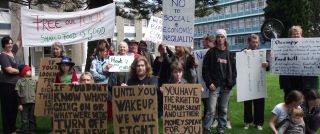
OccupyNewPlymouthphotoOccupy New Plymouth (NZ) Oct 15, 2011

Deeply curious where the Occupy movement had disappeared to, I recently ran across an article about a new project called Rolling Jubilee. It seems a coalition of Occupy groups has joined up to pay off individuals’ personal debt. Rolling Jubilee is a project of Strike Debt, a group formed in November 2012 by a coalition of Occupy groups. It seeks to oppose all forms of debt imposed on society by banks.

The aim of Rolling Jubilee is to abolish millions of dollars of personal debt by purchasing it (at random) on the secondary debt market, as collection agencies do. The latter commonly purchase debt for as little as 1% of its value and then reap enormous profits by demanding debtors pay the full amount. Instead of seeking repayment from debtors, Rolling Jubilee simply erases the debt.

In its first six months of operation Rolling Jubilee raised sufficient funds to buy and abolish more than $8.5 million worth of debt. They list debt they have purchased and eliminated on the Rolling Jubilee website. Most appears to be medical debt, i.e debt incurred for treatments that aren’t covered by health insurance.

A Far Cry from Ending Corporate Rule

At first glance Rolling Jubilee strikes me as a typical feel-good kind of project – like walking 20 miles for a cancer cure – that allows liberals to believe they are making positive change without threatening corporate interests in any way. The project is a far cry from Occupy Wall Street’s original goal of ending corporate rule. I honestly can’t see any way that paying off patients’ medical debt is going to help dismantle the corporate oligarchy that currently rules the industrialized world.

Banks and corporations seem to have the same reaction I do. They love Rolling Jubilee. Business Insider describes the project as brilliant. A Forbes column on the Rolling Jubilee featured the headline “Finally an Occupy Wall Street Idea We Can All Get Behind.”

According to Forbes, banks, credit card companies and student loan agencies can’t forgive debt because the IRS considers this kind of debt relief a “gift” and charges the debtor tax on it. This is utter nonsense, of course. It makes you wonder if the people who write for Forbes have ever met or talked to any unemployed or homeless people. There is no way the IRS is going to tax anyone without income or assets.

Making a Cottage Industry Out of Revolution

Twenty years ago this example of Occupy morphing into a less politically threatening pro-corporate entity would have been condemned as cooptation. However in an era in which CIA-funded left gatekeeping and democracy manipulating foundations head up the nonviolent movement, cooptation doesn’t seem like the correct term any more. Maybe we need to invent a new term – pre-optation, perhaps?

Is a College Degree Worth the Cost?

janitor

The Best Educated Janitors in the World

Given the $962 billion Americans owe in student loan debt, it seems reasonable to ask what a college degree buys them in employability and future income.

Not much according to a recent Online Degree feature revealing that 33,655 PhDs and 239,029 master’s degree recipients are on food stamps. American janitors are the most educated in the world, with 5,000 of them holding doctorates. According to the Bureau of Labor Statistics, approximately 1/3 of US college graduates work in jobs not requiring a bachelor’s degree.

Peter Schiff’s recent encounter with college grads in New Orleans is also extremely revealing:

photo credit: an untrained eye via photopin cc

Crossposted at Daily Censored and Veterans Today


American Ambivalence Towards Empire

soldiers

(The 3rd of 8 posts about my decision to emigrate to New Zealand)

I had to move overseas before it sank in that Americans owe their high standard of living to US military domination of third world resources. The concept of economic imperialism isn’t new to me. I have known for years that the US maintains a monopoly on cheap third world labor and resources via military support of puppet dictators, CIA destabilization campaigns, currency manipulation and Wall Street and IMF/World Bank debt slavery schemes.

Yet for some reason, I placed the entire blame on the bloated US military-industrial complex and the immense power defense contractors wield via their campaign contributions and ownership of US media outlets. I conveniently overlooked the financial advantages ordinary Americans enjoy as a result of world military domination – namely low priced consumer goods. It took the physical reality of living in a smaller, poorer, non military nation and paying higher prices for for gasoline, books, meat, fish and other products – on a much lower income.

Americans Love Cheap Gasoline, Coffee, Sugar and Chocolate

I think most Americans are profoundly ambivalent about the concept of empire. In public opinion polls, Americans consistently oppose foreign wars, except where “US interests” are at stake. And policy makers and the mainstream media are deliberately vague in defining “US interests.” Prior to 1980, a threat to American interests meant a clear threat to America’s democratic system of government or the lives of individual Americans. When Ronald Reagan invaded Grenada in 1984, the official pretext was to evacuate American students at the medical school at St George University (the real reason was to oust pro-Cuban prime minister Bernard Coard).

With the current wars in Afghanistan, Iraq, Pakistan, Syria, Libya, Yemen, Somalia and elsewhere, “US interests” have expanded to include the millions of barrels of cheap foreign oil required for the health of the US economy. Americans love their cheap gasoline, coffee, sugar and chocolate. Few are consciously aware that they owe these cheap luxuries to covert and overt military operations. If they did know, I believe the percentages supporting war would rise significantly.

What Americans Sacrifice for a Bloated Military

I like to think I would be willing to make the sacrifice. In essence I have, by moving to a much smaller, poorer country where tax dollars are used to fund universal health care, subsidized child care and housing and long term unemployment benefits. Because New Zealand feels no compulsion to invade and occupy other countries, they still provide a fairly generous safety net for unemployed, disabled and elderly Kiwis.

Social services were never quite so robust in the US. However prior to Reagan’ election in 1980 and the ballooning of US military expenditures, I could rely on federally funded jobs, vocational rehabilitation and subsidized housing to assist my clients into employment. By 1990 this was no longer possible. The great majority were desperate to get jobs, which would have been far more cost effective for taxpayers. However in the absence of any state or federal support, prospective employers refused to take a chance on hiring them. Thus most remained trapped on Social Security disability.

The systematic dismantling of the American safety net began under Reagan and Bush, as they cut taxes on the rich and redirected tax revenues  toward military priorities – a phenomenally expensive missile defense system (aka the Strategic Defense Initiative or Star Wars) and military interventions in El Salvador, Nicaragua, Guatemala, Grenada, Panama, the Philippines, Somalia and Iraq.

Instead of restoring the social safety net programs his Republican predecessors abolished, Clinton continued to shred the safety net by ending the welfare entitlement for single mothers Franklyn Roosevelt introduced in 1935. Meanwhile he cut taxes even further, continued the SDI and declared war against Serbia – presumably to assist US oil companies to access oil and gas in the Caspian Sea basin.

(To be continued)

photo credit: DVIDSHUB via photopin cc