13th Century AD: Mongol Conquest of Russia and Jin Dynasty

Episode 27: Western Mongol Expansion

Barbarian Empires of the Steppes (2014)

Dr Kenneth Harl

Film Review

According to Harl, Genghis Khan’s sons and grandsons split responsibility for the Mongol Empire following his death.

After being installed as the great khan (by the assembly of Mongol nobles), the third son Ogedei ruled the Mongolian homeland on the eastern steppes and led the military expedition that conquered China’s Jin* empire.

The second son Jugatai assumed control over the central steppes and the fourth Tolui the Mongolian heartlands in eastern Mongolia.

The first son Jochi inherited the western steppes, and his son Batu ran the military campaign to conquer new lands “as far as the western ocean.” After first conquering Persia, Armenia and Georgia, he attacked the south Russian steppes.

In 1223, a coalition of Russian princes confronted an army of 75,000 Mongolian and Turkish troops on the banks of the Kolka River. Following an initial stalemate, the Mongol army withdrew and decimated their Turkish allies, the Cumans (aka the Volga Khans).

After regrouping, Batu strategically employed Chinese and Persian engineers to sack every major Russian city except for the northernmost Novgorod and Pskov. After capturing and deporting a few artisans and women, the Mongols massacred nearly all the civilians in the conquered cities.

In 1241, Batu’s troops next invaded southern Poland, Silesia,** and Hungary, where they encountered they had no hope of breaching. After being notified of Ogedei’s death in 1242, Batu withdrew his forces to return to the Mongolian heartland to elect a new Khan.


*See 10th Century AD: The Steppes Nomads Conquer Northern China

**Historical region in central Europe roughly equivalent to northern Poland.

Film can be viewed free with a library card on Kanopy.
https://www.kanopy.com/en/pukeariki/video/5694984/5695045

The Role of the Rus on the Central Steppes and Their Conversion to Christianity

Episode 18: Pechenegs, Magyars and Cumans

Barbarian Empires of the Steppes (2014)

Dr Kenneth Harl

Film Review

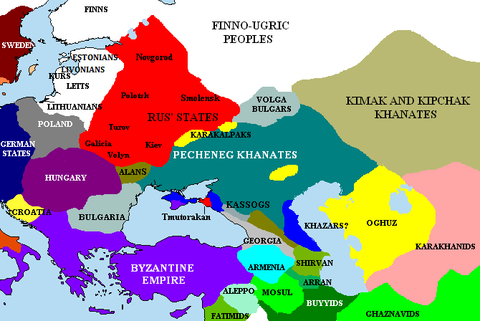
For me the most significant part of this lecture concerns the history of the Rus, Vikings who migrated from Sweden to the central steppes around 750 AD. During the 9th century AD, Rurik the Rus established a trading center in Novgorod, which they subsequently moved to Kiev to cut out the Khazar middlemen, [1] who were taxing their forest products and slaves as they passed through Khazar territory to Constantinople. Following this move, the Rus and Pechenegs formed an alliance to sack the Khazarian capitol Atil, leading to its collapse in the late 10th century.

The Pechenegs, migrating west from Görturk Khanate [2] after losing their ancestral lands to to the Seljuk Turks, formed a trade agreement with the Rus to move forest products and slaves along the Volga River and Caspian Sea to Constantinople and the Muslim world. These very ancient trade routes had brought the Scandinavian Goths (originally a forest people) onto the steppes in the 3rd century AD. It also led to an amalgam of Goths and Sarmations [3] that drastically weakened the Roman Empire at the end of the 3rd century.

Following the Rus leader Vladimir’s conversion to Orthodox Christianity in 988 AD, the Rus and Pechenegs became enemies. As Christians, the Rus were no longer allowed to sell Slavic slaves to the Turks and Arabs. As the slave trade dried up, the Pechenegs began raiding Rus territories to kidnap slaves they could sell on to Arabs and Turks.

In 1183 AD, the Cumans also went to war with the Rus over their refusal to sell them slaves. After organizing their cavalry along the lines of Cuman nomads, the Rus were victorious The 19th century Borodin opera Prince Igor is based on an epic poem about a Rus prince’s successful rebuff of a Cuman invasion.

After European Crusaders sacked the Byzantine empire in 1204 AD, the Cumans would become the primary tribe on the Central Steppes until 1236 AD, when Batu, the grandson of Genghis Khan, swept into Cuman and Russian territory.

In 1091 AD the Byzantine emperor allied with the Cuman Turks (which had occupied and assimilated the Khazar Khanate) to wage a vicious war that killed roughly 80,000 migrating Pechenegs.

At the end of the 9th century, the Magyars, [4] under pressure from repeated Pecheneg raids, also migrated west to the Hungarians plains. From there, they in turn conducted repeated raids against the Byzantine Balkan provinces and against Italy and Western Europe.


[1] See The Arrival of Khazarians on the Steppes and Their Conversion to Judaism

[2] See The Turkmen Role in the Rise of the Tang Dynasty

[3] See The Role of Sarmatian Nomads in Rome’s Military Success

[4] Originally a forest people from the Ural mountains who migrated onto the steppes to become pastoral nomads and traders (of fur, game and fish), the Magyars (founders of modern Hungary) were the only steppes people during this period not to speak a Turkic language. The Magyars spoke a Finno-Ugric language.

Film can be viewed free with a library card on Kanopy.

https://www.kanopy.com/en/pukeariki/video/5694984/5695022